Patala
पाटला
Stereospermum chelonoides (L.f.) DC.
Bignoniaceae · Stereospermum
Benefits & side effects
TRADITIONAL VIEW, WITH SAFETY LIMITS
Hindi name: Padri
What the texts say Patala does
- Shothahara — reduces swelling
- Deepana — kindles digestion (appetiser)
- Vatahara — pacifies vata
- Jwaraghna — used in fever
- Raktashodhana — purifies the blood
What the evidence says. The experimental literature is mostly rodent work on Stereospermum suaveolens extracts; studies in people are lacking.
Side effects and limits
- Digestive upset
Avoid or ask first: No absolute contraindication is documented here. This is written deliberately rather than left blank.
A traditional classification, not a recommendation. The full safety record is below.
Stands in 4 groups
- Shothahara — Reducing swelling
- Prajasthapana — Sustaining progeny (named there as Amogha)
- Aragvadhadi — Kapha, poisoning, and wound cleansing
- Brihat Panchamula — The greater five roots
A Samhita can only be read forwards, from the group to its members. This is the same list read backwards.
Photographs
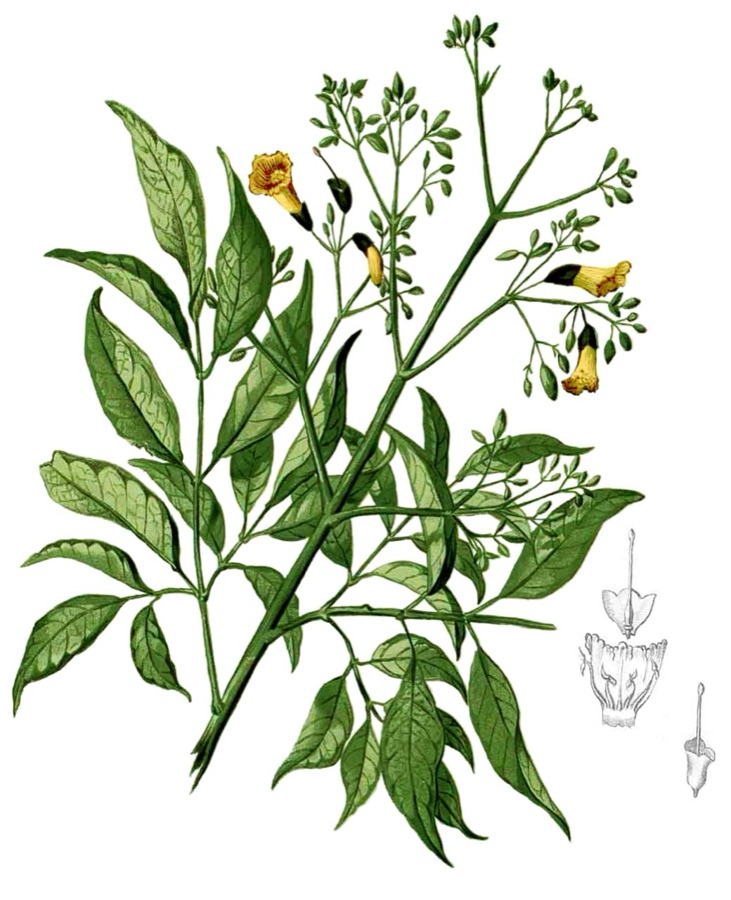
Photo: Francisco Manuel Blanco (O.S.A.) · Public domain · Wikimedia Commons

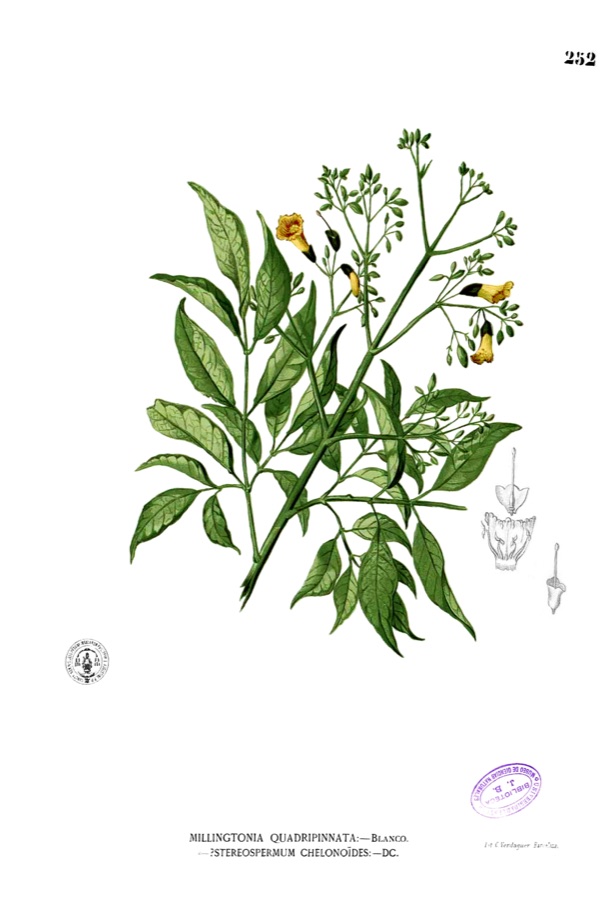
Photo: Francisco Manuel Blanco (O.S.A.) · Public domain · Wikimedia Commons

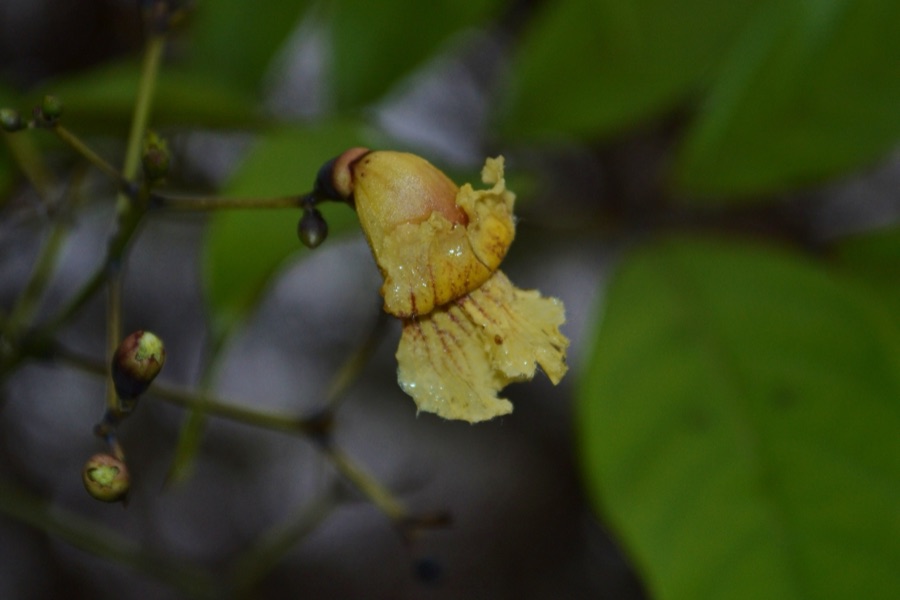
Photo: Delonix · CC BY-SA 3.0 · Wikimedia Commons

Matra and anupana
AS THE CLASSICAL TEXTS AND THE API PRESCRIBE
| Twak kwatha | 50–100 ml |
| Churna | 3–6 g |
| Anupana | Ushnodaka |
| Kala | Adhobhakta |
Classical measures for a decoction and a powder of patala root bark; the flower is a different article with its own use.
Reported from Sharangadhara Samhita and the Ayurvedic Pharmacopoeia of India. Laisha states what the texts prescribe; it does not recommend. No quantity here is adjusted for a particular person — not for agni, koshtha, bala, age, pregnancy, kidney or liver function, or anything already being taken.
Pharmacopoeial standard
Ayurvedic Pharmacopoeia of India, Part I
| Marker | Identity precedes any assay |
| Assay | |
| Total ash | |
| Acid-insoluble ash | |
| Alcohol-soluble extractive | |
| Water-soluble extractive | |
| Foreign matter |
Stereospermum chelonoides root bark is the article. Several Stereospermum species move through trade together, so identity must be settled before any figure is read.
Settling identity first is the monograph's demand, and it is not a test Laisha has run on patala. Numeric limits for ash, extractives and assay are in the current Ayurvedic Pharmacopoeia of India and should be taken from there; this page leaves them out rather than risk a wrong figure reaching a laboratory.
Rasapanchaka
| Rasa | TiktaKashaya |
| Guna | LaghuRuksha |
| Virya | Ushna |
| Vipaka | Katu |
| Prabhava | Its classical identity is as one of the great roots for swelling and for vata; no action is assigned to patala that sets it apart from the other four. |
| Doshakarma | Kaphapittahara, and described as tridoshahara in some texts. |
Tikta and kashaya with ushna virya and katu vipaka.
Karma and part used
In Charaka's fifty groups of ten patala appears once, under shothahara with the rest of Dashamoola, whereas agnimantha and shyonaka are also listed among enema and cold-relieving herbs. Jwaraghna and raktashodhana come from the later nighantu. These are labels in a classification, recorded as such.
| Upayukta anga | Mula (the root) Mula twak (the root bark) Pushpa (the flower) |
| Why it matters | Dashamoola wants the root bark. The pale pink flower that gives patala its name is described as sheeta and is used as a separate dravya. The long fruit is eaten as a wild food in western India and neighbouring countries, and a CSIR-National Botanical Research Institute team has analysed its nutrients. |
Paryaya
Patala names the pale rose of the flower, and Sanskrit uses the same word for that colour. Krishnavrinta, dark-stalked, is the mark a collector looks for. Amogha, unfailing, and Kuberakshi, eye of Kubera, are honorifics, and Kuberakshi is attached to other plants in some lexicons, so it cannot identify the tree alone. Madhudooti can be read as messenger of madhu, the spring season in which the tree flowers.
Names, by language
| English | Trumpet flower |
| Sinhala | Palol |
| Nepali | Padari |
| Hindi | Padri |
| Kannada | Kaligottu |
| Tamil | Padiri |
| Telugu | Kaligottu |
| Malayalam | Pathiri |
| Marathi | Padal |
| Gujarati | Padal |
| Bengali | Parul |
| Punjabi | Padal |
| Odia | Patuli |
| Urdu | Padri |
Classical references
Patala's single Charaka grouping was checked against the Charak Samhita Online text of Sutrasthana 4. The Sushruta and Bhavaprakasha places are named at chapter or varga level only.
Formulations it appears in
| Dashamoolarishta | Patala root is among the ten roots fermented in it. |
| Dashamoola Kwatha | One root in ten, in equal measure. |
| Chyawanprash | Part of the ten-root decoction in the base. |
| Dashamoola Taila | Its root contributes to the decoction that cooks the oil. |
Adulterants and substitutes
Stereospermum colais is collected and sold as patala beside S. chelonoides, and once the root is dried and chopped the two are hard to tell apart. Stem bark also replaces root bark, since it can be stripped without digging. Because lapachol and related compounds differ between parts and possibly between species, a laboratory needs to know which was supplied.
Identity
Stereospermum chelonoides (L.f.) DC., family Bignoniaceae, confirmed against the GBIF backbone on 28 September 2026 at 99 per cent confidence. Most Ayurvedic books, and many pharmacology papers, still call it Stereospermum suaveolens; that is a synonym, not a second plant. Stereospermum colais is a genuinely separate species gathered under the same name. Patala closes the Dashamoola list and is one of its five great roots.
A WAY TO REMEMBER IT
Stereospermum is stereos (hard) + sperma (seed). Chelonoides means tortoise-like, for the shape of the calyx. Patala means pale pink, the flower colour.
What the tradition holds
Patala's root bark is used almost entirely as one tenth of Dashamoola. Sushruta places it among the great roots and Charaka in his swelling group, while the flower has a separate life as a cooling dravya. The texts are the authority for this; nothing here claims an effect in the body.
Constituents. The root contains the naphthoquinone lapachol, the lignan cycloolivil and beta-sitosterol, along with iridoid glycosides. The fruit has been profiled separately for nutrients and phenolic compounds.
What the evidence says
| Status | The experimental literature is mostly rodent work on Stereospermum suaveolens extracts; studies in people are lacking. |
| Suggested | Chemistry is better documented than pharmacology. A 2015 isolation study from the roots identified cycloolivil, lapachol and beta-sitosterol and noted the roots as a Dashamularishta ingredient, and a 2024 study found the fruit nutritionally comparable to common marketed fruit. Naming compounds is not the same as showing a decoction does anything. |
| Not established | No controlled human trial supports patala, alone or within Dashamoola, for any condition. |
| The honest gap | Published work is thin and often does not say which Stereospermum species, or which part, was used. |
Safety
No serious adverse event is recorded for patala in traditional use; that is a gap in study as much as a reassurance. The fruit is eaten locally as a wild food, which says something about the fruit and nothing about concentrated root-bark preparations. Patala is ushna in the texts and normally reaches a patient inside a ten-root compound. Anyone pregnant, taking regular medicines or living with a diagnosed condition should ask a doctor or qualified practitioner first.
| Side effects | Digestive upset |
| Contraindications | No absolute contraindication is documented here. This is written deliberately rather than left blank. |
| Interactions | No specific drug interaction is documented for patala, and no study has looked for one. A prescriber should still be told about it, along with every other herb in the Dashamoola product being taken. |
| Pregnancy and breastfeeding | Safety of patala in pregnancy and lactation is unstudied; a qualified practitioner should be consulted. |
Growing it
| Climate | Tropical, in moist deciduous forest. |
| Soil | Deep, moist, well-drained ground. |
| Planting | A tree, raised from the long slender seed pods. |
| Harvest | Root bark is taken from part of the root system so the tree survives. Flowers are collected in season. |
| What is not stated | Patala is seldom cultivated. Wild trees supply most root bark, and Dashamoola demand is large enough that over-collection is a genuine pressure; partial root harvest that leaves the tree standing is the sustainable practice. |
Last updated · How Laisha writes and checks its pages · Report a mistake
Go further with Laisha Smarter
US$10 a month · one price worldwide · cancel any time
- Ask Laisha about any herb or formulation — up to 1,000 questions a month
- The full study tracks with practice questions
- Reports and exports as real files