How to Grow Black gram
Vigna mungo · Also called: Urad, Urd, Urad dal, Mash, Minumulu, Uzhunnu, Ulundu, Biri
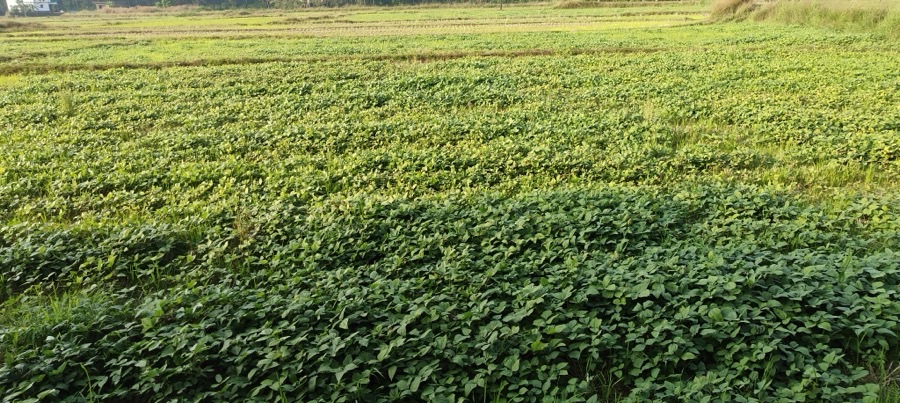
Photo: Rohan Pinto, CC BY-SA 4.0 (Wikimedia Commons)
Black gram is the pulse that cannot be substituted. Its seed is unusually slippery when ground and soaked, and that is exactly what makes idli and dosa batter rise and papad hold together, so no other pulse will do the job. India grows about seven tenths of the world's crop, Myanmar is the second big grower, and Thailand and Myanmar have grown it for export to India and Japan since the late 1980s. In Thailand and Japan its sprouts are preferred to mung bean sprouts because they keep longer, and in Australia and the United States it is also grown for fodder. On a farm it is a short crop of seventy to ninety days that fixes its own nitrogen, so it slots into a rainy season, into a dry season on the water a rice crop left behind, or into a spring gap with irrigation. Its worst problem is a whitefly-carried virus that no spray can cure.
Growing Black gram, Stage by Stage
- 1. Pick the black gram land and the season — Black gram is grown three ways on a farm: as a rainy-season crop on rain alone, as an irrigated dry-season crop, or thrown into a rice field just before the rice is cut to live on the water left in the soil. Choose the one that fits your water. Then pick a clay loam or black clay field that drains, at pH 6 to 7, with no salt, in a climate of about 25 to 35 °C by day and no frost.
- 2. Buy the right black gram seed and treat it — Buy certified seed of a kind released as resistant to yellow mosaic virus for your region, of a duration that fits your gap: about seventy-five to eighty days after rice. Dress it against rots, then coat it with black gram root-nodule bacteria last and sow it the same day.
- 3. Sow at the right rate, spacing and depth — In a prepared field, sow in rows about 25 to 30 cm apart with plants about 10 cm apart, using about 20 kg of seed per hectare, a few centimetres deep into moist soil. That gives roughly thirty plants per square metre. After rice, broadcast about 25 to 30 kg per hectare into the standing rice five to ten days before it is cut.
- 4. Give water at flowering and pod fill — Flowering and pod formation are the critical stages: a dry spell then costs a fifth to a third of the crop or more. An irrigated crop is watered straight after sowing, again around day three, then every seven to ten days. A rice-fallow crop lives on stored water, so it must be sown early. Never let water stand on black clay.
- 5. Feed lightly and weed the rows for a month — Put phosphorus and sulphur in at sowing, limed if the pH is below 6, and give nitrogen only as a small starter dose because the nodules supply the rest. Keep the rows clean for the first thirty days, by hand weeding at about fifteen and thirty days or a registered herbicide chosen by HRAC group.
- 6. Read the flowers and the upright hairy pods — The first small yellow flowers come at about five to six weeks. The pods are short, thick, very hairy and held upright, unlike the long smooth spreading pods of mung bean. Flowering runs for weeks, so one plant carries flowers, green pods and black pods at once. Heat or drought now makes the flowers drop.
- 7. Scout for whitefly, pod borer and leaf disease — Walk the field twice a week. Whitefly carries yellow mosaic and leaf crinkle viruses, which cannot be cured, so sick plants are pulled while few. Spotted pod borer webs the flowers and bores the pods; Cercospora leaf spot and powdery mildew mark the leaves. Any spray is chosen with a licensed dealer, rotating IRAC or FRAC groups.
- 8. Harvest black gram by picking or cutting — Harvest starts when the pods turn black, about sixty to ninety days after sowing. Small farms pick ripe pods by hand two or three times, a week apart, in the early morning. Larger farms wait until most pods are black and cut or pull the whole crop to dry in heaps. Ripe seed sprouts in a wet pod, so harvest ahead of rain.
- 9. Dry, thresh, clean and store the beans — Sun-dry the pods until they split, thresh gently on a tarpaulin or with a slow thresher, and winnow out the hairs and husk. Dry the beans to about 10 per cent moisture before storing, since damp seed draws pulse beetles, and keep them in airtight bags off the floor. Grade out broken and stained beans before sale as whole seed, dal or sprout seed.
Common Problems & Troubleshooting
If you see: Young leaves splashed with bright yellow next to green, the plant shorter than its neighbours, and only a few small, twisted pods.
It likely means: Yellow mosaic disease, a virus moved from plant to plant by whitefly. Losses above half the crop are reported, and a plant that has it stays sick.
Do this: Next season, sow a kind released as resistant for your region; that choice does more than anything done after sowing.
If you see: A buyer rejecting the lot, or a field that ripens and behaves differently from the kind you thought you sowed.
It likely means: Mixed or wrong seed. Black gram and mung bean are separate species with separate markets.
Do this: Black gram seed is black or very dark with a raised white eye; mung bean seed is green or golden.
If you see: Round holes in stored beans, fine powder in the bottom of the bag, and small beetles when the bag is opened.
It likely means: Pulse beetles, also called bruchids. The infestation often starts in the field and builds up in store; losses of a fifth to all of the stored seed are reported.
Do this: Dry the seed to about 10 per cent moisture or below before it goes into store.
If you see: Swollen, sprouting beans inside pods that were rained on while ripe.
It likely means: The crop ripened in wet weather. Black gram seed has little dormancy and germinates in a wet pod.
Do this: Shift the sowing date so the last fortnight of the crop falls in a dry spell.
If you see: Tall, dark, leafy black gram with plenty of flowers that fall and very few pods.
It likely means: Heat or drought at flowering, or too much nitrogen. High temperatures can cut seed yield by between about a third and four fifths.
Do this: Water at flowering and pod formation if you can.
If you see: Thick, wrinkled, oversized leaves, a bunched stunted plant, and almost no pods.
It likely means: Leaf crinkle disease, a seed-borne virus that is worse in cool weather and is also spread by insects. Reported losses run from about a third to four fifths of the seed.
Do this: Rogue out affected plants as soon as you see them.
If you see: Flowers and pods webbed together, holes in pods, and green droppings on the leaves.
It likely means: Spotted pod borer caterpillars feeding inside the flowers and pods. Losses of about 15 to 24 per cent are reported.
Do this: Open a few webbed flowers on each field walk to see whether caterpillars are present.
If you see: Pickers and threshers with itching skin and sore eyes after a day in the crop.
It likely means: The dense stiff hairs on black gram pods, which are much hairier than mung bean pods.
Do this: Wear long sleeves and cover the face when winnowing.
Yield & Market Value
A black gram farm earns twice: once from the seed it threshes, and again from the nitrogen it leaves for the next crop. Knowing a normal yield and the going price keeps both from being given away.
Remember It This Way
Ten short lines that carry a black gram crop from the field you pick to the bag you seal.
- Heavy loam that drains, pH six to seven, no salt.
- Pick your system: rain-fed, irrigated, or after the rice.
- Resistant seed first. The mosaic has no cure.
- Inoculate last and sow the same day.
- Thirty centimetres between rows, ten in the row.
- Phosphorus and sulphur in, nitrogen only a pinch.
- Water at flowering and pod fill, never let it stand.
- Clean rows for thirty days, then stay out.
- Black pods, early morning, long sleeves.
- Ten per cent moisture, airtight bag, check monthly.
Test Yourself: Identification
What is this low green crop growing in a field that had rice in it a month ago?
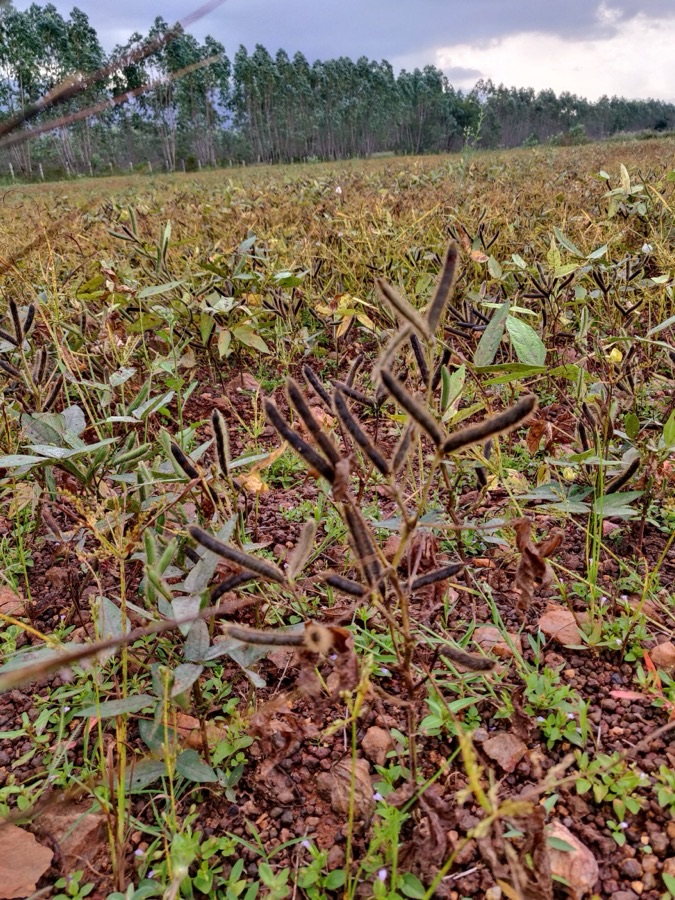
Why are these pods standing up instead of hanging down?
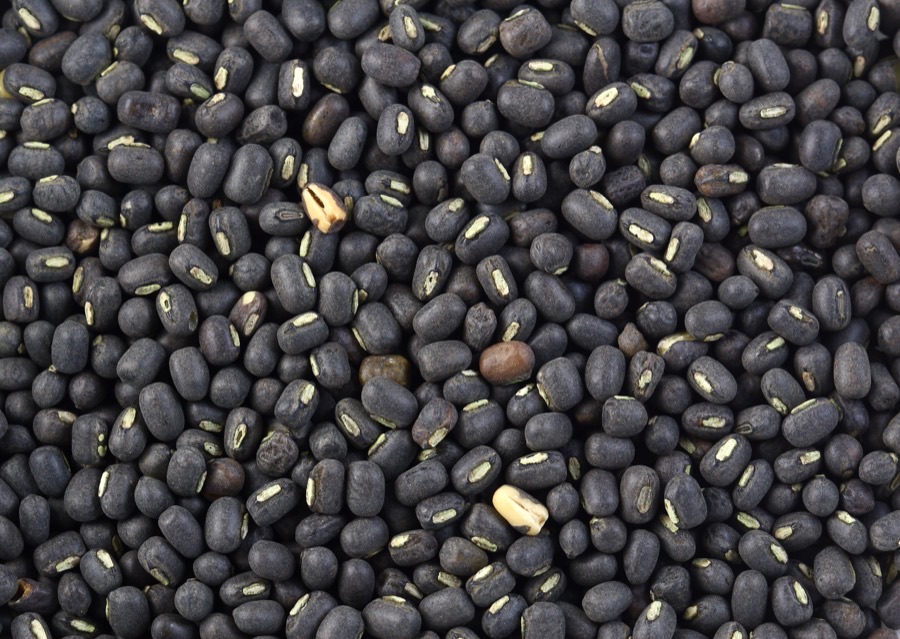
How do I know this is black gram and not something else in the sack?
Honest Limits of This Guide
- Sowing months are not given because black gram is grown in rainy seasons, dry irrigated seasons and rice fallows that fall at different times from India to Myanmar to Australia. The seed rates and spacings quoted come from one Indian state university guide and should be checked against your own national advice.
- Resistance to yellow mosaic is specific to the virus strains in a region and is lost as they change, so this guide does not name kinds.
- Sprays are described only by IRAC, FRAC and HRAC group. Registrations differ by country; your licensed dealer and the label decide.
- World figures for black gram are hard to separate from other dry beans in international statistics, so the production numbers here come from a 2023 research review rather than from a single official table.
Sources
- GBIF Backbone Taxonomy species-match record for Vigna mungo (L.) Hepper — Global Biodiversity Information Facility (GBIF), Copenhagen (source)
- EPPO Global Database — Vigna mungo (EPPO code PHSMU) — European and Mediterranean Plant Protection Organization (EPPO), Paris (source)
- FAOSTAT crops and livestock products — production data for beans, dry and other pulses — Food and Agriculture Organization of the United Nations (FAO), Rome (source)
- Vigna mungo (black gram) — CABI Compendium datasheet — CABI, Wallingford (source)
- Blackgram (Vigna mungo L.) — crop production guide, TNAU Agritech Portal — Tamil Nadu Agricultural University (TNAU), Coimbatore (source)
- Genetics, genomics, and breeding of black gram [Vigna mungo (L.) Hepper] (Nair R.M. et al.), Frontiers in Plant Science 14:1273363 — Frontiers Media, Lausanne (authors from World Vegetable Center and partner institutes) (source)
- Black gram (Vigna mungo) — Feedipedia datasheet (Heuzé V., Tran G., Boval M.) — Feedipedia, a programme of INRAE, CIRAD, AFZ and FAO (source)
Last updated · How Laisha writes and checks its pages · Report a mistake
Go further with Laisha Smarter
US$10 a month · one price worldwide · cancel any time
- Your own crop calendar for this crop, stage by stage
- Pest and disease alerts with IRAC/FRAC-group spray plans
- Ask Laisha about your field — up to 1,000 questions a month
| Free | Smarter | |
|---|---|---|
| Grow guides, pest pages, articles | Read all | Read all |
| Ask Laisha | 5 a day | Up to 1,000 a month |
| Exam practice | The sample on each page | Every question, timed papers |
| Crop calendar and pest alerts | — | For your own fields |
| Calculators and tools | — | All |
| Uploads and reports | — | 100 a month, real files |