How to Grow Chickpea
Cicer arietinum · Also called: garbanzo bean, garbanzo, gram, Bengal gram, chana, desi chana, kala chana, kabuli chana
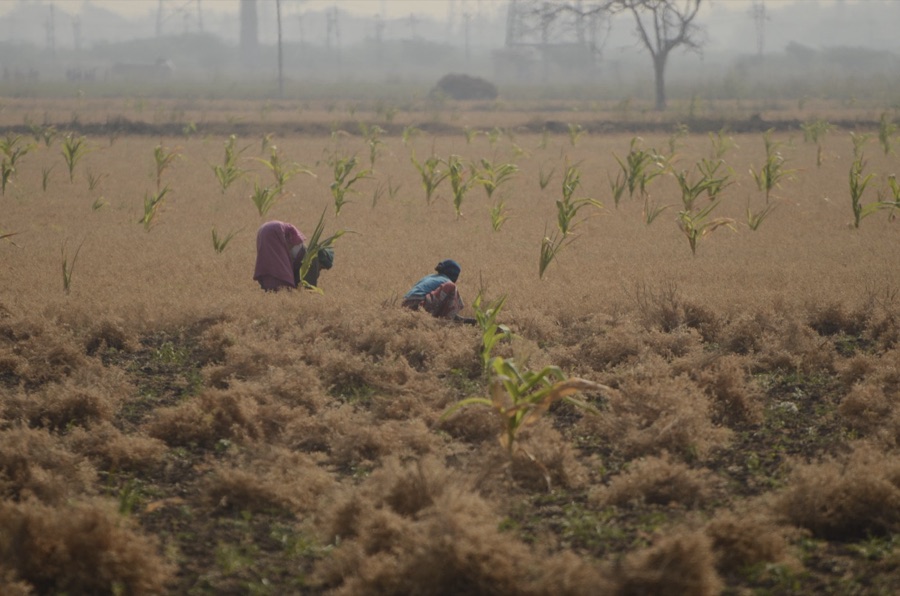
Photo: PJeganathan, CC BY-SA 4.0 (Wikimedia Commons)
Chickpea is one species, Cicer arietinum, sold as two different products. Desi chickpea has a small, angular seed with a thick, dark coat. Kabuli chickpea has a large, round, cream seed with a thin coat. The two are sown at different rates and depths, ripen about two weeks apart, and go to different buyers, so a chickpea farm starts by deciding which one it grows. Laisha's curated crop-priority research finds chickpea among the top ten crops of 10 of the world's 195 countries, from South Asia and the Middle East to North and East Africa and Australia, and India alone grows more than the other nine together. USA Pulses records that about 90 percent of the world crop, mostly desi, is eaten in India. Chickpea teams up with its own root bacterium, Mesorhizobium ciceri, to make much of its nitrogen, and its deep taproot lets it finish a crop on water stored in the soil through a dry, cool season. Three threats shape every chickpea field: Ascochyta blight on leaves and pods after rain, Fusarium wilt living in the soil, and the pod borer caterpillar, which has outlasted one insecticide group after another. Any spray against them must come from a licensed dealer and be used exactly as its label says.
Global Importance
Chickpea belongs to the dry, cool-season belts of South Asia, the Middle East, North and East Africa, and to Australia and the Canadian Prairies. Laisha's 10-country dataset is led by India by a very wide margin, and USA Pulses puts world chickpea production at roughly three times that of lentil. The checkable country figures below come from that dataset, alongside one separately confirmed world total.
Market Segments
Desi and kabuli chickpea go to different buyers. USA Pulses records that desi seed is mostly dehulled after its moisture is adjusted, then split or milled for South and East Asian foods, while kabuli is sold mainly for canning or as dry whole seed, and also milled to flour. Kabuli is graded by seed size: Saskatchewan's guidance notes that 9 and 10 mm seed can be sold commercially. A smaller market buys green chickpea fresh in the pod. Pick the buyer first, then the seed.
Growth Habit
Chickpea is a short, bushy annual with feathery leaves. USA Pulses gives kabuli plants as 14 to 22 inches tall (about 35 to 55 cm) and desi as 10 to 20 inches (about 25 to 50 cm). A deep taproot gives it more drought tolerance than pea or lentil, and it tolerates heat at flowering better than pea. It forms nodules only with its own bacterium, Mesorhizobium ciceri, so a field that has never grown chickpea needs a chickpea-specific inoculant on the seed.
Growing Chickpea, Stage by Stage
- 1. Pick well-drained land with a long chickpea break — Chickpea wants a well-drained field and a season that ends dry. USA Pulses advises growing it on the same land only once in four years, so Ascochyta-infected residue has time to rot away.
- 2. Choose desi or kabuli, then test the seed — Choose the type your buyer wants. Test the lot for germination and Ascochyta: Saskatchewan advises seed as close to zero percent infection as possible, and notes a 1,000-seed test finds seed-borne disease better than the usual 400-seed test.
- 3. Sow deep into moisture, counting plants — Saskatchewan targets 33 to 44 plants per square metre, sown 3.5 to 6 cm deep, once soil at seed depth reaches 7 °C for desi or 10 °C for kabuli. Big kabuli seed needs far more kilos per hectare than desi for the same stand.
- 4. Inoculate the seed and skip the nitrogen — Coat the seed with a chickpea inoculant and sow it the same day. Use a soil test for phosphorus and other nutrients, and let the nodules supply the nitrogen.
- 5. Let the taproot find stored water — The deep taproot carries chickpea through dry spells better than pea or lentil. Its weak points are waterlogged soil at any stage and heat or drought while it flowers.
- 6. Weed the short, open canopy early — Chickpea's short, open canopy closes late, so weeds get weeks of light. Control them early. Saskatchewan advises against rolling after emergence, which can spread Ascochyta and bruise the stiff young stems.
- 7. Scout flowers and young pods for pod borer — The pod borer, Helicoverpa armigera, lays eggs on flowers and young pods. Catch the small caterpillars before they bore in, and rotate insecticide groups, because this pest has resisted so many.
- 8. Check for blight after rain, wilt in dry patches — Ascochyta blight spreads in rain splash and leaves dark rings on leaves, stems and pods. Fusarium wilt yellows plants from the base, often in patches, and survives in the soil for years.
- 9. Harvest at about 18 percent seed moisture — Kabuli ripens about two weeks after desi. USA Pulses records that growers usually harvest at about 18 percent seed moisture, then dry the seed down before storage.
- 10. Dry to 14 percent and keep the types apart — Seed stores at about 14 percent moisture. Keep it sealed against pulse beetles, and never let desi and kabuli lots mix.
Fertiliser Programme
Chickpea's nitrogen comes mostly from the nodules on its roots, so its fertiliser plan is about a good inoculation and a soil test, not a bag of nitrogen. Saskatchewan's guidance says to let fungicide-treated seed dry before the inoculant goes on, to sow soon after inoculating because delay cuts its effect, and notes that granular inoculants suffer less from seed treatments. Extra nitrogen on chickpea mostly grows leaf, not seed.
Common Problems & Troubleshooting
If you see: Small, dark lesions on leaves, stems and pods, spreading fast after rain or heavy dew, sometimes with dark marks directly on the seed coat inside a pod.
It likely means: Ascochyta blight, caused by the fungus Ascochyta rabiei, recorded in 35 countries by a published source and one of this crop's own two most globally significant real diseases.
Do this: Rotate away from chickpea and close relatives for at least three years on a badly affected plot.
If you see: Single plants or small patches turning dull yellow and drooping from the lowest leaves up, sometimes down one side only, with no leaf spots at all.
It likely means: Fusarium wilt, caused by the fungus Fusarium oxysporum, recorded in 32 countries by a published source, which states this disease "causes regular yield reductions of 10 to 15%" where it is present.
Do this: Rotate away from chickpea for several years on a badly affected plot, since this fungus survives in the soil itself for a real, long period.
If you see: A small, round hole chewed through the side of a pod, caterpillar droppings nearby, and hollowed-out or partly eaten seed inside an opened pod.
It likely means: The pod borer, Helicoverpa armigera, this crop's own single most globally significant real insect pest, feeding on the developing seed inside the pod.
Do this: Scout twice a week, checking flowers and young pods specifically, since eggs and small caterpillars feed openly before boring inside.
If you see: Plenty of flowers on a healthy-looking chickpea crop, but most drop off without forming pods, often during a hot, dry week at flowering.
It likely means: Heat or drought stress at flowering. A published source records that drought periods measurably cut chickpea growth, even though the deep taproot protects the plant in most dry spells.
Do this: Next season, choose a sowing date or a quicker-ripening kind so flowering falls before the hottest, driest weeks where you farm.
If you see: Seedlings rotting or young plants dying in low corners of the field after heavy rain, with kabuli hit far worse than desi.
It likely means: Waterlogging and seed or root rot. Saskatchewan's guidance notes that kabuli's very thin seed coat is easily infected by soil fungi such as Pythium, while desi's thick, dark coat usually protects it.
Do this: Keep chickpea off fields that pond, and use a seed treatment on kabuli seed as Saskatchewan advises, following its label exactly.
If you see: Small, round exit holes appearing in stored dry chickpea seed weeks or months after harvest, with tiny beetles present in the sack or container.
It likely means: A real, well-documented stored-pulse pest, the pulse beetle (Callosobruchus chinensis and related species), which a published source records as attacking "many stored legumes, including green gram, lentil, cowpea, pigeon pea, chickpea and split pea."
Do this: Dry seed thoroughly before storage. This pest thrives in seed that was never fully dried down.
Real Farm Economics
A chickpea crop is paid twice. First by the seed, priced by type and, for kabuli, by size, so a lot of large, clean, unstained seed is worth more than the same weight of small or blighted seed. Second by the next crop, which follows a legume rather than another cereal. Ascochyta is the main cost risk: clean tested seed, a four-year break and fungicide passes in a wet season all come out of the margin.
Yield & Market Value
A chickpea harvest is judged by weight and by grade. Kabuli is graded on seed size and colour; desi goes mostly to dehulling and splitting. Find out what a normal yield and the going price look like for your type in your own market before you agree a sale.
Remember It This Way
If you forget every other page of this guide, keep these lines. They are the whole crop, in order, short enough to carry in your head.
- Desi is small and dark. Kabuli is large and pale. Know which one you grew.
- This crop was bred for a dry season from the very start.
- Inoculate the seed. The nodules make the nitrogen, not the bag.
- Dark spreading lesions on leaves and pods mean Ascochyta blight, not dirt.
- One-sided yellowing and wilting from the base means Fusarium wilt, working underground.
- A hole in the pod with droppings nearby means the pod borer got there first.
- This pest has beaten almost every insecticide ever aimed at it. Rotate your groups.
- Store desi and kabuli apart. Buyers pay by type and size.
Test Yourself: Identification
This small, low, bushy annual with feathery leaves on many branching stems is which crop?
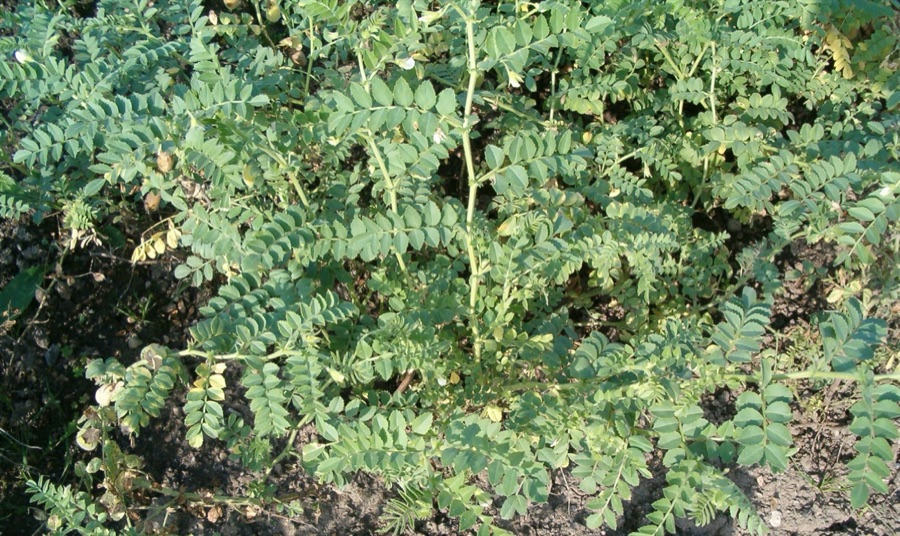
Whose white, blue-veined flower and small young pod are these?
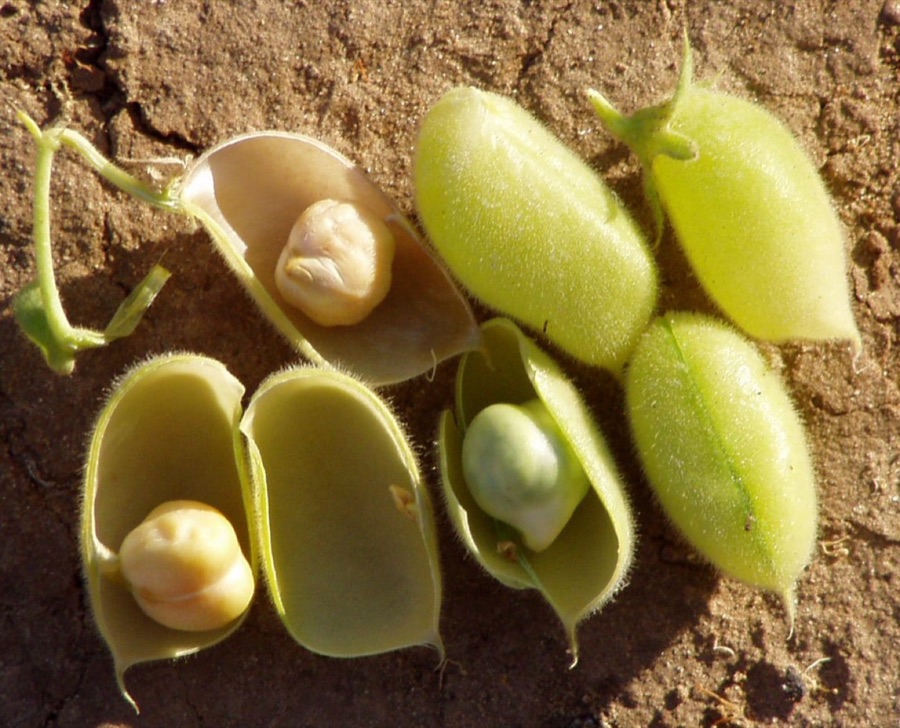
Which crop grows this short, puffed pod, still on the plant, holding only two or three seeds?
Honest Limits of This Guide
- Chickpea is sown in different seasons in different regions, from a post-rainy-season sowing on stored soil water in the tropics to a spring sowing where winters are hard. This guide gives the signs to sow by, moisture at seed depth and, in cold-spring regions, soil temperature, rather than one month.
- The depth, plant count and soil temperatures given here come from Saskatchewan, a cold-spring, long-day region. They are a sound starting point, but tropical and Mediterranean extension services publish their own numbers; ask yours for your variety.
- No single soil pH or minimum-rainfall figure for chickpea was found in the sources checked. What is well recorded is its drought tolerance and its dislike of waterlogged ground.
- No per-hectare fertiliser or cost figure that holds for chickpea worldwide was found. Inoculation and a local soil test do more for this crop than any copied rate.
- No published price premium for kabuli over desi could be confirmed, though the differences in seed size, coat and market are well documented.
- No European Union seed-marketing directive covering chickpea specifically was found among the sources checked. This guide states that gap honestly rather than inventing a figure to fill it.
- No crop-wide percentage of yield lost to pod borer on chickpea could be confirmed, though published sources treat it as a major pest worldwide.
- Sprays for Ascochyta, wilt or pod borer are named here only by mode-of-action group, never by product or compound. Buy from a licensed dealer and follow the label on the pack you hold.
- The colour band printed on a pesticide pack is a hazard rule, not a fixed list: one compound can carry a different band in another formulation or country. Read the band on your own pack.
- Looking at seed cannot tell you whether a lot carries Ascochyta or will resist it. Only a laboratory seed test, ideally on 1,000 seeds as Saskatchewan advises, and your own field's disease history can.

The rest of this Chickpea guide is inside Laisha
Every stage, the full fertiliser programme, the economics and the pest diagnosis for Chickpea live in the app — alongside photo-based diagnosis, live market prices, and an agronomist you can actually ask.
Open Laisha — ten days freeTen days free, no card. After that 10 US dollars a month, one price worldwide.
1 more sections of this guide continue inside.
Related Laisha Tools
- Global Market Price Outlook — Check today's price and trend
- Crop Calendar — Build a season-long sowing plan
- Pest & Disease Intelligence — Risk reasoning and a global pest & disease library
- Crop Health — Photo-based first read on a field problem
- Seed Quality Intelligence — Check a seed lot before you plant it
- Post-Harvest Loss Prevention — Real storage science by crop
Sources
- GBIF Backbone Taxonomy record for Cicer arietinum L. (usage key 2947311) — Global Biodiversity Information Facility (GBIF), Copenhagen (source)
- World Checklist of Vascular Plants (WCVP), the checklist behind Plants of the World Online — record for Cicer arietinum L. (usage key 207047608) — Royal Botanic Gardens, Kew (source)
- EPPO Global Database entry for Cicer arietinum (EPPO code CIEAR) — European and Mediterranean Plant Protection Organization (EPPO), Paris (source)
- Wikipedia: Chickpea — Wikimedia Foundation (source)
- Wikipedia: Cicer reticulatum — Wikimedia Foundation (source)
- Wikipedia: Mesorhizobium ciceri — Wikimedia Foundation (source)
- Wikipedia: Didymella rabiei (Ascochyta blight of chickpea) — Wikimedia Foundation (source)
- Wikipedia: Fusarium wilt — Wikimedia Foundation (source)
- Wikipedia: Helicoverpa armigera — Wikimedia Foundation (source)
- Old World bollworm (Helicoverpa armigera) — Insecticide Resistance Action Committee — Insecticide Resistance Action Committee (IRAC) (source)
- Pest Knowledge Base — cotton bollworm / gram pod borer entry — Laisha internal reference data set, compiled from CABI Compendium, IRAC and published entomological literature including a PLOS One field-resistance study (source)
- Global Crop Priority Research — Laisha internal reference data set, built on FAOSTAT (source)
- Global Seed Certification Standards — Laisha internal reference data set, compiled from the primary legal instruments it cites — India's own Minimum Seed Certification Standards, FAO Plant Production and Protection Paper 185 (2006), and Canada's Seeds Regulations C.R.C. c. 1400 (source)
- Agrochemical Reference — IRAC, FRAC and HRAC mode-of-action classifications, and the India Insecticides Act 1968 / Insecticide Rules 1971 colour-coded hazard triangle — Laisha internal reference data set, built on IRAC, FRAC, HRAC and the Central Insecticides Board & Registration Committee (CIBRC), Government of India (source)
- Wikipedia: Callosobruchus chinensis — Wikimedia Foundation (source)
- Wikipedia: Guasanas — Wikimedia Foundation (source)
- Wikipedia: Kadhi — Wikimedia Foundation (source)
- Chickpea Seeding Considerations — Government of Saskatchewan, Ministry of Agriculture (source)
- Chapter 3: Chickpeas, Processing Information and Technical Manual — USA Pulses (USA Dry Pea & Lentil Council) (source)
Last updated · How Laisha writes and checks its pages · Report a mistake
Go further with Laisha Smarter
US$10 a month · one price worldwide · cancel any time
- Your own crop calendar for this crop, stage by stage
- Pest and disease alerts with IRAC/FRAC-group spray plans
- Ask Laisha about your field — up to 1,000 questions a month
| Free | Smarter | |
|---|---|---|
| Grow guides, pest pages, articles | Read all | Read all |
| Ask Laisha | 5 a day | Up to 1,000 a month |
| Exam practice | The sample on each page | Every question, timed papers |
| Crop calendar and pest alerts | — | For your own fields |
| Calculators and tools | — | All |
| Uploads and reports | — | 100 a month, real files |