How to Grow Faba bean
Vicia faba · Also called: broad bean, fava bean, field bean, horse bean, tic bean, tick bean, bell bean, haba
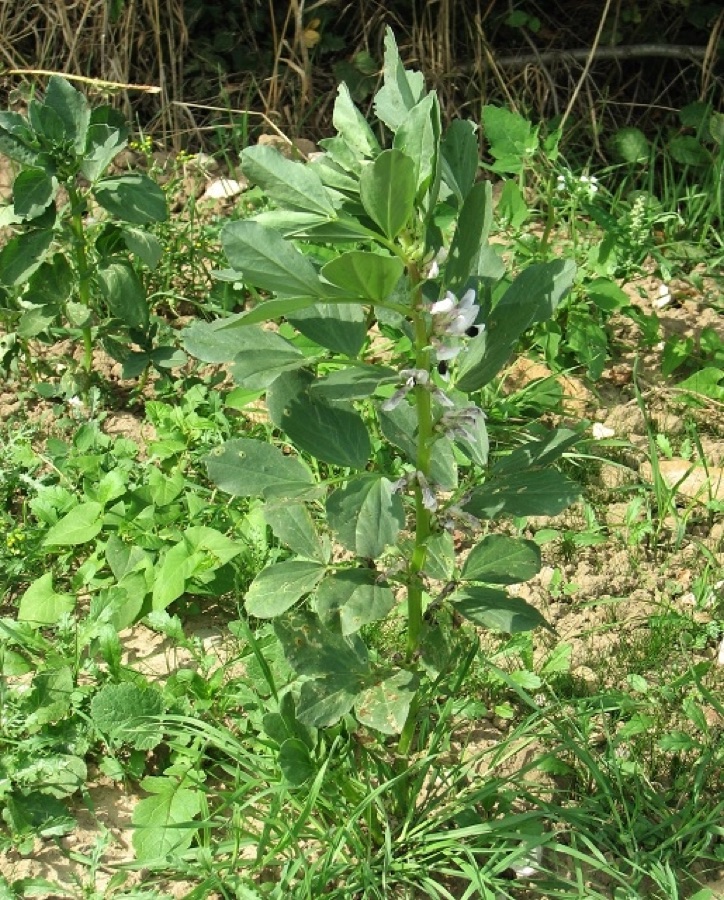
Photo: Evelyn Simak, CC BY-SA 2.0 (Wikimedia Commons)
Faba bean is the cold-season bean. Hardy kinds shrug off frost that kills most grain legumes: a published source records them surviving about minus 10 degrees Celsius without serious injury, a different climate story from this library's warm-season cowpea, common bean, groundnut and soybean. It grows as a stiff, upright plant 1 to 1.5 metres tall, Saskatchewan Pulse Growers record, and draws up to 90 percent of its nitrogen from its root nodules. Laisha's curated crop-priority research finds faba bean among the top ten crops of 11 of the world's 195 countries, from northern and Baltic Europe, Britain and Ireland to Morocco, Tunisia and Ethiopia, with Ethiopia growing the most of that list. Big, tannin-coated beans feed people, in dishes such as Egypt and Sudan's ful medames; small, low-tannin, white-flowered field beans feed livestock. One warning comes before any farming step: favism, a serious reaction to eating the bean in people with the common inherited condition G6PD deficiency, covered in full below. Sprays for this crop come from a licensed dealer and are used only as their label directs.
Global Importance
Faba bean is a crop of cool winters and cool uplands: temperate Europe, the North African coast, and the highlands of Ethiopia. Laisha's 11-country dataset shows output spread across many countries rather than led by one or two, and a separate market-intelligence source names China, Ethiopia, France, Australia and Egypt among the large producers. The figures below are the dataset's own, with an honest gap where a current world total could not be confirmed.
Market Segments
Faba bean has distinct buyers. Food buyers want large, even, unstained beans, usually tan-to-brown seed coats that contain tannins. Feed buyers take small, low-tannin, white-flowered types for high-protein rations; Saskatchewan Pulse Growers record that about 60 percent of that province's crop is this kind. A newer market splits the bean into protein, starch and flour. Fresh green beans for the vegetable trade are another market again. Decide which one you serve before you buy seed.
Growth Habit
Faba bean stands upright on hollow, square stems, 1 to 1.5 metres tall, over a taproot averaging about 0.6 metres deep. On the Canadian Prairies it flowers 45 to 60 days after sowing and ripens in 100 to 130 days. Bees working the flowers raise pod set above what the plant manages by itself, and heat at flowering makes the flowers drop. It is one of the most cold-tolerant food legumes in the world.
Growing Faba bean, Stage by Stage
- 1. Choose cool, heavier, well-drained land — Faba bean likes loam or clay with a pH of 6.5 to 9.0 and about 39 cm of water over the season, and does poorly on saline land. Keep a long break between faba bean crops to slow chocolate spot and broomrape.
- 2. Choose a food or feed type, then weigh the seed — Food buyers want large, tannin-coated beans; feed buyers want low-tannin, white-flowered types. Weigh 1,000 seeds before setting the drill, because lots range from 300 to 800 grams.
- 3. Sow early into cold soil — Faba bean can be sown once soil at seed depth reaches 3 to 5 °C, the temperature at which it germinates, in autumn, winter or early spring depending on your climate. Seedlings stand light frost and can regrow from lower nodes if the main shoot is killed.
- 4. Inoculate, then feed phosphorus, not nitrogen — Use a faba bean inoculant and let the nodules supply the nitrogen. Supply phosphorus with modest seed-placed rates, and sulphur by soil test.
- 5. Keep water steady up to flowering — Faba bean uses about 39 cm of water across the season and is hurt most by early drought and by heat at flowering. It copes with wet soil better than other pulses but still yields poorly in saturated ground.
- 6. Weed early, and learn to spot broomrape — Clear weeds in the first six weeks. Around the Mediterranean and in North Africa, learn the leafless broomrape spike, a parasite that feeds straight from faba bean roots.
- 7. Check the growing tips for black bean aphid — Black bean aphid colonies start at the very tip of the plant and build fast from early summer. Look at the tips every week.
- 8. Watch for chocolate spot and rust in humid weather — Chocolate spot starts as red-brown spots that spread into grey-centred patches; rust shows as orange pustules. Both build in damp, warm weather.
- 9. Harvest when the pods have blackened — Pods turn black and the beans harden as the crop ripens. Maturity runs from about 90 to 220 days by variety and climate; on the Canadian Prairies it is 100 to 130 days.
- 10. Keep food and feed lots apart in store — Clean, dry and seal the beans against damp and storage insects, and keep food-grade and feed-grade lots in separate, labelled bags.
Fertiliser Programme
Faba bean draws up to 90 percent of its nitrogen from its nodules, so Saskatchewan Pulse Growers advise no nitrogen fertiliser at all: soil nitrogen above about 55 kg per hectare can stop nodules forming. Phosphorus is the nutrient it needs in quantity, but seed-placed phosphate should stay at or below 45 kg P2O5 per hectare in good moisture, and lower in dry soil, to avoid seed injury. Apply sulphur according to a soil test.
Common Problems & Troubleshooting
If you see: Someone who has recently eaten faba beans, fresh or dried, develops yellowish skin or eyes, dark urine, unusual tiredness or shortness of breath, especially a young child.
It likely means: A possible favism reaction, a real, potentially severe hemolytic crisis in a person with G6PD deficiency, triggered by this crop's own natural vicine and convicine content.
Do this: Treat this as a real medical emergency, not a farming problem. Seek medical care immediately rather than waiting to see if symptoms pass on their own.
If you see: Small red-brown spots on leaves, stems or flowers that enlarge into a grey, dead centre with a reddish-brown edge, worst in warm, humid weather.
It likely means: Chocolate spot, caused by the fungus Botrytis fabae, this crop's own most damaging real disease worldwide.
Do this: Sow early where your own climate allows it, since this real disease favours the warm, humid weather of late spring into early summer in many growing regions.
If you see: Small orange pustules ringed with a pale yellow halo on the leaf surface, sometimes merging into a solid orange patch, worst in warm, humid weather with dew or rain on the leaves.
It likely means: Rust, caused by the fungus Uromyces viciae-fabae, a real, wind-spread disease that can travel long distances between fields.
Do this: Use clean seed and control any volunteer faba bean plants nearby, since both can carry the disease forward.
If you see: Dense clusters of small, dark, soft insects covering the growing tip of the plant, spreading down young stems from early summer onward.
It likely means: The black bean aphid, Aphis fabae, this crop's own most significant real insect pest, which typically starts at the very tip of the plant.
Do this: Check the growing tip specifically on your weekly field walk, since this is where infestations genuinely start.
If you see: A leafless, pale yellow or purplish flower spike pushing straight up through the soil near a stunted, wilting faba bean plant, with little or no green leaf of its own visible above ground.
It likely means: Orobanche crenata, a real parasitic weed that attaches directly to this crop's own root, a genuine, serious constraint in parts of mainland Europe and North Africa.
Do this: Pull up and burn any broomrape plant you find before it flowers and sets its own tiny seed, since one plant can release enormous numbers of seeds that survive for years in the soil.
If you see: Lots of flowers on the stem but few pods forming, especially after a hot week or on plants far from any bees.
It likely means: Heat at flowering, which Saskatchewan Pulse Growers say makes faba bean flowers abort, or too few bees. Unlike chickpea and pea, faba bean sets more pods when bees work its flowers.
Do this: Look back at the weather during flowering, since temperatures above roughly 25 to 27 degrees Celsius at that stage measurably cut pod set.
If you see: Yellowing, stunted faba bean plants in the hollows of a field where water lay after rain.
It likely means: Root stress from saturated soil. Faba bean copes with wet soil better than other pulses, but Saskatchewan Pulse Growers note it still performs poorly when waterlogged.
Do this: Drain those hollows, or leave them out of next year's faba bean area, rather than treating single plants now.
Real Farm Economics
A faba bean crop earns from its beans and from the nitrogen-rich ground it leaves for the next crop. Food-grade beans earn more than feed beans, but only when they are large, clean and unstained. The biggest cost is seed: at 300 to 800 grams per thousand seeds, a full stand takes far more kilograms of seed per hectare than any cereal.
Yield & Market Value
Faba bean yield is counted in clean, dry beans, and what they fetch depends on the buyer: food, feed or protein processing. Find out what a normal yield and the going rate for your bean type are in your area before you sign with anyone.
Remember It This Way
If you forget every other page of this guide, keep these lines. They are the whole crop, in order, short enough to carry in your head.
- Favism is real. No amount of cooking makes this bean safe for everyone.
- If someone turns yellow or tired after eating this bean, treat it as an emergency.
- This crop loves cold most other legumes cannot survive.
- Bees are not optional here. They genuinely fill more pods than the plant manages alone.
- A grey-centred leaf spot is chocolate spot, this crop's own worst real enemy.
- Orange dust on the leaf is rust, not dirt.
- Big tan beans go to food, small white-flowered ones to feed. Never mix the lots.
- Up to 90 percent of its nitrogen comes from nodules. Add none.
Test Yourself: Identification
This upright, square-stemmed field plant is which crop?
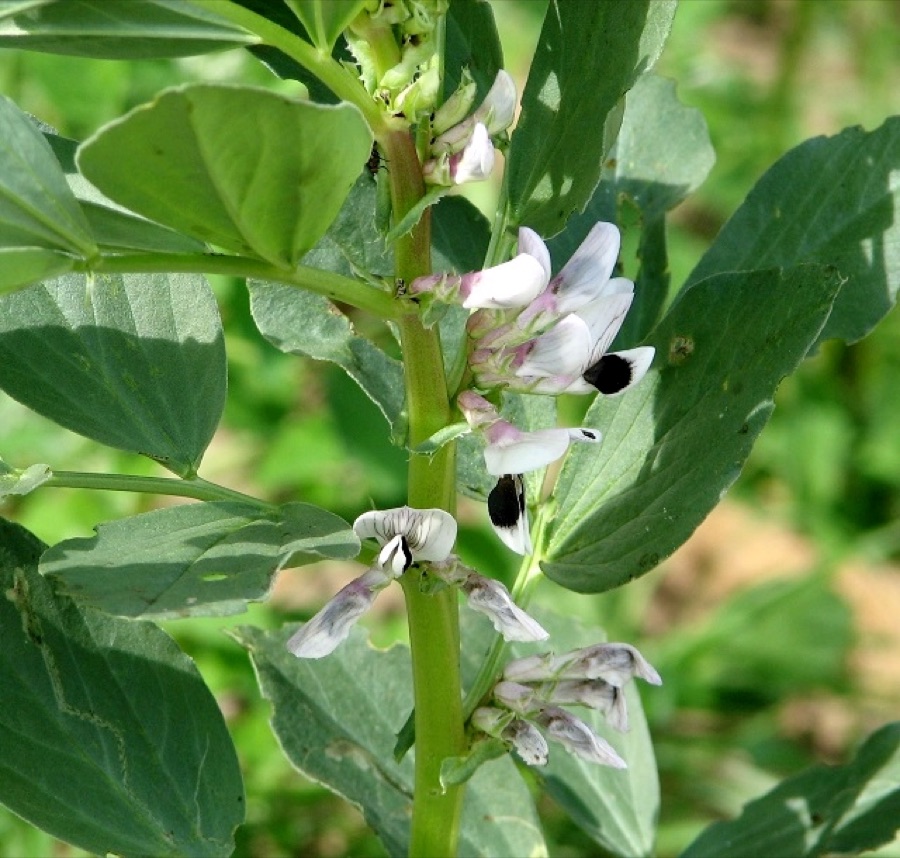
This white flower with a black spot on its wing petals belongs to which crop?
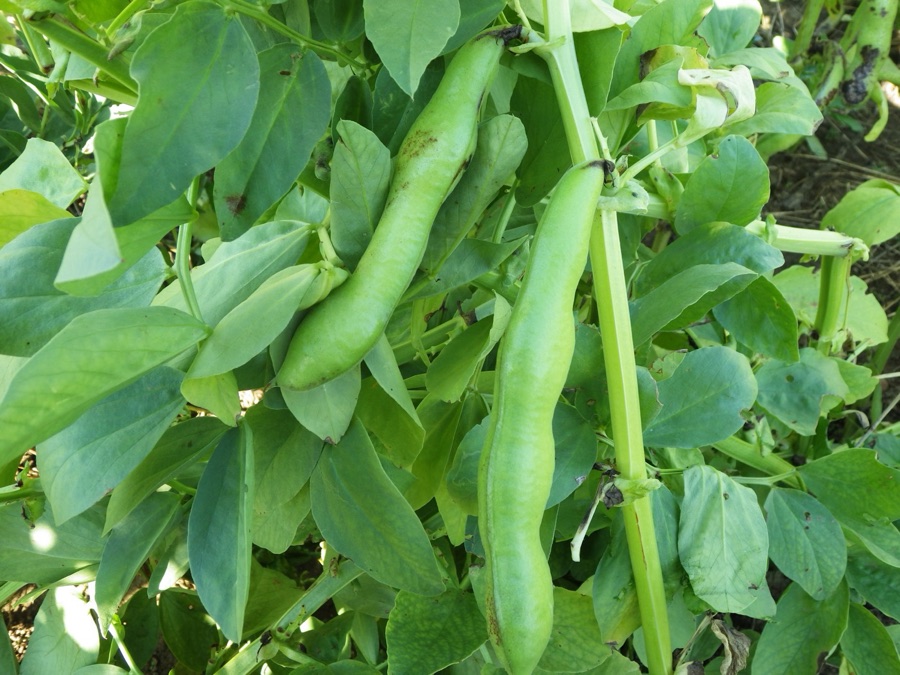
Whose broad, downy pod is this, still on the plant and turning dark toward harvest?
Honest Limits of This Guide
- Faba bean is autumn-sown where winters are mild and spring-sown where they are hard. This guide gives the signal, soil at seed depth reaching 3 to 5 °C, rather than a month.
- This guide could not independently confirm a single current world total production figure for faba bean, though a published market-intelligence source names China, Ethiopia, France, Australia and Egypt among the world's major producers. Laisha's 11-country curated dataset is stated honestly as real, checkable figures, not a substitute for a missing current world total.
- No per-hectare cost figure for faba bean that holds worldwide was found. The Saskatchewan nitrogen and phosphorus limits quoted here are a regional guide, not a universal rate.
- This session's own seed-certification source data could not unambiguously confirm which specific germination percentage column of Canada's Seeds Regulations Table V applies to field bean and faba bean, so no single figure is asserted for Canada in seedGradingAndCertification, an honest gap rather than a guess.
- No documented case of fungicide resistance in Botrytis fabae itself was found. The advice to rotate fungicide groups rests on resistance recorded in the wider Botrytis genus.
- This guide could not independently confirm a published price premium, or a published minimum vicine-convicine content threshold, for seed marketed specifically as low-vicine-convicine.
- Chocolate spot, rust and aphid sprays are given here only as mode-of-action groups. No product or compound is named. A licensed dealer and the pack label are the authority.
- A hazard colour band on a pack belongs to that formulation in that country, not to the compound everywhere. Check the band on the pack in your hands.
- India's own Minimum Seed Certification Standards carry no separate faba bean or broad bean line. This gap is stated honestly rather than filled with a guessed figure.
- Looking at a bean cannot tell you its vicine and convicine level, and looking at a person cannot tell you whether they carry G6PD deficiency. A laboratory seed test and a medical test are the only ways to know.

The rest of this Faba bean guide is inside Laisha
Every stage, the full fertiliser programme, the economics and the pest diagnosis for Faba bean live in the app — alongside photo-based diagnosis, live market prices, and an agronomist you can actually ask.
Open Laisha — ten days freeTen days free, no card. After that 10 US dollars a month, one price worldwide.
1 more sections of this guide continue inside.
Related Laisha Tools
- Global Market Price Outlook — Check today's price and trend
- Crop Calendar — Build a season-long sowing plan
- Pest & Disease Intelligence — Risk reasoning and a global pest & disease library
- Crop Health — Photo-based first read on a field problem
- Seed Quality Intelligence — Check a seed lot before you plant it
- Post-Harvest Loss Prevention — Real storage science by crop
Sources
- GBIF Backbone Taxonomy record for Vicia faba L. (usage key 2974832) — Global Biodiversity Information Facility (GBIF), Copenhagen (source)
- World Checklist of Vascular Plants (WCVP), the checklist behind Plants of the World Online — record for Vicia faba L. (usage key 207099342) — Royal Botanic Gardens, Kew (source)
- EPPO Global Database entry for Vicia faba (EPPO code VICFX) — European and Mediterranean Plant Protection Organization (EPPO), Paris (source)
- Wikipedia: Vicia faba — Wikimedia Foundation (source)
- Wikipedia: Favism — Wikimedia Foundation (source)
- MedlinePlus Genetics: Glucose-6-phosphate dehydrogenase deficiency — United States National Library of Medicine, National Institutes of Health (source)
- Wikipedia: Vicine — Wikimedia Foundation (source)
- Duke, J.A. (1981). Handbook of Legumes of World Economic Importance — Vicia faba entry, hosted by Purdue University's NewCROP Center — Purdue University Center for New Crops and Plants Products (source)
- Wikipedia: Botrytis fabae — Wikimedia Foundation (source)
- Wikipedia: Uromyces viciae-fabae — Wikimedia Foundation (source)
- Wikipedia: Botrytis cinerea — Wikimedia Foundation (source)
- Tridge market intelligence: Broad bean — Tridge (source)
- Global Crop Priority Research — Laisha internal reference data set, built on FAOSTAT (source)
- Global Seed Certification Standards — Laisha internal reference data set, compiled from the primary legal instruments it cites — Council Directive 66/401/EEC, Council Directive 2002/55/EC, FAO Plant Production and Protection Paper 185 (2006), and Canada's Seeds Regulations C.R.C. c. 1400 (source)
- Agrochemical Reference — IRAC, FRAC and HRAC mode-of-action classifications, and the India Insecticides Act 1968 / Insecticide Rules 1971 colour-coded hazard triangle — Laisha internal reference data set, built on IRAC, FRAC, HRAC and the Central Insecticides Board & Registration Committee (CIBRC), Government of India (source)
- Faba Beans: Seeding, Description and Adaptation — Saskatchewan Pulse Growers (source)
Last updated · How Laisha writes and checks its pages · Report a mistake
Go further with Laisha Smarter
US$10 a month · one price worldwide · cancel any time
- Your own crop calendar for this crop, stage by stage
- Pest and disease alerts with IRAC/FRAC-group spray plans
- Ask Laisha about your field — up to 1,000 questions a month
| Free | Smarter | |
|---|---|---|
| Grow guides, pest pages, articles | Read all | Read all |
| Ask Laisha | 5 a day | Up to 1,000 a month |
| Exam practice | The sample on each page | Every question, timed papers |
| Crop calendar and pest alerts | — | For your own fields |
| Calculators and tools | — | All |
| Uploads and reports | — | 100 a month, real files |