How to Grow Snake gourd
Trichosanthes cucumerina · Also called: Serpent gourd, Chichinda, Padwal, Pudalangai, Potlakaya, Padavalanga, Chichinga, Viper gourd
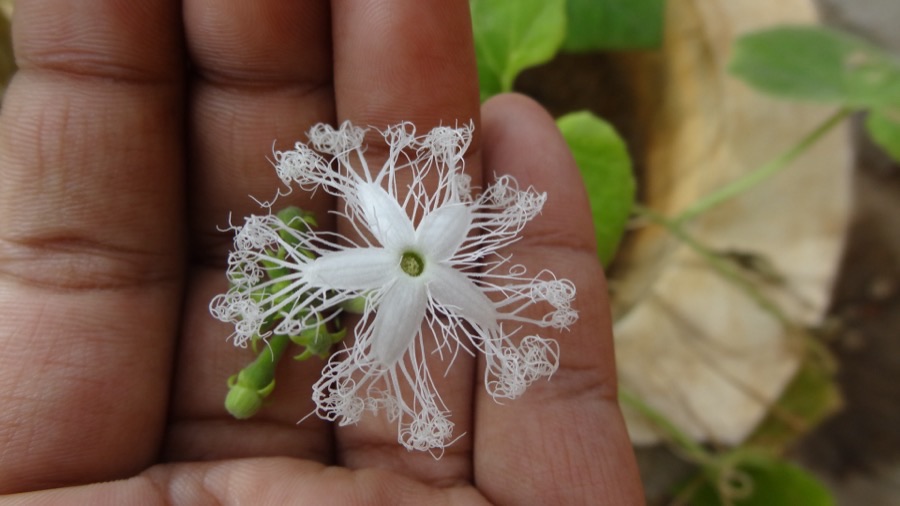
Photo: Aathavan jaffna, CC BY-SA 3.0 (Wikimedia Commons)
Snake gourd is a cheap, generous vegetable that turns a few poles and some wire into food for months. Seed goes into a pit at the foot of a pandal post, the vine reaches the top of the frame in a few weeks, and long pale fruit begins hanging through the wire roughly two months after sowing. Growers in Kerala, Tamil Nadu, Sri Lanka, Bangladesh and across Southeast Asia raise it in backyards and in commercial pandal blocks. It also has one property no other gourd in this library shares: the fruit can be a metre or more long, and it will only grow straight if it is allowed to hang freely. That is why this crop is not really optional about trellising. A snake gourd grown on the ground curls into a coil, spots where it touches the soil, and is worth a fraction of a straight one.
Growing Snake gourd, Stage by Stage
- 1. Prepare the land, build the pandal, then dig the pits — The frame matters more here than anywhere else in this library.
- 2. Soak, sow five to a pit, thin to two — Thick-coated seed. Soak it, then sow into warm, watered basins.
- 3. Basin watering, weeding and one nitrogen top-up — Steady moisture while the fruit is filling, and a light hand once flowering starts.
- 4. Fringed white flowers at dusk — White fringed flowers that open at dusk and are worked by moths.
- 5. Stung fruit, mildew and night-time care — The fruit fly again, working from inside the young fruit.
- 6. Harvest young and green — Two weeks after the flower, while a thumbnail still marks it.
- 7. Lay it flat, sell it fast, keep a red fruit for seed — It is long, fragile and full of water. Handle it once and sell it fast.
Common Problems & Troubleshooting
If you see: Fruit that has grown into a coil or a tight bend instead of hanging straight.
It likely means: It had nothing to hang freely from. This fruit only grows straight under its own weight, so a vine on the ground or on a low frame coils every fruit it makes.
Do this: Build an overhead frame about two metres high before sowing, not after the vine starts running.
If you see: A long green fruit with a kink near the tip, small dark stings on the skin, and soft rotting flesh with maggots when cut.
It likely means: Melon fruit fly. Snake gourd is one of its favourite hosts; in one Pacific island survey nine in ten snake gourd fruits were infested. The maggots feed inside the flesh, so a fruit can look fine from a distance and be rotten within.
Do this: Pull every kinked or stung fruit off the frame as soon as you notice it, and never leave it lying under the pandal.
If you see: Plenty of white fringed flowers opening at dusk, but the slim female fruits yellow and drop off instead of lengthening.
It likely means: If only males are open so far, that is normal. If females are opening and falling, the night-flying moths that pollinate this crop are not reaching them.
Do this: Give the vine time; snake gourd's first blooms are male and the fruiting females appear later.
If you see: Fruit turning orange or red on the vine.
It likely means: It was left too long. This gourd is eaten green, and a ripening fruit is finished as a vegetable however good it looks.
Do this: Go over the whole frame every two or three days without exception.
If you see: Long fruit snapped or kinked by the time it reaches the market.
It likely means: It was bent to fit a crate, stacked under other produce, or carried carelessly. A metre-long fruit full of water breaks easily.
Do this: Cut with a short stalk and carry the fruit supported along its length.
If you see: A short, fat, bitter fruit where you expected a long slender one.
It likely means: Usually the basins dried out while fruit was filling. It can also mean the seed was the short wild form, or a cross with it, rather than the long cultivated snake gourd.
Do this: Fill the basin at every plant about once a week, and more in sandy soil or hot wind, through the whole picking season.
Yield & Market Value
On snake gourd, money depends on three things: how many fruits came off the pandal, how long and straight they were, and what the nearest good market paid on the day. This section covers all three.
Remember It This Way
If you forget every other page of this guide, keep these lines. They are the whole crop, in order, short enough to carry in your head.
- Build the frame first. Two metres, strong, walk under it.
- The fruit only grows straight if it hangs free.
- Seed coat is thick. Soak overnight, sow five, keep two.
- Male blooms come first and fall. Females follow.
- The flowers open at dusk. Moths do the work.
- Never spray in the evening. You would kill your pollinators.
- Tie a stone to a fruit that starts to curl.
- Pick at two weeks, green, while a thumbnail marks it.
- Orange means finished. Pick it off anyway.
- Lay it out straight. Bending it after picking breaks it.
Test Yourself: Identification
What does the flower look like?
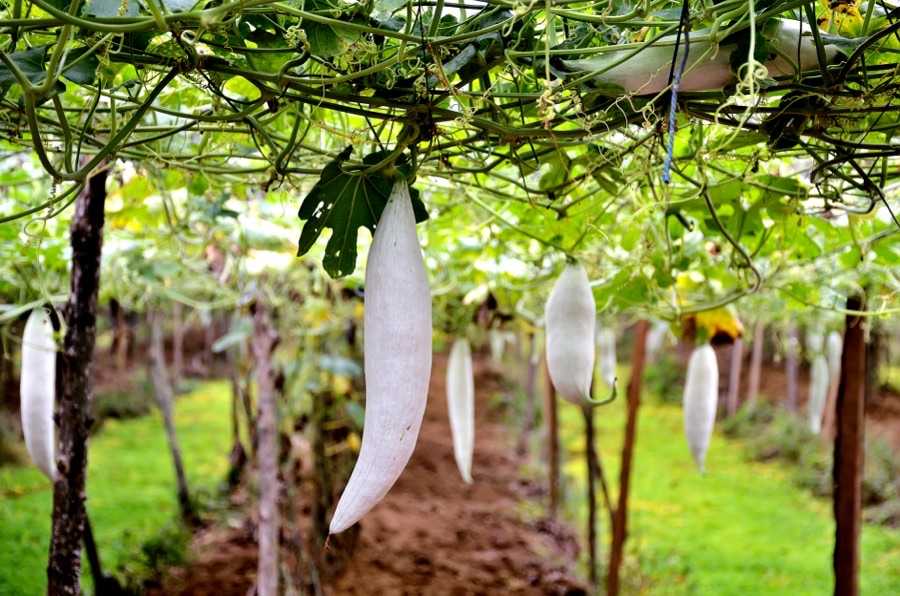
What does a snake gourd pandal look like in full crop?
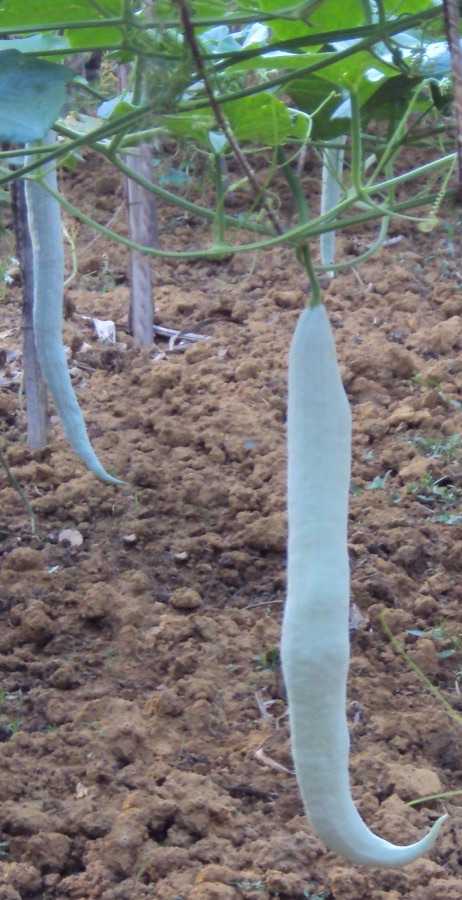
How do I tell a snake gourd is ready to cut?
Honest Limits of This Guide
- No calendar months are given. In southern India growers sow around July and again around January, but snake gourd is grown year-round in the wet tropics and only in the warm season elsewhere, so count from your own sowing.
- This guide covers the long cultivated snake gourd, usually written as var. anguina. The short bitter wild form of the same species is a weed and is not the crop.
- The pictures are of backyard and small-plot pandals, not a large commercial block, because no licensed photograph of one could be found. The frame, the vine and the hanging fruit are the same at any scale.
- The practice of tying a small weight to a curling fruit is a real and widely used local technique. How much weight and when is a matter of local judgement rather than a rule.
- The variety names in this guide come from one Indian university and are examples only. Snake gourd types run from short ones of about 30 cm to kinds near two metres long, and which your market pays for is a question for that market.
- Fruit fly advice here relies on removing stung fruit, sleeving and timing, which any grower can do and which reach a maggot sitting inside the flesh. Baited traps are used in many places and are worth asking a local adviser about.
- No product or active ingredient is named. The fruit is cooked with its skin, its pollinating moths fly at dusk, and what is permitted differs by country and buyer. If a product is needed, choose by its IRAC or FRAC group with a licensed dealer, follow the label and never apply in the evening.
Sources
- GBIF Backbone Taxonomy species-match record for Trichosanthes cucumerina L. — Global Biodiversity Information Facility (GBIF), Copenhagen (source)
- EPPO Global Database — Trichosanthes cucumerina (EPPO code TTHCU) — European and Mediterranean Plant Protection Organization (EPPO), Paris (source)
- Trichosanthes cucumerina and cucurbit fruit flies — CABI Compendium datasheets — CABI, Wallingford (source)
- Indian Council of Agricultural Research and State Agricultural University extension guidance on snake gourd (Trichosanthes cucumerina) under pandals — Indian Council of Agricultural Research (ICAR), New Delhi (source)
- FAO guidance on post-harvest handling of perishable vegetables, applied to long fragile snake gourd fruit — Food and Agriculture Organization of the United Nations (FAO), Rome (source)
- Snake gourd (Trichosanthes cucumerina): crop production guide — Tamil Nadu Agricultural University (TNAU) Agritech Portal, Coimbatore (source)
- The melon fruit fly, Bactrocera cucurbitae: a review of its biology and management (Dhillon, Singh, Naresh and Sharma), Journal of Insect Science 5:40 — Journal of Insect Science, via PubMed Central (US National Library of Medicine) (source)
Last updated · How Laisha writes and checks its pages · Report a mistake
Go further with Laisha Smarter
US$10 a month · one price worldwide · cancel any time
- Your own crop calendar for this crop, stage by stage
- Pest and disease alerts with IRAC/FRAC-group spray plans
- Ask Laisha about your field — up to 1,000 questions a month
| Free | Smarter | |
|---|---|---|
| Grow guides, pest pages, articles | Read all | Read all |
| Ask Laisha | 5 a day | Up to 1,000 a month |
| Exam practice | The sample on each page | Every question, timed papers |
| Crop calendar and pest alerts | — | For your own fields |
| Calculators and tools | — | All |
| Uploads and reports | — | 100 a month, real files |