How to Grow Watermelon
Citrullus lanatus · Also called: watermelons, tarbooz, tarbuj, kalingad, battikha, bateekh, pastèque, sandía
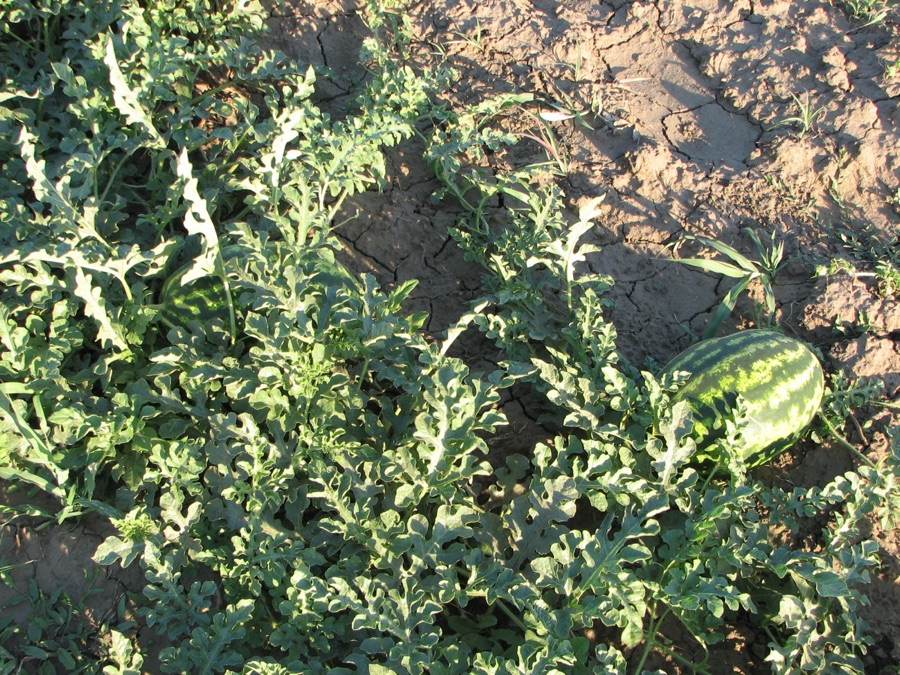
Photo: Mihaib21, CC BY-SA 3.0 (Wikimedia Commons)
Watermelon is grown across a genuinely wide belt of warm countries, and real, FAOSTAT-sourced 2024 figures compiled through Wikipedia's own maintained production table put world production at approximately 105 million tonnes — led overwhelmingly by China at approximately 63.5 million tonnes, roughly 60 percent of the entire world total, with India (approximately 3.7 million tonnes), Turkey (approximately 3.2 million tonnes), Algeria (approximately 2.5 million tonnes) and Brazil (approximately 2.0 million tonnes) a distant second tier. Laisha's curated crop-priority research finds watermelon ranked among the top ten crops grown, by area, in 18 of the world's 195 countries, a real list leaning toward warm, often dry Middle Eastern, Central Asian, Caribbean and Pacific island economies. This crop carries one genuinely distinctive real biological demand almost no grain or legume crop in this library shares in the same way: a published source records that a normal, evenly shaped, properly filled fruit needs roughly a thousand grains of pollen delivered and spread evenly across the three lobes of its own flower's stigma, meaning real, adequate insect pollination is not a minor detail here but the single biggest lever most growers actually control over final fruit shape and quality. Watermelon also carries a genuinely modern seed-industry story worth knowing honestly before buying seed at all: the seedless fruit now dominant in many retail markets is produced through a real, deliberate triploid-hybrid breeding system, not genetic modification, and understanding that system changes how a grower plans a planting from the very first row. As with every crop in this library, any agrochemical used on this crop must be bought only from a licensed dealer, used exactly as its label says, and never guessed at from a name half-remembered from a neighbour.
Global Importance
Watermelon is grown across a genuinely wide, mostly warm belt of the world, but its own real 18-country top-ten-crop list leans toward Middle Eastern, Central Asian, Caribbean and Pacific island economies rather than the handful of huge-tonnage producers that dominate world output.
Market Segments
Watermelon splits into real, materially different markets decided by fruit size class and, increasingly, by whether the fruit carries seed at all — and this last split is genuinely modern, not traditional, reshaping which real seed a grower actually buys.
Growth Habit
Three real, foundational facts decide almost everything else a watermelon grower does: this crop is a genuinely sprawling, warm-season vine that will not tolerate cold, wet soil; its flowers are monoecious, so every single fruit needs a real, adequate pollen delivery from an insect; and a triploid, seedless planting genuinely cannot pollinate itself without a real diploid partner variety planted alongside it.
Growing Watermelon, Stage by Stage
- 1. Choose your land, your real market, and plan rotation — Decide before anything else whether this planting is seeded or seedless, and pick land free of recent cucurbit cropping.
- 2. Prepare the ground and lay out real spacing — Build up the planting area and lay out real spacing, adjusted for whether you are using bare ground or plastic sheeting with drip irrigation.
- 3. Plant the seed or transplant — Sow or transplant once soil is genuinely warm, keeping any pollenizer variety in its own planned rows.
- 4. Feed the crop — Base your programme on a real soil test, split fertiliser between planting and mid-season, and avoid a single heavy late dose of nitrogen.
- 5. Deep, steady water until the melons size up — Water deeply and evenly from transplanting through fruit sizing, and hold back a little only as the melons near ripeness.
- 6. Weeding before the runners close the rows — Watermelon runners spread metres across the ground, so do the weeding early and turn runners back into the bed.
- 7. Bees, pollen and the pollenizer row — Every female flower needs hundreds of pollen grains in its single open day, and a seedless field needs a seeded pollenizer plant close by.
- 8. Insect pests, stage by stage — Aphids matter more here for the viruses they spread than for the direct feeding damage they cause, and root-knot nematodes deserve real respect underground.
- 9. Diseases — Fusarium wilt, anthracnose and aphid-spread viruses — Fusarium wilt is this crop's own single most serious soil-borne disease, anthracnose its own most damaging fungal leaf and fruit disease, and both are managed mainly through rotation and resistant varieties rather than any spray.
- 10. Manage developing fruit — Cushion fruit off bare soil, thin where your market wants fewer, larger fruit, and let each fruit build toward the real ripeness signs Stage 11 teaches.
- 11. Know when it is ripe — read the ground spot and the tendril — Judge readiness by three real, visible field signs together rather than any one alone, since this fruit cannot be re-ripened once cut from the vine.
- 12. Handle, cool and store the harvest — Cool harvested fruit promptly, store it correctly, and remember its own real cut-fruit safety rule before it reaches a household kitchen.
Fertiliser Programme
Watermelon is fed in real, staged amounts through a genuinely long season, starting from a soil test and split between a planting-time base and drip-injected top-ups, at real rates noticeably lighter than this library's pumpkin/squash guide records for its own related crop.
Common Problems & Troubleshooting
If you see: Sudden wilting that looks worse on one side of the plant than the other, with real brown discolouration inside the stem when the crown is cut open.
It likely means: Fusarium wilt, caused by the real soil-borne fungus Fusarium oxysporum f. sp. niveum, this crop's own single most serious disease.
Do this: Confirm the diagnosis by cutting a wilted plant's crown open and checking for a real, brown vascular discolouration.
If you see: Dark, sunken lesions spreading across leaves, stems and fruit, worse in warm, humid, rainy weather.
It likely means: Anthracnose, caused by the real fungus Colletotrichum orbiculare, with three real distinct races documented in published research.
Do this: Rotate away from cucurbits for two to three seasons on affected land.
If you see: A mottled pattern of light and dark green on leaves, with stunted, distorted new growth and sometimes bumpy, discoloured fruit.
It likely means: A mosaic virus, most often watermelon mosaic virus or papaya ringspot virus, spread mainly by the melon and cotton aphid and the green peach aphid.
Do this: Understand that no spray treats the virus itself once a plant is infected. Only the aphid vector can be managed, and only before infection happens.
If you see: A real, internal cavity or crack inside the fruit's own flesh when cut open, despite an otherwise healthy-looking rind and normal shape.
It likely means: A physiological disorder, most often traced to inadequate pollen delivery, genuinely more common in seedless triploid fruit than in ordinary seeded fruit.
Do this: Improve real pollinator access, since a shortfall in the roughly thousand grains of pollen a flower needs is the most common real cause.
If you see: Baby melons the size of a thumb turning yellow and dropping, or melons that grow lopsided, narrow at one end.
It likely means: Too little pollen reached the female flower in its one open day. In a seedless field the usual causes are too few bees, or seedless plants growing too far from a seeded pollenizer.
Do this: Watch the flowers on a sunny morning and count how many bees are working them.
If you see: Fruit growing lumpy, pointed, or unevenly rounded rather than smooth, despite the vine otherwise looking healthy.
It likely means: Uneven pollen distribution across the flower's own three stigma lobes, the same real underlying shortfall that can also cause hollow heart.
Do this: Improve real pollinator access, since a normal fruit needs roughly a thousand grains of pollen spread evenly across the stigma.
If you see: Stunted, wilting plants in patches across the field, with real, swollen, knotted galls on the roots when a plant is dug up and checked.
It likely means: Root-knot nematodes, microscopic soil-dwelling worms, a real, documented pest of this crop.
Do this: Dig up a suspect plant and check its roots directly for real, swollen galls before assuming another cause.
If you see: Pale yellow blotches and a white dusty growth on the tops and undersides of older watermelon leaves under the canopy.
It likely means: Powdery mildew, a fungus of the gourd family that weakens the leaf cover shading the melons and feeding them sugar.
Do this: Do not crowd plants beyond the spacing in Stage 2, so the runners are not stacked in layers.
Real Farm Economics
Real, published United States figures illustrate this crop's own genuine economics at commercial scale, and Laisha's curated 18-country data shows just how far real per-hectare returns can swing between extensive and intensively irrigated systems on the same crop.
Yield & Market Value
Watermelons are sold by the bin, by the fruit or by weight, and buyers sort them into size classes. This section covers what a field normally yields and how to find the price for your class.
Remember It This Way
If you forget every other page of this guide, keep these lines. They are the whole crop, in order, short enough to carry in your head.
- A different plant from pumpkin and cucumber. Same family, different genus entirely.
- Every fruit needs about a thousand grains of pollen, spread evenly, to grow the right shape.
- Seedless is a real cross, not a modification. It still needs a pollen-giving partner planted beside it.
- Never spray an open flower. This whole crop's fruit set depends on the bees that visit it.
- Read the ground spot, the tendril, and the dull skin together. No single sign alone is enough.
- Once cut from the vine, it stops ripening. Judge readiness before you cut, not after.
- Fusarium wilt has no cure. Rotation and resistant varieties are the only real defence.
- Wash the rind before you cut it. The knife can carry soil straight into the sweet flesh.
Test Yourself: Identification
What crop is growing here, low across the ground?
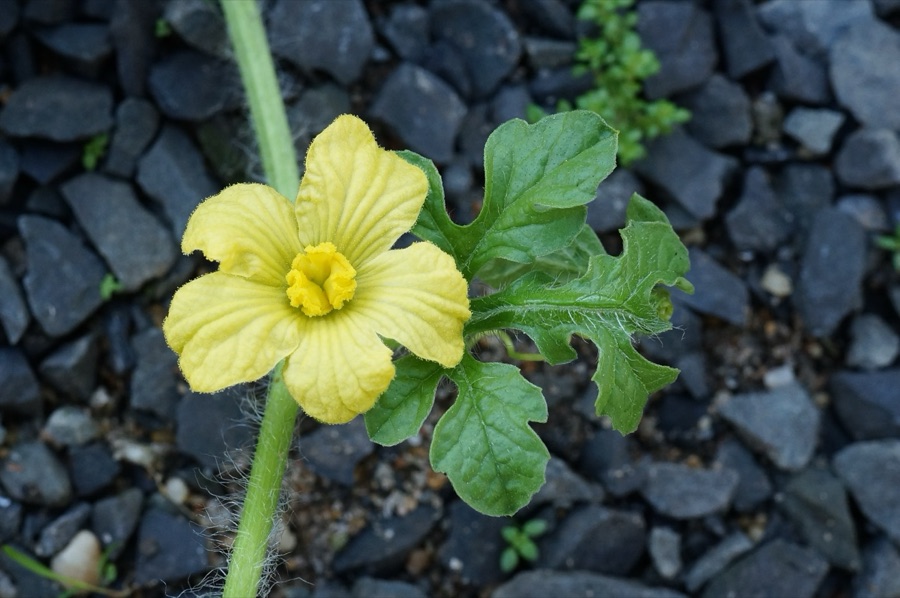
What is this yellow flower, and is it male or female?
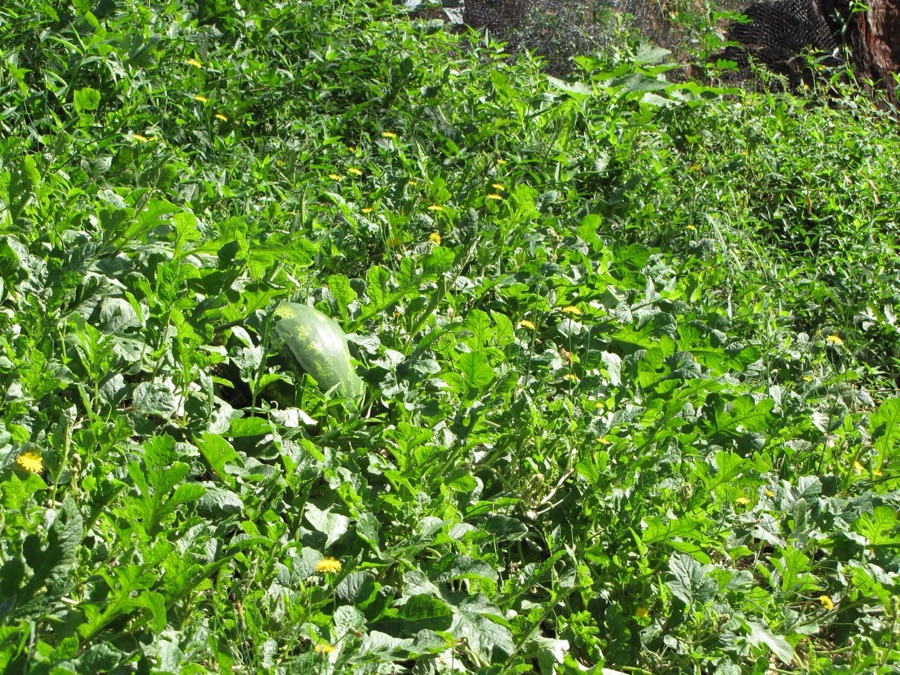
Is this fruit ready to pick?
Honest Limits of This Guide
- No month is named for planting. Set your own date from your last frost and a soil thermometer reading of 15.5 degrees Celsius (60 degrees Fahrenheit) or more.
- This session's own directly fetched extension sources confirmed the ground spot, tendril and dull-rind ripeness signs in real detail, but did not themselves document the traditional thump test's own real acoustic mechanism from a single citable source, so this guide presents it honestly as a widely practised extra check rather than a fully sourced primary sign (Stage 11).
- We could not confirm a specific race count or citable primary source naming the exact number of Fusarium oxysporum f. sp. niveum races active on watermelon worldwide, beyond the honest, general fact that real published resistant varieties exist.
- We could not confirm a specific real figure for how much more expensive seedless triploid seed is than ordinary seeded varieties, beyond the honest, general fact that its own production method is genuinely more complex.
- Laisha's seed-certification reference has no Indian Minimum Seed Certification Standards line for watermelon.
- No checked world area or world average watermelon yield is given; Laisha's country-level data stands in for it.
- No spray product or active ingredient is named for watermelon. If one is needed, choose by IRAC, FRAC or HRAC group with a licensed dealer and follow the label.
Related Laisha Tools
- Global Market Price Outlook — Check today's price and trend
- Crop Calendar — Build a season-long sowing plan
- Pest & Disease Intelligence — Risk reasoning and a global pest & disease library
- Crop Health — Photo-based first read on a field problem
- Post-Harvest Loss Prevention — Real storage science by crop
Sources
- GBIF Backbone Taxonomy species-match record for Citrullus lanatus (Thunb.) Matsum. & Nakai — Global Biodiversity Information Facility (GBIF), Copenhagen (source)
- EPPO Global Database taxon record for Citrullus lanatus, code CITLA — European and Mediterranean Plant Protection Organization (EPPO), Paris (source)
- Wikipedia: Watermelon — Wikimedia Foundation, citing FAOSTAT and other primary sources (source)
- Wikipedia: Citrullus colocynthis — Wikimedia Foundation (source)
- Wikipedia: Colletotrichum orbiculare — Wikimedia Foundation (source)
- Wikipedia: Powdery mildew — Wikimedia Foundation (source)
- Watermelon Production — Pennsylvania State University Extension (source)
- Commercial Watermelon Production, Bulletin B996 — University of Georgia Cooperative Extension, College of Agricultural and Environmental Sciences (source)
- Watermelon (home garden fact sheet) — Clemson University Cooperative Extension, Home & Garden Information Center (source)
- Fusarium Wilt of Watermelon — NC State Extension, North Carolina State University (source)
- Selecting and Serving Produce Safely — U.S. Food and Drug Administration (source)
- Global Crop Priority Research — Laisha internal reference data set, built on FAOSTAT (source)
- Global Seed Certification Standards, watermelon entries — Laisha internal reference data set, compiled from the primary legal instruments it cites (source)
- Laisha's own curated agrochemical mode-of-action and toxicity colour-band reference — Laisha (internal curated research) (source)
- Watermelon Pollination, Fruit Set, and Hollow Heart (Gordon Johnson, Weekly Crop Update) — University of Delaware Cooperative Extension, Newark (source)
Last updated · How Laisha writes and checks its pages · Report a mistake
Go further with Laisha Smarter
US$10 a month · one price worldwide · cancel any time
- Your own crop calendar for this crop, stage by stage
- Pest and disease alerts with IRAC/FRAC-group spray plans
- Ask Laisha about your field — up to 1,000 questions a month
| Free | Smarter | |
|---|---|---|
| Grow guides, pest pages, articles | Read all | Read all |
| Ask Laisha | 5 a day | Up to 1,000 a month |
| Exam practice | The sample on each page | Every question, timed papers |
| Crop calendar and pest alerts | — | For your own fields |
| Calculators and tools | — | All |
| Uploads and reports | — | 100 a month, real files |