Phytophthora blight of pepper and cucurbits
Phytophthora capsici Phytophthora capsici Leonian, 1922
- Phytophthora crown and root rot · English, Worldwide
- marchitez del chile · Spanish, Mexico
- 辣椒疫病 (làjiāo yìbìng) · Chinese, East Asia
- 고추 역병 (gochu yeokbyeong) · Korean, Korea
Phytophthora blight is caused by a water mould that rots the roots, crowns, stems, leaves and fruit of pepper and of squash, pumpkin, cucumber, melon and watermelon. Pepper plants wilt suddenly and die, often along wet, low parts of a field, and fruit rots under a white, powdery growth. The pathogen spreads with water and survives in soil for years, so a field once infested stays at risk.
- Type
- Oomycete disease · Oomycete (water mould), not a true fungus
- Classification
- Stramenopila (Chromista) › Oomycota › Peronosporales › Peronosporaceae
- Main crops
- Chilli & sweet pepper, Pumpkin / squash, Cucumber, Melon (cantaloupe), Watermelon, Tomato, Eggplant, Lima bean, Green bean
- Found in
- Americas, East and South Asia, Europe and the Mediterranean, Africa and Oceania
- Chemical groups
- FRAC 4, FRAC 40, FRAC 21, FRAC 43, FRAC 49 (mode-of-action groups, not products)
- Last reviewed
- 2026-10-20
What causes phytophthora blight of pepper and cucurbits?
Phytophthora blight of pepper and cucurbits is caused by Phytophthora capsici Phytophthora capsici Leonian, 1922, an oomycete (water mould), not a true fungus (order Peronosporales, family Peronosporaceae).
Where it occurs
First described from pepper in New Mexico in 1922; now found in vegetable-growing regions worldwide, especially under irrigation and in warm, rainy seasons.
| Region | Status |
|---|---|
| Americas | Widespread in pepper and cucurbits |
| East and South Asia | Widespread; major disease of pepper in Korea, China and India |
| Europe and the Mediterranean | Present |
| Africa and Oceania | Present |
Symptoms and identification of phytophthora blight of pepper and cucurbits
The organism
A water mould with lemon-shaped sporangia on long stalks that release swimming zoospores in water. It has two mating types (A1 and A2); where both meet, thick-walled oospores form that survive in soil for many years. Diagnosis is confirmed in the laboratory or with rapid test kits.
Signs in the crop, stage by stage
| Crop stage | What you see |
|---|---|
| Seedlings | Damping-off and collapse of seedlings in wet beds. |
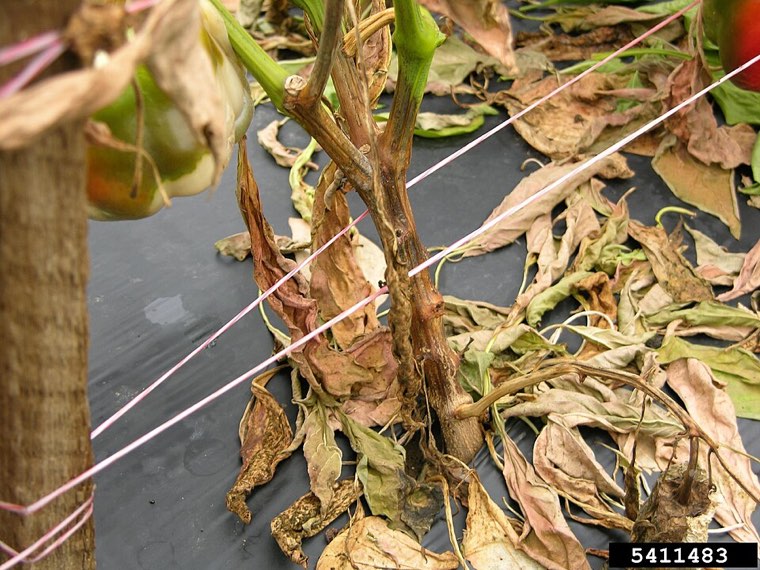
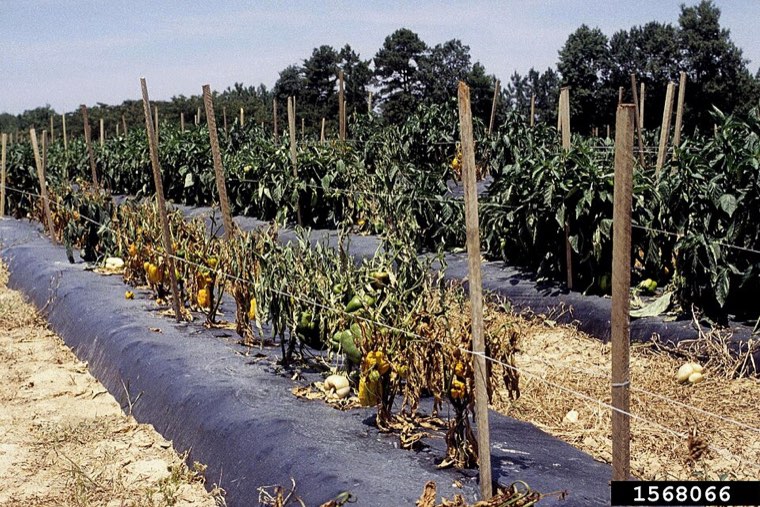
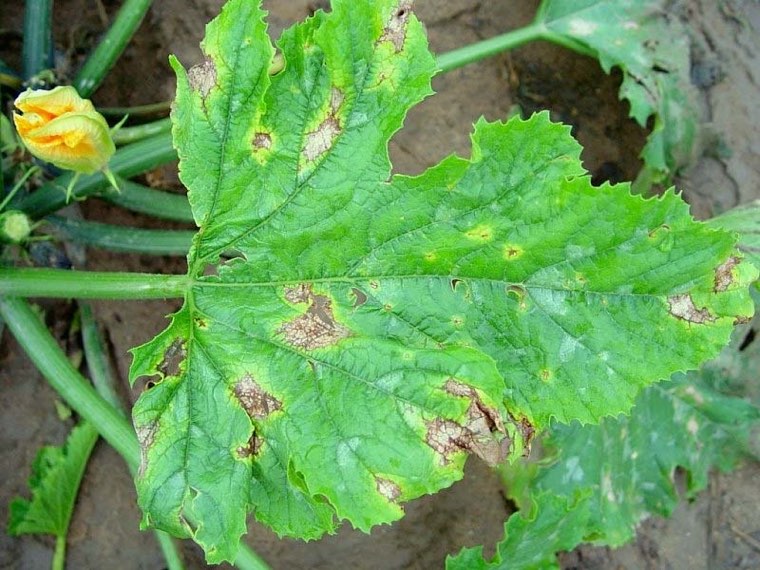
| Pepper plants | Dark brown to black lesion girdling the stem at the soil line; sudden, permanent wilting and death of plants, often in patches or along rows where water stands; dark, water-soaked leaf spots after splashing rain. |
| Fruit | Water-soaked areas that become covered with white, powdery growth (sporangia); fruit shrivel and stay attached; on cucurbits the fruit rots with the same white growth, also in storage and transit. |
Disease cycle of phytophthora blight of pepper and cucurbits
Oospores and infected debris in soil germinate when soil is saturated, producing sporangia that release zoospores. Zoospores swim in soil water to roots and crowns and are splashed onto leaves and fruit. Infected tissue produces new sporangia within days, which move with irrigation and rain water across a field and into ditches and ponds.
| Stage | Duration | Notes |
|---|---|---|
| Oospores and mycelium in soil | Years | Thick-walled resting spores. |
| Sporangia and zoospores | Hours after soil saturation | Swim in water films. |
| Infection and symptoms | About 3-5 days | Roots, crowns, leaves, fruit. |
| New sporangia | Repeated cycles | Spread by water and splash. |
Temperature
Most severe at about 25-30 °C with heavy rain or irrigation that saturates soil; disease stops spreading in dry weather.
Generations
Many cycles in warm, wet periods.
Conditions that favour it
Saturated soil, poor drainage and low spots, heavy rain or overirrigation, irrigation water from contaminated ponds or rivers, short rotations with pepper and cucurbits, and movement of infested soil on equipment.
Economic threshold level (ETL)
There is no numeric threshold; because spread is rapid and the pathogen persists in soil, management is preventive in fields with a history of the disease.
Thresholds are local. They depend on crop price, control cost, variety and natural-enemy activity, so use the figure your local extension service publishes where one exists.
Damage and yield loss from phytophthora blight of pepper and cucurbits
Plant deaths and fruit rot can destroy most of a pepper or cucurbit crop in wet seasons; infested fields are often taken out of pepper and cucurbit production for years.
Monitoring
- Walk low and wet areas of fields after heavy rain or irrigation and look for wilted plants with dark stem lesions at the soil line.
- Send samples to a diagnostic laboratory to confirm the cause, because wilts from other diseases look similar.
- Map infested areas so that equipment and water management can be adjusted.
How to control phytophthora blight of pepper and cucurbits (integrated management)
Control works best as a sequence: prevent, monitor, then act only when a threshold or a risk forecast says so, using the least disruptive option that works.
Cultural control
- Plant on raised, dome-shaped beds in well-drained fields; avoid low areas and fix drainage problems.
- Manage irrigation to avoid saturating the soil, and avoid irrigation water from sources that drain infested fields.
- Rotate away from pepper, cucurbits and other hosts for at least three years.
- Remove infected plants and a buffer of neighbouring plants; clean soil from equipment before moving from infested fields.
Mechanical and physical control
- Plastic mulch on raised beds reduces splash of soil onto fruit.
Biological control
- Some Trichoderma, Bacillus and other biological products give partial suppression in trials; they cannot replace drainage and rotation.
Host resistance
- Pepper varieties with resistance to the root and crown rot phase, derived from sources such as the line Criollo de Morelos 334, are available; resistance to leaf and fruit infection is weaker, and pathogen populations differ in virulence.
Chemical control of phytophthora blight of pepper and cucurbits — by mode-of-action group only
Oomycete-specific fungicides, applied to soil or foliage before and during high-risk periods, reduce losses when combined with cultural measures. Resistance to some groups is common. What is registered differs by country and changes over time; follow the label and your local plant-protection authority.
| Scheme | Group | Mode of action | Notes |
|---|---|---|---|
| FRAC | 4 | Phenylamides | Resistance widespread in P. capsici; test local populations. |
| FRAC | 40 | Carboxylic acid amides (CAA) | Foliar and soil uses. |
| FRAC | 21 | Quinone inside inhibitors (QiI) | Foliar. |
| FRAC | 43 | Benzamides (pyridinylmethyl-benzamides) | Use in mixtures. |
| FRAC | 49 | Oxysterol binding protein inhibitors (OSBPI) | High resistance risk; use in mixtures. |
Resistance management
- Alternate and mix groups with different modes of action and follow label limits; phenylamide resistance in P. capsici is common, so do not rely on group 4 alone.
Look-alikes and how to tell them apart
- Bacterial wilt — Wilting without a dark stem lesion at the soil line; cut stems ooze bacterial streams in water.
- Southern blight (Athelia rolfsii) — White fan-shaped growth and mustard-seed sclerotia at the stem base.
- Fusarium and Verticillium wilts — Slower wilting with brown discoloration inside the stem rather than an external lesion.
Host range
Pepper and cucurbits are the main hosts; tomato, eggplant, lima and snap beans and some weeds are also infected.
What is still uncertain
- Virulence and fungicide sensitivity differ between local populations.
- Long-term survival in soils of different regions has been studied mainly in North America and East Asia.
Grow guides for its host crops
How to grow the crop well is the first line of defence. Laisha's free grow guides cover each crop from sowing to harvest:
Sources
- Phytophthora capsici (stem and fruit rot of Capsicum) datasheet — CABI Compendium. https://doi.org/10.1079/cabicompendium.40959
- Phytophthora capsici (PHYTCP) — EPPO Global Database. https://gd.eppo.int/taxon/PHYTCP
- The oomycete broad-host-range pathogen Phytophthora capsici — Molecular Plant Pathology. https://doi.org/10.1111/j.1364-3703.2011.00754.x
- Phytophthora blight of peppers — NC State Extension. https://content.ces.ncsu.edu/phytophthora-blight-of-peppers
- Phytophthora blight — Cornell Vegetables. https://www.vegetables.cornell.edu/pest-management/disease-factsheets/phytophthora-blight/
Written by Laisha from the sources above, in its own words. This page is general reference, not a prescription: confirm identification locally and follow the label and your plant-protection authority.
How Laisha writes and checks its pages · Report a mistake
Go further with Laisha Smarter
US$10 a month · one price worldwide · cancel any time
- A full IRAC/FRAC-rotated spray plan for your crop and stage
- Outbreak alerts and a scouting calendar for your fields
- Ask Laisha about what you see — up to 1,000 questions a month