Yashtimadhu
यष्टिमधु
Glycyrrhiza glabra L.
Fabaceae · Glycyrrhiza
One name, more than one plant
Three species are used: Glycyrrhiza glabra, Glycyrrhiza uralensis and Glycyrrhiza inflata. Products may contain any of them. Confirmed live against the GBIF backbone taxonomy.
Benefits & side effects
TRADITIONAL VIEW, WITH SAFETY LIMITS
Hindi name: Mulethi
What the texts say Yashtimadhu does
- Jivaniya — vitalising, life-sustaining
- Varnya — improves complexion
- Kanthya — good for the throat and voice
- Chakshushya — good for the eyes
- Vrishya — aphrodisiac, supports reproductive vigour
- Shothahara — reduces swelling
What the evidence says. Weak. NCCIH states there is not enough high-quality evidence to clearly support its use for any health condition.
Side effects and limits
- Raised blood pressure
- Irregular heartbeat
Avoid or ask first: Avoid if you have high blood pressure, heart disease or kidney disease, unless a doctor says otherwise.; Avoid large amounts in pregnancy.
A traditional classification, not a recommendation. The full safety record is below.
Stands in 19 groups
- Jivaniya — Life-sustaining (named there as Madhuka)
- Sandhaniya — Uniting and healing (named there as Madhuka)
- Varnya — Improving complexion (named there as Madhuka)
- Kanthya — Good for the voice and throat (named there as Madhuka)
- Kandughna — Relieving itching (named there as Madhuka)
- Snehopaga — Adjuvant to oleation (named there as Madhuka)
- Vamanopaga — Adjuvant to emesis (named there as Madhuka)
- Asthapanopaga — Adjuvant to niruha basti (named there as Madhuka)
- Mutravirajaniya — Correcting the colour of urine (named there as Madhuka)
- Dahaprashamana — Allaying burning (named there as Madhuka)
- Angamardaprashamana — Allaying body ache (named there as Madhuka)
- Shonitasthapana — Arresting bleeding (named there as Madhuka)
- Haridradi — Purifying breast milk, digesting ama and diarrhoea (shares its verse with Vachadi) (named there as Madhuka)
- Brihatyadi — Agni, bladder and the urinary passage (named there as Madhuka)
- Kakolyadi — Pitta, bleeding, and the building of tissue (named there as Madhuka)
- Sarivadi — Thirst, burning, and Pitta fever (named there as Madhuka)
- Anjanadi — Bleeding, burning, and poison (named there as Madhuka)
- Ambashthadi — Wound healing and the binding of stool (named there as Madhuka)
- Utpaladi — Pitta, bleeding, thirst and poison (named there as Madhuka)
A Samhita can only be read forwards, from the group to its members. This is the same list read backwards.
Photographs
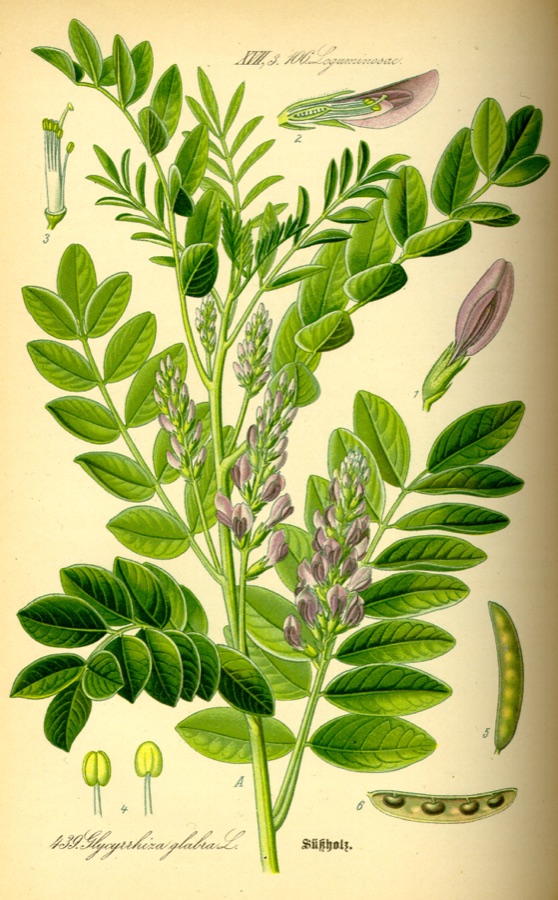
Photo: Unknown · Public domain · Wikimedia Commons

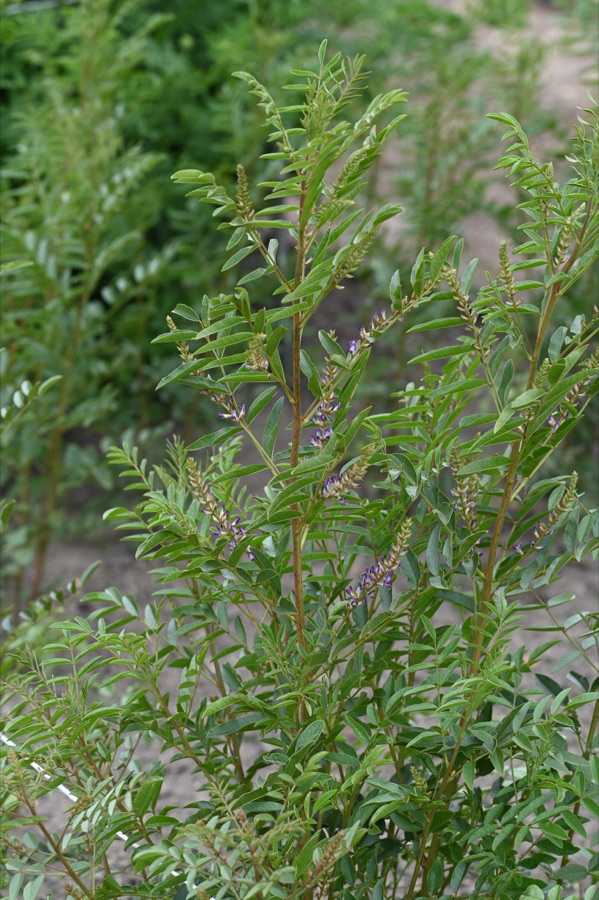
Photo: Krzysztof Ziarnek, Kenraiz · CC BY-SA 4.0 · Wikimedia Commons

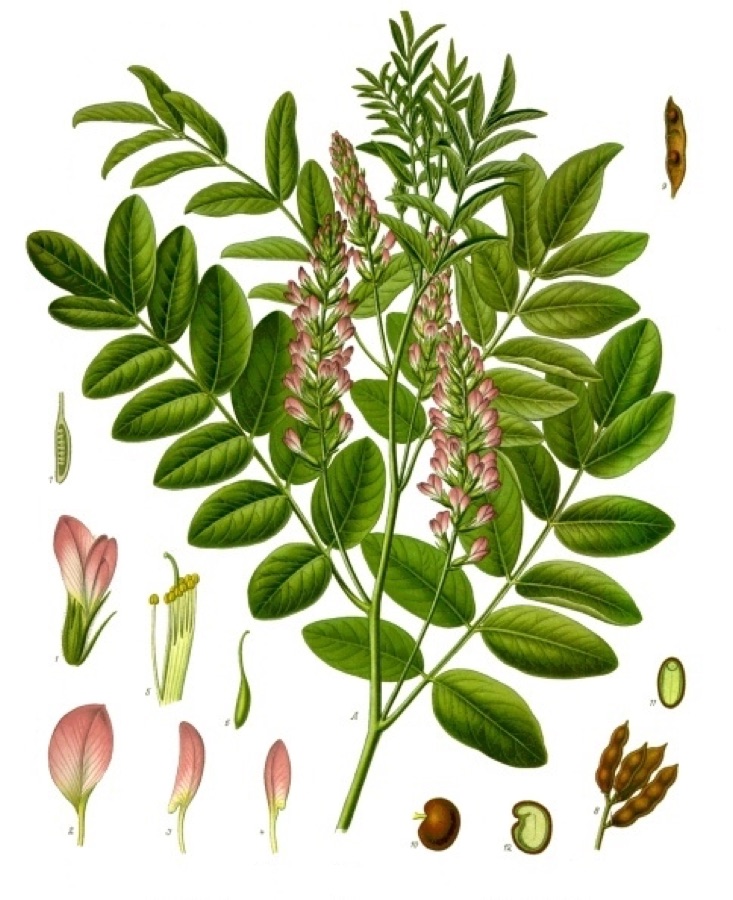
Photo: Franz Eugen Köhler, Köhler's Medizinal-Pflanzen · Public domain · Wikimedia Commons

Matra and anupana
AS THE CLASSICAL TEXTS AND THE API PRESCRIBE
| Churna | 2–4 g |
| Kwatha | 50–100 ml |
| Anupana | Dugdha · Ghrita · Madhu |
| Kala | Adhobhakta |
Time-limited by design: prolonged use causes sodium and water retention with potassium loss. EMA/HMPC gives roughly 100 mg glycyrrhizin a day and no more than 4–6 weeks without supervision.
Reported from Sharangadhara Samhita and the Ayurvedic Pharmacopoeia of India. Laisha states what the texts prescribe; it does not recommend. No quantity here is adjusted for a particular person — not for agni, koshtha, bala, age, pregnancy, kidney or liver function, or anything already being taken.
Pharmacopoeial standard
Ayurvedic Pharmacopoeia of India, Part I
| Marker | Glycyrrhizin |
| Assay | Not less than 4.0 per cent |
| Total ash | Total ash not more than 10 per cent |
| Acid-insoluble ash | Not more than 2 per cent |
| Alcohol-soluble extractive | Alcohol-soluble extractive not less than 10 per cent |
| Water-soluble extractive | Water-soluble extractive not less than 20 per cent |
| Foreign matter | Foreign matter not more than 2 per cent |
Glycyrrhizin is both the marker and the hazard, which is why this per cent matters more than most: the EMA ceiling on daily glycyrrhizin is stated in the matra block above, and it is only meaningful if you know what fraction of the drug is glycyrrhizin. A sample assaying at twice the minimum delivers twice the exposure at the same matra.
These are the pharmacopoeial limits for the article, not a test Laisha has run on anything. They are here so a practitioner can ask a supplier for a certificate of analysis and know what the numbers on it should say.
Rasapanchaka
| Rasa | Madhura |
| Guna | GuruSnigdha |
| Virya | Sheeta |
| Vipaka | Madhura |
| Prabhava | The texts place yashtimadhu among the jivaniya, the group named for sustaining life, and among the varnya dravya. |
| Doshakarma | Vatapittahara. Being guru and snigdha it increases kapha, which the texts state plainly. |
A single rasa, madhura, and one of the clearest examples of it in the materia medica.
Karma and part used
These are the actions the classical texts record. They are statements about what the tradition holds, and this library does not restate them as findings about a human body.
| Upayukta anga | Mula (the root and stolon) |
| Why it matters | The root is used. Some products are deglycyrrhizinated, meaning the component responsible for most of the harm has been removed — and a label that does not say so should not be assumed to be. |
Paryaya
Yashti means a stick and madhu means sweet: the sweet stick. The name is a description of the article as it is sold.
Names, by language
| English | Liquorice |
| Nepali | Jethimadhu |
| Arabic | Sus |
| Hindi | Mulethi |
| Kannada | Jestamadhu |
| Tamil | Athimadhuram |
| Telugu | Atimadhuram |
| Malayalam | Iratimadhuram |
| Marathi | Jeshthamadh |
| Gujarati | Jethimadh |
| Bengali | Jashtimadhu |
| Punjabi | Mulathi |
| Odia | Jatimadhu |
| Urdu | Mulethi |
Classical references
Rasa, guna, virya, vipaka and karma are recorded as the classical texts give them, with the text and section named so a student can open the book and check. Where an exact chapter and verse could not be confirmed, this library names the section rather than inventing a number.
Formulations it appears in
| Yashtimadhu Churna | The plain powdered root. |
| Jivaniya Gana preparations | Yashtimadhu heads the group these are built on. |
| Brahma Rasayana | Among the dravya of the formulation. |
Adulterants and substitutes
Abrus precatorius, gunja, is called Indian liquorice and its root is substituted for yashtimadhu in some markets. That is a substitution worth knowing about, because Abrus seed is severely toxic; the root is not the seed, but a trade that confuses the plants is a trade that can confuse the parts. Exhausted root — already extracted for its sweetness and dried again — is the commoner and quieter adulteration.
Identity
Three species are used: Glycyrrhiza glabra, Glycyrrhiza uralensis and Glycyrrhiza inflata. Products may contain any of them. Confirmed live against the GBIF backbone taxonomy.
A WAY TO REMEMBER IT
Glycyrrhiza is glykys (sweet) + rhiza (root) — sweet root, and liquorice is the same two Greek words worn down through Latin and French. Glabra means smooth, without hairs. Yashti-madhu means sweet stick: the Sanskrit is the Greek, translated.
What the tradition holds
Licorice appears in Ayurveda as yashtimadhu and is among the most widely used plants in traditional Chinese medicine. That is what the traditions hold; it is not a finding about what the plant does in a body, and the cardiac effects described here occurred within traditional and everyday use.
What the evidence says
| Status | Weak. NCCIH states there is not enough high-quality evidence to clearly support its use for any health condition. |
| Suggested | Limited findings: a licorice mouth rinse might reduce the size and pain of canker sores; gargling or lozenges before surgery may help prevent or lessen sore throat after intubation; preliminary evidence suggests topical gels may help eczema or burn healing; and one study indicated a mouthwash with licorice extract might improve bad breath. |
| Not established | No health condition is clearly supported by high-quality evidence. |
| The honest gap | Every positive finding above is topical or in the mouth. None of them is a reason to swallow licorice regularly, which is where the documented harm lies. |
Safety
Glycyrrhizin can cause irregular heartbeat and cardiac arrest, especially in large amounts or over time. Even small amounts have been linked to severe effects in people with high blood pressure, heart or kidney conditions, or a high-salt diet.
| Side effects | Raised blood pressure Irregular heartbeat |
| Contraindications | Avoid if you have high blood pressure, heart disease or kidney disease, unless a doctor says otherwise. Avoid large amounts in pregnancy. |
| Interactions | Thiazide and loop diuretics — glycyrrhizin inhibits 11-beta-hydroxysteroid dehydrogenase type 2, producing a pseudohyperaldosteronism with sodium retention and potassium loss. Added to a potassium-wasting diuretic the hypokalaemia is additive and can be severe. Check serum potassium. Digoxin — the hypokalaemia above sensitises the myocardium to digoxin, so toxicity can appear at a digoxin level that was previously fine. This is the most dangerous interaction in this entry. Antihypertensives — sodium and water retention opposes them and blood pressure may rise on a stable dose. Corticosteroids — glycyrrhetinic acid slows cortisol breakdown and potentiates the mineralocorticoid effect. Potassium-depleting laxatives and prolonged stimulant laxative use — additive potassium loss. Warfarin — case reports of altered INR; monitor if the two are combined. |
| Pregnancy and breastfeeding | NCCIH states that consuming licorice in large amounts during pregnancy is unsafe and has been associated with early delivery. The quantity at which that was observed is published by the regulator; this library states the hazard and not the number, because a number here reads as a threshold that is safe to approach |
Growing it
| Climate | A perennial legume of warm temperate regions with long dry summers. |
| Soil | Deep, loose, free-draining and fertile soil. The crop is the root, so depth matters. |
| Planting | Grown from root divisions or from seed, and it takes several years before roots are worth lifting. |
| Harvest | Roots are lifted after several seasons of growth, then washed and dried. |
| What is not stated | Laisha holds no sourced yield, spacing or cost figure for licorice and offers none. |
Last updated · How Laisha writes and checks its pages · Report a mistake
Go further with Laisha Smarter
US$10 a month · one price worldwide · cancel any time
- Ask Laisha about any herb or formulation — up to 1,000 questions a month
- The full study tracks with practice questions
- Reports and exports as real files