Eid al-Adha 2028 · Saturday 6 May 2028 (expected)
Eid Mubarak from Laisha
Warm wishes to every farming family celebrating: may the day bring generosity, family and plenty.
The days of Eid al-Adha 2028
- Eid al-Adha (expected; moon sighting decides)
Eid al-Adha 2028 at a glance
- Main day: Saturday 6 May 2028 (expected; the moon sighting decides).
- Year: 2028 CE, Vikram Samvat 2085.
- On the main day in New Delhi: sunrise 05:36, sunset 18:59 IST; Shukla Dwadashi at sunrise; nakshatra Hasta.
- Compared with 2027: then it was Monday 17 May 2027; this year it comes 10 days earlier in the year.
- Next year: Wednesday 25 April 2029, 12 days earlier in the year than this year.
The panchang for each day of Eid al-Adha 2028
For New Delhi, in IST. A tithi is the lunar day; it rarely starts at sunrise, so the table gives the tithis that run through each date with their start and end, and the nakshatra at sunrise.
| Day | Sunrise / sunset | Tithi | Nakshatra at sunrise |
|---|---|---|---|
| Eid al-Adha (expected; moon sighting decides) Saturday 6 May 2028 | 05:36 / 18:59 | Shukla Dwadashi 11:33 (5 May)–08:48; Shukla Trayodashi 08:48–06:06 (7 May) | Hasta until 21:08 |
Saturday 6 May 2028 hour by hour (New Delhi)
Moonset 04:02 (7 May), moonrise 16:32. The Islamic date itself is set by the sighting of the new crescent the evening before, not by this table.
Daily periods the engine computes: Brahma Muhurat 04:11–04:53; Abhijit Muhurat 11:51–12:44; Rahu Kaal 08:57–10:37; Yamaganda 13:58–15:38; Gulika Kaal 05:36–07:16; Amrit Kaal (Hasta) 15:38–17:06.
Computed with the Sunyra astronomical engine. Times shift by a few minutes for other Indian cities. No puja muhurta is given here: our engine computes the tithi, the nakshatra, sunrise and sunset, not the window a family or temple chooses for the puja, so follow your local panchang or priest for that.
Where Eid al-Adha 2028 falls in the farming season
Counted from the sowing windows in Laisha's farming calendar for the tropical and monsoon north (South Asia), which gives sowing by month:
- Rice (wet-season rice): sowing opens in May; 6 May 2028 is 5 days into the window.
- Maize (wet-season maize): sowing opens in May; 6 May 2028 is 5 days into the window.
- Cotton: sowing opens in May; 6 May 2028 is 5 days into the window.
- Sorghum: sowing opens in June; 6 May 2028 is 26 days before it opens.
On the farm in May 2028
Whatever the season, Eid is a day for family and for sharing. Here is what the farming calendar says for this month.
Harvested in May: Rice (dry-season irrigated rice), Onion & shallot (dry-season onion), Mango.
Ticks and Crimean-Congo haemorrhagic fever around Eid al-Adha
In 2028 Eid al-Adha falls in early May, as tick numbers climb with the warm weather. In Pakistan, Afghanistan, Iraq, Iran and Türkiye, health authorities warn every year about Crimean-Congo haemorrhagic fever (CCHF) in the weeks around the festival, because more people than usual handle livestock and fresh blood.
CCHF is caused by a virus carried mainly by Hyalomma ticks. Livestock infected by tick bites carry the virus in their blood for about a week without looking ill, so a healthy-looking animal can still pass it on. People are infected by a tick bite, by crushing a tick with bare hands, or by contact with the blood or tissues of an infected animal during or just after slaughter. The virus can also spread between people through blood and body fluids, which is why health workers are at risk. WHO reports a case fatality rate of about 10 to 40 per cent.
Protection is practical. Check animals for ticks, especially in the ears, under the tail, around the udder and between the legs, and have the animal treated against ticks by your veterinarian well before bringing it home. Never crush ticks with bare fingers. Wear gloves and, if possible, long sleeves when slaughtering and cutting meat; avoid getting blood on broken skin or in the eyes, and wash thoroughly with soap afterwards. Slaughter in designated places where waste is collected, not in streets and lanes.
Watch for symptoms in the two weeks after contact: sudden fever, muscle aches, dizziness, neck pain, vomiting and, later, bleeding from the gums or nose or easy bruising. Anyone with these signs after handling animals or ticks should go to a hospital at once and tell staff about the contact; early care improves survival.
Ticks also spread diseases of the animals themselves, such as theileriosis and babesiosis, so tick control protects the herd as well as the family.
Sources: WHO: Crimean-Congo haemorrhagic fever fact sheet · WOAH: Crimean-Congo haemorrhagic fever
Send a greeting
A card for your family, friends and fellow farmers.
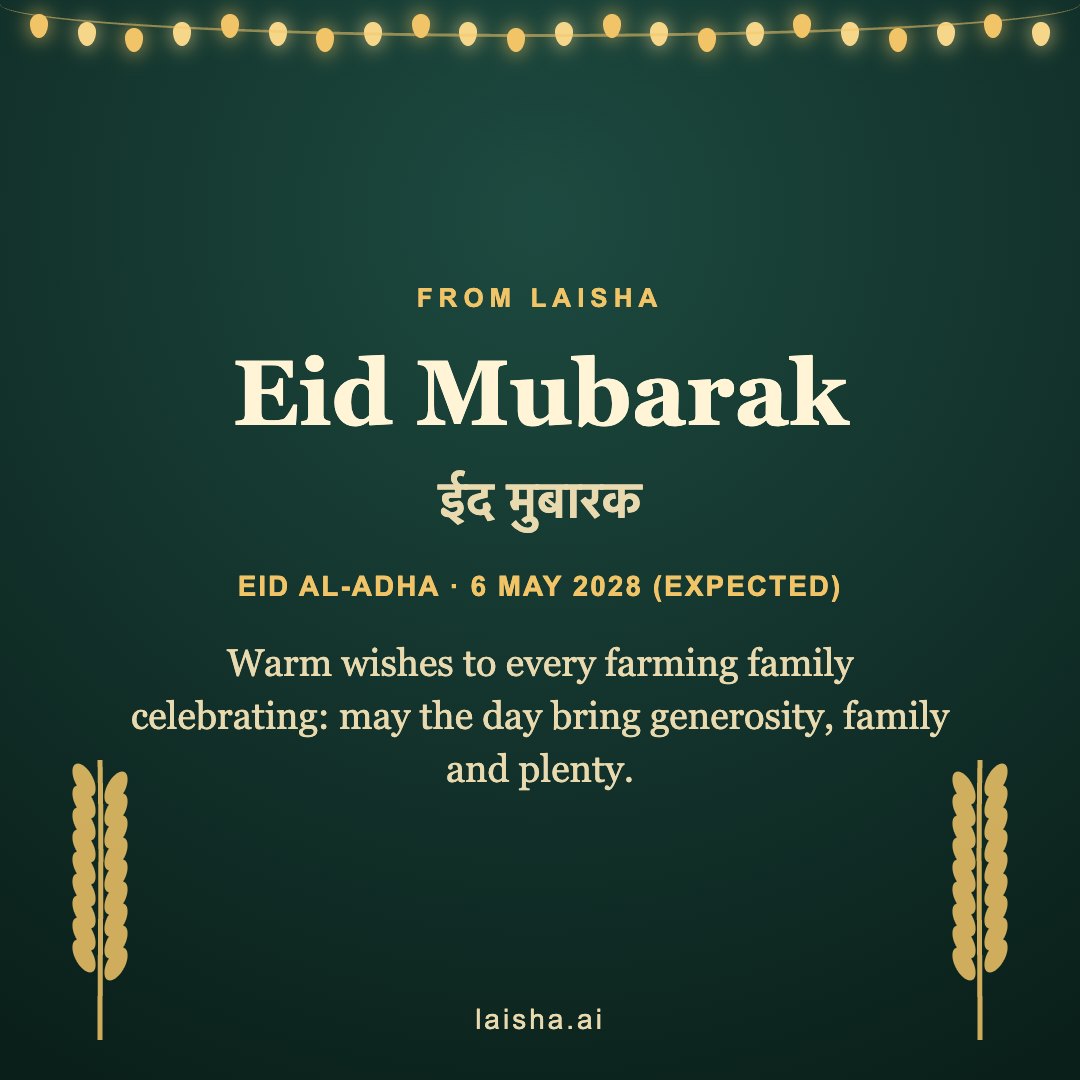
ईद मुबारक
ईद मनाने वाले हर किसान परिवार को हार्दिक शुभकामनाएँ: यह दिन उदारता, परिवार और बरकत लाए।
ईद-उल-अज़हा 2028 के दिन
- ईद-उल-अज़हा (संभावित; चाँद दिखने पर)
मई 2028 में खेत पर
मौसम कोई भी हो, ईद परिवार और बाँटने का दिन है। इस महीने के लिए खेती का कैलेंडर यह कहता है।
मई में बुआई (दक्षिण एशिया जैसी उष्णकटिबंधीय, मानसूनी जलवायु): धान, मक्का, कपास, Cassava।
शुभकामना भेजें
More festivals
- Makar Sankranti 2028Saturday 15 January 2028
- Eid al-Fitr 2028Sunday 27 February 2028
- Holi 2028Saturday 11 March 2028
- Janmashtami 2028Sunday 13 August 2028
- Navratri and Dussehra 2028Wednesday 27 September 2028
- Diwali 2028Tuesday 17 October 2028
- Christmas 2028 and New Year 2029Monday 25 December 2028
Last updated · How Laisha writes and checks its pages · Report a mistake