Eid al-Adha 2026 · Thursday 28 May 2026 (expected)
Eid Mubarak from Laisha
Warm wishes to every farming family celebrating: may the day bring generosity, family and plenty.
The days of Eid al-Adha 2026
- Eid al-Adha (expected; moon sighting decides)
Eid al-Adha 2026 at a glance
- Main day: Thursday 28 May 2026 (expected; the moon sighting decides).
- Year: 2026 CE, Vikram Samvat 2083.
- On the main day in New Delhi: sunrise 05:24, sunset 19:12 IST; Shukla Dwadashi at sunrise; nakshatra Chitra.
- Next year: Monday 17 May 2027, 11 days earlier in the year than this year.
The panchang for each day of Eid al-Adha 2026
For New Delhi, in IST. A tithi is the lunar day; it rarely starts at sunrise, so the table gives the tithis that run through each date with their start and end, and the nakshatra at sunrise.
| Day | Sunrise / sunset | Tithi | Nakshatra at sunrise |
|---|---|---|---|
| Eid al-Adha (expected; moon sighting decides) Thursday 28 May 2026 | 05:24 / 19:12 | Shukla Dwadashi 06:22 (27 May)–07:57; Shukla Trayodashi 07:57–09:51 (29 May) | Chitra until 08:08 |
Thursday 28 May 2026 hour by hour (New Delhi)
Moonset 03:37 (29 May), moonrise 16:42. The Islamic date itself is set by the sighting of the new crescent the evening before, not by this table.
Daily periods the engine computes: Brahma Muhurat 04:03–04:43; Abhijit Muhurat 11:50–12:46; Rahu Kaal 14:01–15:45; Yamaganda 05:24–07:08; Gulika Kaal 08:51–10:35; Amrit Kaal (Swati) 00:55 (29 May)–02:41 (29 May).
Computed with the Sunyra astronomical engine. Times shift by a few minutes for other Indian cities. No puja muhurta is given here: our engine computes the tithi, the nakshatra, sunrise and sunset, not the window a family or temple chooses for the puja, so follow your local panchang or priest for that.
Where Eid al-Adha 2026 falls in the farming season
Counted from the sowing windows in Laisha's farming calendar for the tropical and monsoon north (South Asia), which gives sowing by month:
- Sorghum: sowing opens in June; 28 May 2026 is 4 days before it opens.
- Millet (pearl millet): sowing opens in June; 28 May 2026 is 4 days before it opens.
- Groundnut: sowing opens in June; 28 May 2026 is 4 days before it opens.
- Soybean: sowing opens in June; 28 May 2026 is 4 days before it opens.
On the farm in May 2026
Whatever the season, Eid is a day for family and for sharing. Here is what the farming calendar says for this month.
Harvested in May: Rice (dry-season irrigated rice), Onion & shallot (dry-season onion), Mango.
Animal care for Eid al-Adha in late May: heat stress
In 2026 Eid al-Adha falls at the end of May, among the hottest weeks of the year across South Asia, the Middle East and North Africa. Millions of goats, sheep, cattle and camels are trucked from farms to markets and from markets to homes in the days before the festival, and heat is the biggest welfare risk they face.
Animals show heat stress before they collapse. Watch for fast, shallow breathing, panting with the mouth open and the tongue out, drooling, standing with the neck stretched and head low, refusing feed and seeking shade. Sheep and goats cope with heat better than cattle, but heavy, recently fattened animals and animals with dark coats suffer sooner, and buffalo, which have few sweat glands, need water or mud to wallow in.
Most losses can be prevented with simple steps. Give clean, cool water at all times; a hot animal may drink several times its usual amount. Give shade with free airflow rather than a closed shed. Feed in the cool of the early morning and evening, because digesting feed itself produces heat. Move and transport animals at night or early in the morning, never pack a vehicle so tightly that animals cannot stand comfortably, and stop to water on long journeys.
An animal that is panting hard and unsteady needs cooling at once: move it to shade, wet its body with cool (not ice-cold) water, especially the head, neck and legs, fan it, and call a veterinarian. Heat stress also lowers meat quality, because stressed animals use up the muscle glycogen that would otherwise lower the meat's pH after slaughter, giving dark, firm, dry meat that spoils faster.
Buying a few days early and keeping the animal calm, watered and shaded at home is kinder to the animal and gives better meat for the family and the people it will be shared with.
Sources: WOAH: Animal welfare standards
Send a greeting
A card for your family, friends and fellow farmers.
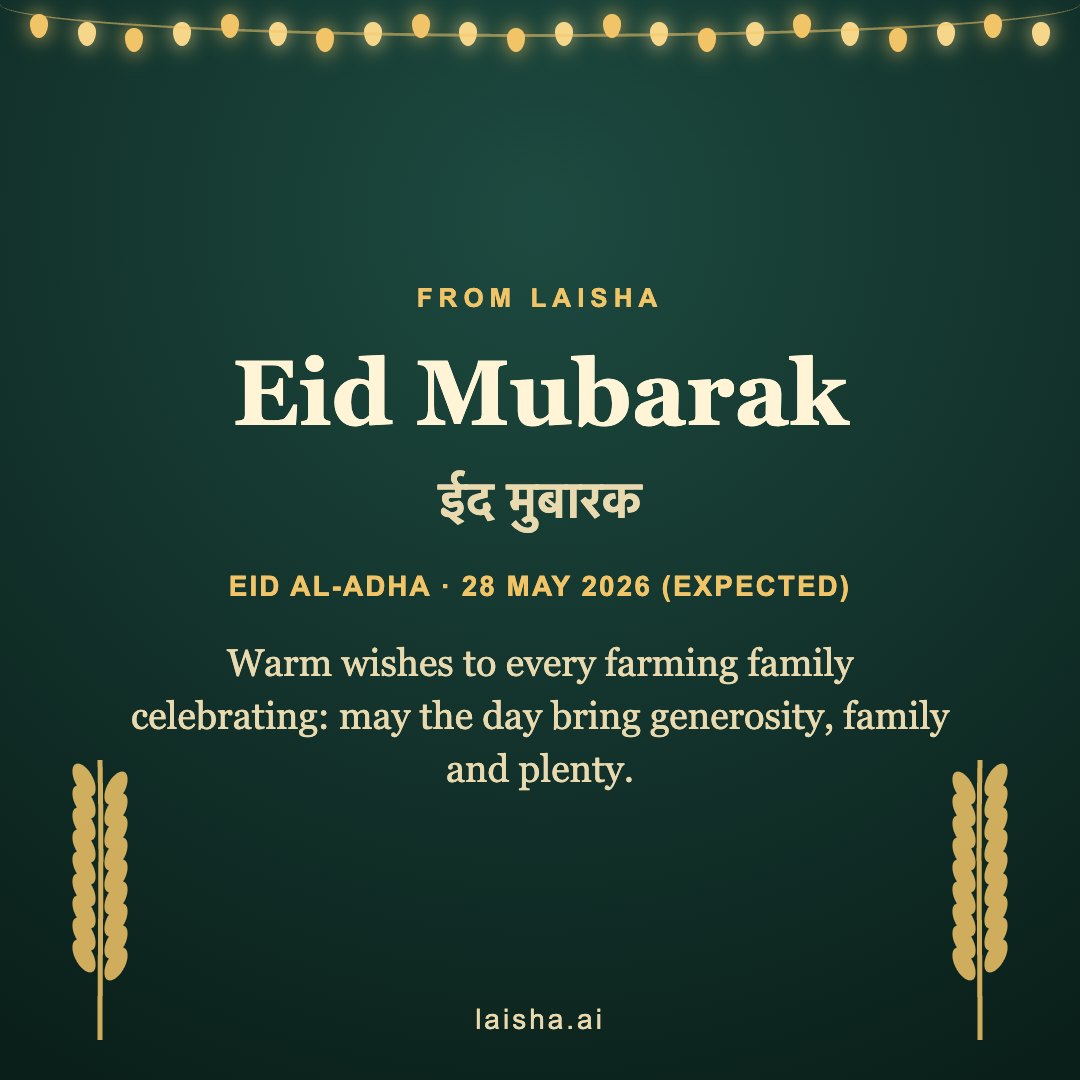
ईद मुबारक
ईद मनाने वाले हर किसान परिवार को हार्दिक शुभकामनाएँ: यह दिन उदारता, परिवार और बरकत लाए।
ईद-उल-अज़हा 2026 के दिन
- ईद-उल-अज़हा (संभावित; चाँद दिखने पर)
मई 2026 में खेत पर
मौसम कोई भी हो, ईद परिवार और बाँटने का दिन है। इस महीने के लिए खेती का कैलेंडर यह कहता है।
मई में बुआई (दक्षिण एशिया जैसी उष्णकटिबंधीय, मानसूनी जलवायु): धान, मक्का, कपास, Cassava।
शुभकामना भेजें
More festivals
- Makar Sankranti 2026Wednesday 14 January 2026
- Holi 2026Wednesday 4 March 2026
- Eid al-Fitr 2026Saturday 21 March 2026
- Janmashtami 2026Friday 4 September 2026
- Navratri and Dussehra 2026Tuesday 20 October 2026
- Diwali 2026Sunday 8 November 2026
- Christmas 2026 and New Year 2027Friday 25 December 2026
Last updated · How Laisha writes and checks its pages · Report a mistake