Eid al-Adha 2030 · Sunday 14 April 2030 (expected)
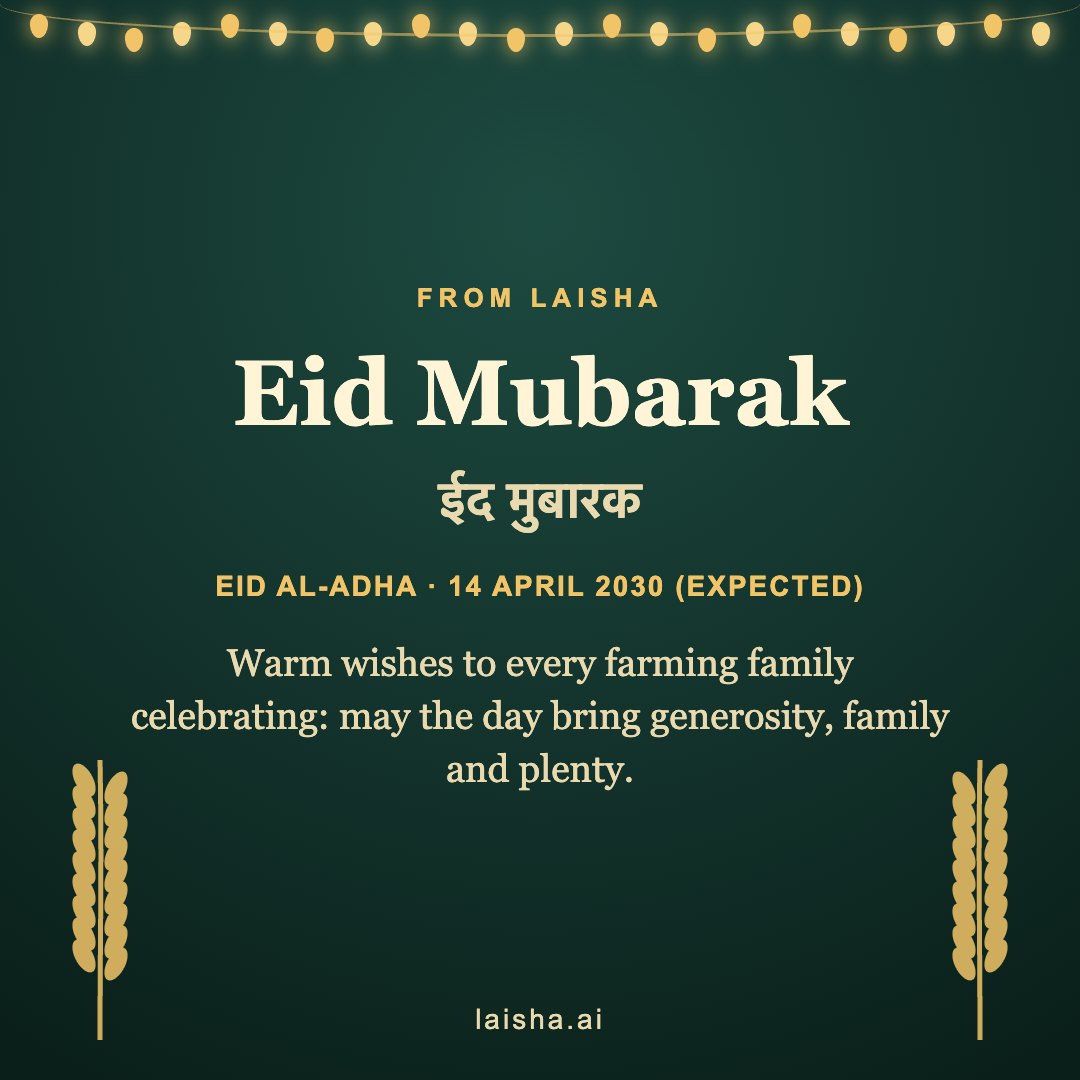
Eid Mubarak from Laisha
Warm wishes to every farming family celebrating: may the day bring generosity, family and plenty.
The days of Eid al-Adha 2030
- Eid al-Adha (expected; moon sighting decides)
Eid al-Adha 2030 at a glance
- Main day: Sunday 14 April 2030 (expected; the moon sighting decides).
- Year: 2030 CE, Vikram Samvat 2087.
- On the main day in New Delhi: sunrise 05:57, sunset 18:46 IST; Shukla Ekadashi at sunrise; nakshatra Magha.
- Compared with 2029: then it was Wednesday 25 April 2029; this year it comes 11 days earlier in the year.
- Next year: Thursday 3 April 2031, 11 days earlier in the year than this year.
The panchang for each day of Eid al-Adha 2030
For New Delhi, in IST. A tithi is the lunar day; it rarely starts at sunrise, so the table gives the tithis that run through each date with their start and end, and the nakshatra at sunrise.
| Day | Sunrise / sunset | Tithi | Nakshatra at sunrise |
|---|---|---|---|
| Eid al-Adha (expected; moon sighting decides) Sunday 14 April 2030 | 05:57 / 18:46 | Shukla Ekadashi 21:14 (13 Apr)–20:02; Shukla Dwadashi 20:02–18:04 (15 Apr) | Magha until 21:38 |
Sunday 14 April 2030 hour by hour (New Delhi)
Moonset 03:36 (15 Apr), moonrise 14:54. The Islamic date itself is set by the sighting of the new crescent the evening before, not by this table.
Daily periods the engine computes: Brahma Muhurat 04:27–05:12; Abhijit Muhurat 11:56–12:47; Rahu Kaal 17:10–18:46; Yamaganda 12:21–13:57; Gulika Kaal 15:34–17:10; Amrit Kaal (Magha) 19:17–20:51.
Computed with the Sunyra astronomical engine. Times shift by a few minutes for other Indian cities. No puja muhurta is given here: our engine computes the tithi, the nakshatra, sunrise and sunset, not the window a family or temple chooses for the puja, so follow your local panchang or priest for that.
Where Eid al-Adha 2030 falls in the farming season
Counted from the sowing windows in Laisha's farming calendar for the tropical and monsoon north (South Asia), which gives sowing by month:
- Cassava: sowing opens in April; 14 April 2030 is 13 days into the window.
- Rice (wet-season rice): sowing opens in May; 14 April 2030 is 17 days before it opens.
- Maize (wet-season maize): sowing opens in May; 14 April 2030 is 17 days before it opens.
- Cotton: sowing opens in May; 14 April 2030 is 17 days before it opens.
On the farm in April 2030
Whatever the season, Eid is a day for family and for sharing. Here is what the farming calendar says for this month.
Harvested in April: Rice (dry-season irrigated rice), Wheat (cool dry-season wheat), Chickpea, Tomato (cool dry-season tomato), Onion & shallot (dry-season onion), Sugarcane.
Farming calendar for April 2030 → · Laisha Lens: this month →
After the sacrifice: hides, skins and clean disposal
Each Eid al-Adha produces millions of hides and skins in a few days. In many countries they are donated to mosques, madrasas or charities, which sell them to tanneries, so their value supports good causes. Much of that value is lost in the first hours, through careless flaying and slow curing, and in 2030 the festival falls in mid-April, when warm days make spoilage faster.
Damage starts with the knife. Cuts and holes made while flaying, called flay cuts, lower the grade of the leather or make parts of it useless. Using a curved, well-sharpened flaying knife, pulling the skin away rather than cutting deep, and working from the belly outwards along a straight line reduces this. Avoid dragging hides on the ground, where dirt and dung stain and scratch the grain.
Next comes putrefaction. A raw hide is wet protein, and bacteria begin to break it down within hours in warm weather; hair slipping out easily is a sign the hide is already damaged. Hides should be cooled and cured the same day. The usual method is wet salting: spread the hide flesh side up in the shade, cover the whole flesh side evenly with clean salt, fold or stack it, and leave it to drain. Collection centres and tanneries can advise on the amount of salt and how long to wait before they collect.
Clean disposal of the rest of the animal matters as much. Blood, gut contents and offcuts left in drains or empty plots attract flies and dogs, smell within a day, and spread disease. Many cities set up collection points and pits for Eid waste; where there is none, bury waste deep enough that animals cannot dig it up, away from wells and water channels.
Done well, the hide becomes leather, the waste becomes compost or is safely buried, and the festival leaves the neighbourhood as clean as it found it.
Sources: WOAH: Animal welfare standards
Send a greeting
A card for your family, friends and fellow farmers.
ईद मुबारक
ईद मनाने वाले हर किसान परिवार को हार्दिक शुभकामनाएँ: यह दिन उदारता, परिवार और बरकत लाए।
ईद-उल-अज़हा 2030 के दिन
- ईद-उल-अज़हा (संभावित; चाँद दिखने पर)
अप्रैल 2030 में खेत पर
मौसम कोई भी हो, ईद परिवार और बाँटने का दिन है। इस महीने के लिए खेती का कैलेंडर यह कहता है।
अप्रैल में बुआई (दक्षिण एशिया जैसी उष्णकटिबंधीय, मानसूनी जलवायु): Cassava।
शुभकामना भेजें
More festivals
- Makar Sankranti 2030Monday 14 January 2030
- Eid al-Fitr 2030Tuesday 5 February 2030
- Holi 2030Wednesday 20 March 2030
- Janmashtami 2030Wednesday 21 August 2030
- Navratri and Dussehra 2030Sunday 6 October 2030
- Diwali 2030Saturday 26 October 2030
- Christmas 2030 and New Year 2031Wednesday 25 December 2030
Last updated · How Laisha writes and checks its pages · Report a mistake