Eid al-Fitr 2030 · Tuesday 5 February 2030 (expected)
Eid Mubarak from Laisha
Warm wishes to every farming family celebrating: may the day bring joy, togetherness and plenty.
The days of Eid al-Fitr 2030
- Eid al-Fitr (expected; moon sighting decides)
Eid al-Fitr 2030 at a glance
- Main day: Tuesday 5 February 2030 (expected; the moon sighting decides).
- Year: 2030 CE, Vikram Samvat 2086.
- On the main day in New Delhi: sunrise 07:06, sunset 18:03 IST; Shukla Tritiya at sunrise; nakshatra Purva Bhadrapada.
- Compared with 2029: then it was Thursday 15 February 2029; this year it comes 10 days earlier in the year.
- Next year: Saturday 25 January 2031, 11 days earlier in the year than this year.
The panchang for each day of Eid al-Fitr 2030
For New Delhi, in IST. A tithi is the lunar day; it rarely starts at sunrise, so the table gives the tithis that run through each date with their start and end, and the nakshatra at sunrise.
| Day | Sunrise / sunset | Tithi | Nakshatra at sunrise |
|---|---|---|---|
| Eid al-Fitr (expected; moon sighting decides) Tuesday 5 February 2030 | 07:06 / 18:03 | Shukla Tritiya 20:25 (4 Feb)–20:43; Shukla Chaturthi 20:43–21:41 (6 Feb) | Purva Bhadrapada until 05:44 (6 Feb) |
Tuesday 5 February 2030 hour by hour (New Delhi)
Moonset 20:47, moonrise 08:23. The Islamic date itself is set by the sighting of the new crescent the evening before, not by this table.
Daily periods the engine computes: Brahma Muhurat 05:22–06:14; Abhijit Muhurat 12:13–12:57; Rahu Kaal 15:19–16:41; Yamaganda 09:51–11:13; Gulika Kaal 12:35–13:57; Amrit Kaal (Purva Bhadrapada) 21:22–23:03.
Computed with the Sunyra astronomical engine. Times shift by a few minutes for other Indian cities. No puja muhurta is given here: our engine computes the tithi, the nakshatra, sunrise and sunset, not the window a family or temple chooses for the puja, so follow your local panchang or priest for that.
Where Eid al-Fitr 2030 falls in the farming season
Counted from the sowing windows in Laisha's farming calendar for the tropical and monsoon north (South Asia), which gives sowing by month:
- Sugarcane: sowing opens in January; 5 February 2030 is 35 days into the window.
On the farm in February 2030
Whatever the season, Eid is a day for family and for sharing. Here is what the farming calendar says for this month.
Harvested in February: Pigeon pea, Chickpea, Mustard, Potato (cool-season potato on the plains), Tomato (cool dry-season tomato), Sugarcane.
Farming calendar for February 2030 → · Laisha Lens: this month →
The crop behind the feast: lentils and chickpeas in the iftar soup
From Morocco's harira to Turkey's red lentil soup and the dal of South Asia, a bowl of pulses is often the first warm food after the fast. In 2030 Ramadan runs through January and Eid falls in early February, in the cool season when chickpea and lentil crops are flowering and setting pods across South Asia, the Middle East and North Africa.
Lentils and chickpeas are legumes, and they feed the soil as well as people. Bacteria called rhizobia live in nodules on their roots and fix nitrogen from the air, so a good pulse crop needs little or no nitrogen fertiliser and leaves some nitrogen for the next crop. Where a field has not grown the crop for years, seed is often coated with the right rhizobium inoculant before sowing so nodules form.
India is the largest producer and consumer of pulses, and also a large importer; Canada and Australia are the biggest exporters of lentils. Chickpeas come in two main types: small, dark, rough desi seeds, grown mostly in South Asia and Ethiopia and usually split into dal or milled into besan, and larger, cream-coloured kabuli seeds, used whole in soups, salads and hummus.
In February the main threats to a flowering chickpea crop are the pod borer, Helicoverpa armigera, whose caterpillars bore into pods, and, in cool, wet spells, Ascochyta blight and Botrytis grey mould, which spread fast through dense crops. Scouting with pheromone traps and looking for caterpillars on the plants decides when control is worth it; wider rows and varieties with some resistance reduce the diseases.
Lentils and chickpeas store well when they are dry, but pulse beetles (bruchids) breed in stored seed and leave round exit holes. Drying the grain well, storing it in sealed containers, and not mixing old and new stock keeps the household's supply sound until the next season.
Sources: FAO: Pulses, nutritious seeds for a sustainable future · ICRISAT
Send a greeting
A card for your family, friends and fellow farmers.
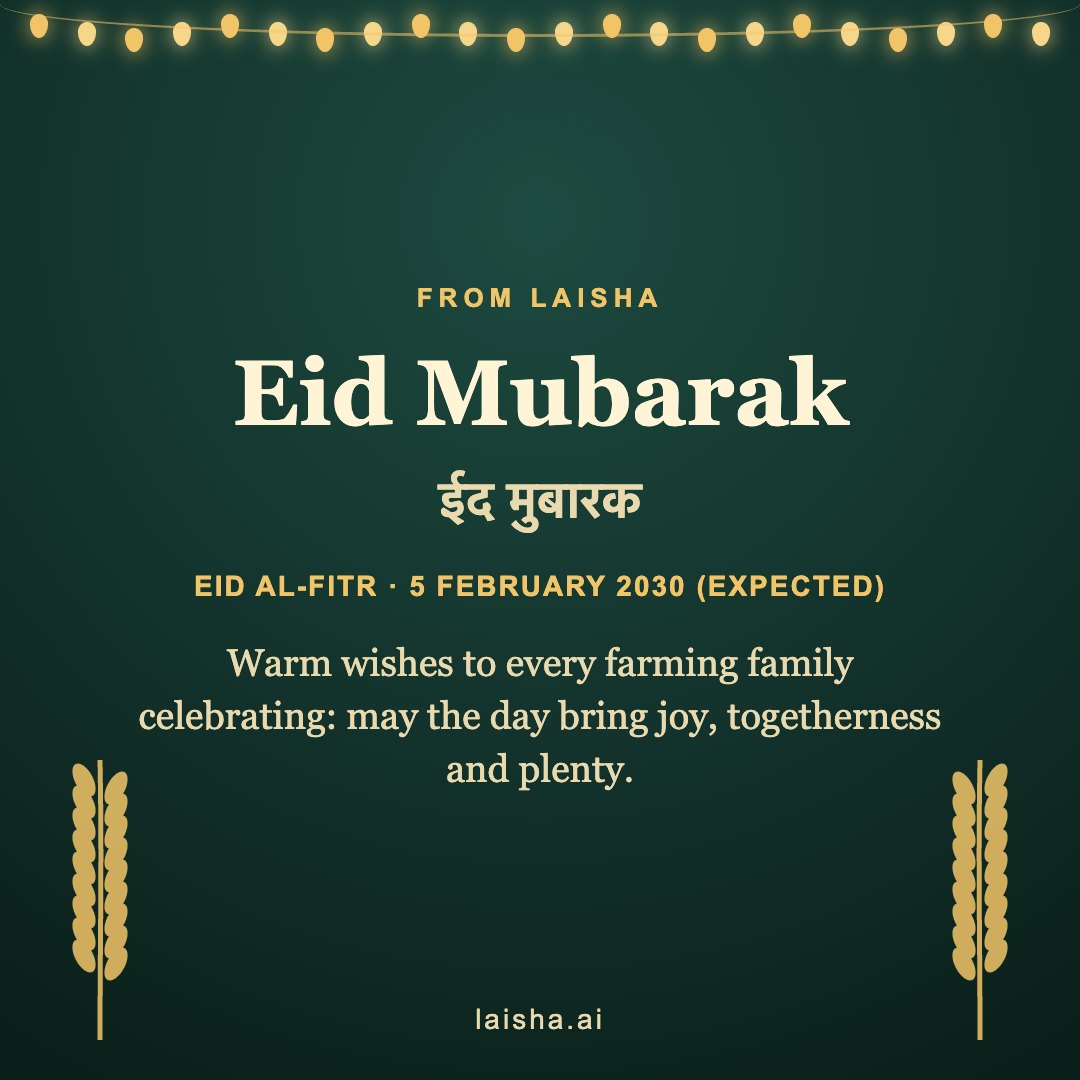
ईद मुबारक
ईद मनाने वाले हर किसान परिवार को हार्दिक शुभकामनाएँ: यह दिन ख़ुशी, अपनापन और बरकत लाए।
ईद-उल-फ़ित्र 2030 के दिन
- ईद-उल-फ़ित्र (संभावित; चाँद दिखने पर)
फ़रवरी 2030 में खेत पर
मौसम कोई भी हो, ईद परिवार और बाँटने का दिन है। इस महीने के लिए खेती का कैलेंडर यह कहता है।
फ़रवरी में बुआई (दक्षिण एशिया जैसी उष्णकटिबंधीय, मानसूनी जलवायु): गन्ने।
शुभकामना भेजें
More festivals
- Makar Sankranti 2030Monday 14 January 2030
- Holi 2030Wednesday 20 March 2030
- Eid al-Adha 2030Sunday 14 April 2030
- Janmashtami 2030Wednesday 21 August 2030
- Navratri and Dussehra 2030Sunday 6 October 2030
- Diwali 2030Saturday 26 October 2030
- Christmas 2030 and New Year 2031Wednesday 25 December 2030
Last updated · How Laisha writes and checks its pages · Report a mistake