Makar Sankranti 2030 · Monday 14 January 2030
Happy Makar Sankranti from Laisha
A sweet harvest festival to every farming family: til, gur and a good year ahead.
The days of Makar Sankranti 2030
- Lohri
- Makar Sankranti · Pongal
Makar Sankranti 2030 at a glance
- Main day: Monday 14 January 2030.
- Year: 2030 CE, Vikram Samvat 2086.
- On the main day in New Delhi: sunrise 07:15, sunset 17:45 IST; Shukla Dashami at sunrise; nakshatra Bharani.
- Compared with 2029: then it was Sunday 14 January 2029; this year it comes on the same calendar date.
- Next year: Wednesday 15 January 2031, 1 days later in the year than this year.
The panchang for each day of Makar Sankranti 2030
For New Delhi, in IST. A tithi is the lunar day; it rarely starts at sunrise, so the table gives the tithis that run through each date with their start and end, and the nakshatra at sunrise.
| Day | Sunrise / sunset | Tithi | Nakshatra at sunrise |
|---|---|---|---|
| Lohri Sunday 13 January 2030 | 07:15 / 17:44 | Shukla Navami 08:48 (12 Jan)–11:25; Shukla Dashami 11:25–14:03 (14 Jan) | Bharani until 07:26 (14 Jan) |
| Makar Sankranti · Pongal Monday 14 January 2030 | 07:15 / 17:45 | Shukla Dashami 11:25 (13 Jan)–14:03; Shukla Ekadashi 14:03–16:30 (15 Jan) | Bharani until 07:26 |
Monday 14 January 2030 hour by hour (New Delhi)
Yoga Shubha until 02:42 (15 Jan); karana Gara until 14:03. Moonrise 13:19. Moonset 03:28 (15 Jan).
Daily periods the engine computes: Brahma Muhurat 05:27–06:21; Abhijit Muhurat 12:09–12:51; Rahu Kaal 08:33–09:52; Yamaganda 11:11–12:30; Gulika Kaal 13:49–15:07.
| Choghadiya | Day | Night |
|---|---|---|
| 1 | Amrit (good) 07:15–08:33 | Char (neutral) 17:45–19:26 |
| 2 | Kaal (bad) 08:33–09:52 | Rog (bad) 19:26–21:07 |
| 3 | Shubh (good) 09:52–11:11 | Kaal (bad) 21:07–22:49 |
| 4 | Rog (bad) 11:11–12:30 | Labh (good) 22:49–00:30 (15 Jan) |
| 5 | Udveg (bad) 12:30–13:49 | Udveg (bad) 00:30 (15 Jan)–02:11 (15 Jan) |
| 6 | Char (neutral) 13:49–15:07 | Shubh (good) 02:11 (15 Jan)–03:52 (15 Jan) |
| 7 | Labh (good) 15:07–16:26 | Amrit (good) 03:52 (15 Jan)–05:33 (15 Jan) |
| 8 | Amrit (good) 16:26–17:45 | Char (neutral) 05:33 (15 Jan)–07:14 (15 Jan) |
Computed with the Sunyra astronomical engine. Times shift by a few minutes for other Indian cities. No puja muhurta is given here: our engine computes the tithi, the nakshatra, sunrise and sunset, not the window a family or temple chooses for the puja, so follow your local panchang or priest for that.
Where Makar Sankranti 2030 falls in the farming season
Counted from the sowing windows in Laisha's farming calendar for the tropical and monsoon north (South Asia), which gives sowing by month:
- Sugarcane: sowing opens in January; 14 January 2030 is 13 days into the window.
- Rice (dry-season irrigated rice): sowing opens in November; 14 January 2030 is 291 days before it opens.
- Onion & shallot (dry-season onion): sowing opens in December; 14 January 2030 is 321 days before it opens.
On the farm in January 2030
Makar Sankranti is the winter harvest festival: sugarcane is being crushed, the rabi crops are growing, and in the south the new rice is cooked as Pongal.
Harvested in January: Cotton, Pigeon pea, Potato (cool-season potato on the plains), Tomato (cool dry-season tomato), Sugarcane, Coffee.
Farming calendar for January 2030 → · Laisha Lens: this month →
Groundnut chikki for Uttarayan, and keeping groundnuts free of aflatoxin
In Gujarat, Makar Sankranti is Uttarayan, the kite festival, and rooftops are full of kite flyers eating chikki made of groundnuts and jaggery, undhiyu and sesame sweets. Gujarat is India's largest groundnut-growing state, with the crop sown mostly in the kharif season on the light soils of Saurashtra.
The groundnut, Arachis hypogaea, came from South America and is unusual among crops: after its flowers are pollinated above ground, a stalk called the peg grows down into the soil, and the pod develops underground. That is why groundnuts need loose, light soil and enough soil moisture at pegging and pod filling, and why heavy clay soils make harvest hard.
Developing underground also exposes the pods to a serious food safety problem: aflatoxin. Aspergillus flavus and related moulds in the soil can invade pods, especially when the crop is drought-stressed late in the season or the pods are damaged by insects. After harvest, slow drying in damp heaps lets the mould grow fast. Aflatoxins are potent toxins and cause liver cancer with long exposure, so importing countries set strict limits and test groundnut shipments.
ICRISAT and national programmes recommend a set of simple steps: irrigate if possible late in the season, harvest on time, dry the pods quickly, on a tarpaulin rather than bare soil, to safe moisture of about 8 to 10 per cent, remove damaged and shrivelled pods, and store dry in clean bags off the floor. Each step is cheap compared with a rejected consignment.
So as the chikki is shared on the terrace, the groundnut in it has passed through the same careful handling that makes Indian groundnuts acceptable in markets around the world.
Sources: ICRISAT · ICAR-Directorate of Groundnut Research, Junagadh
Send a greeting
A card for your family, friends and fellow farmers.
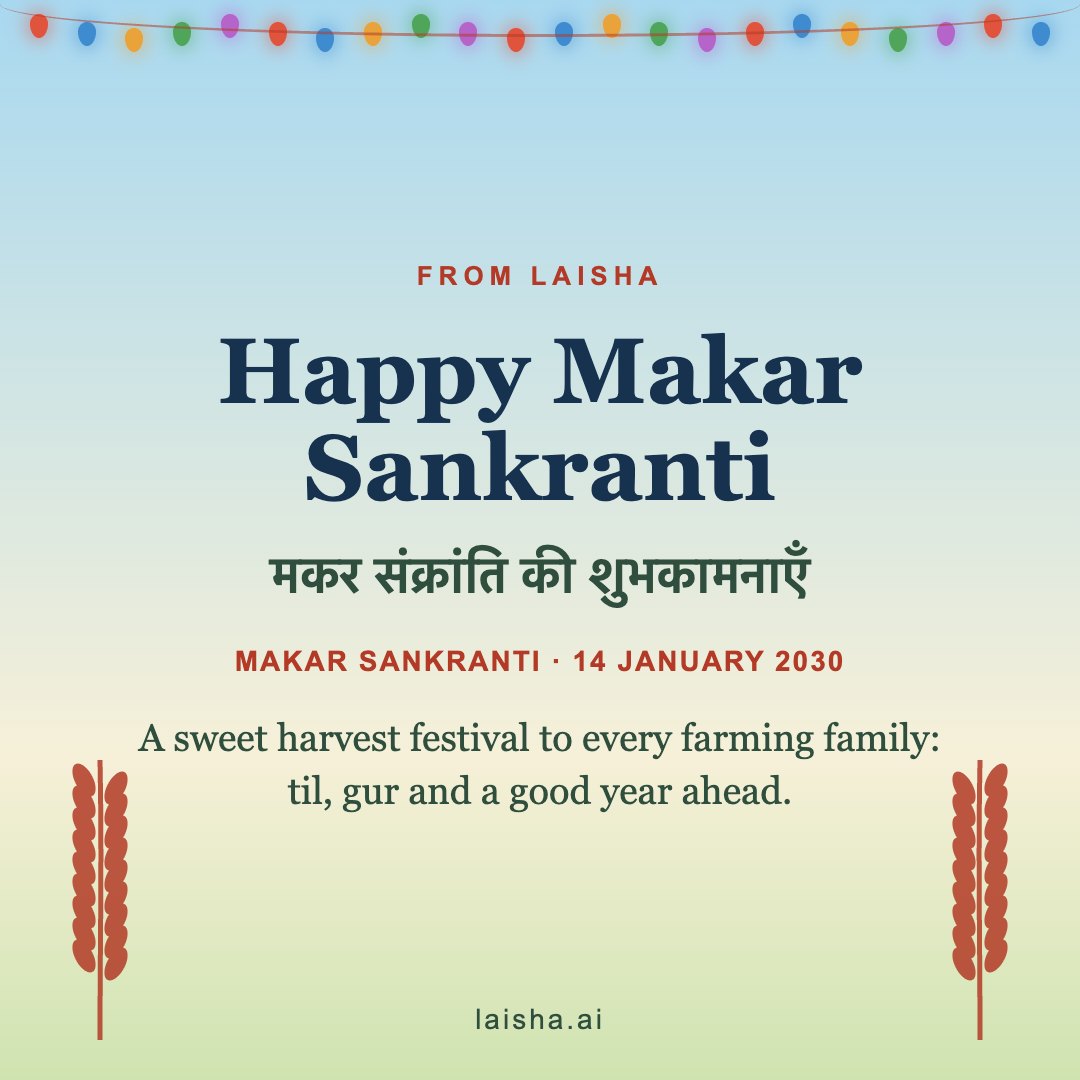
मकर संक्रांति की शुभकामनाएँ
हर किसान परिवार को फ़सल उत्सव की मीठी शुभकामनाएँ: तिल, गुड़ और आगे एक अच्छा साल।
मकर संक्रांति 2030 के दिन
- लोहड़ी
- मकर संक्रांति · पोंगल
जनवरी 2030 में खेत पर
मकर संक्रांति सर्दियों का फ़सल उत्सव है: गन्ने की पेराई चल रही होती है, रबी की फ़सलें बढ़ रही होती हैं, और दक्षिण में नए चावल से पोंगल बनता है।
जनवरी में बुआई (दक्षिण एशिया जैसी उष्णकटिबंधीय, मानसूनी जलवायु): धान, प्याज, गन्ने।
जनवरी में कटाई: कपास, अरहर (तूर), आलू, टमाटर, गन्ने, Coffee।
शुभकामना भेजें
More festivals
- Eid al-Fitr 2030Tuesday 5 February 2030
- Holi 2030Wednesday 20 March 2030
- Eid al-Adha 2030Sunday 14 April 2030
- Janmashtami 2030Wednesday 21 August 2030
- Navratri and Dussehra 2030Sunday 6 October 2030
- Diwali 2030Saturday 26 October 2030
- Christmas 2030 and New Year 2031Wednesday 25 December 2030
Last updated · How Laisha writes and checks its pages · Report a mistake