Makar Sankranti 2029 · Sunday 14 January 2029
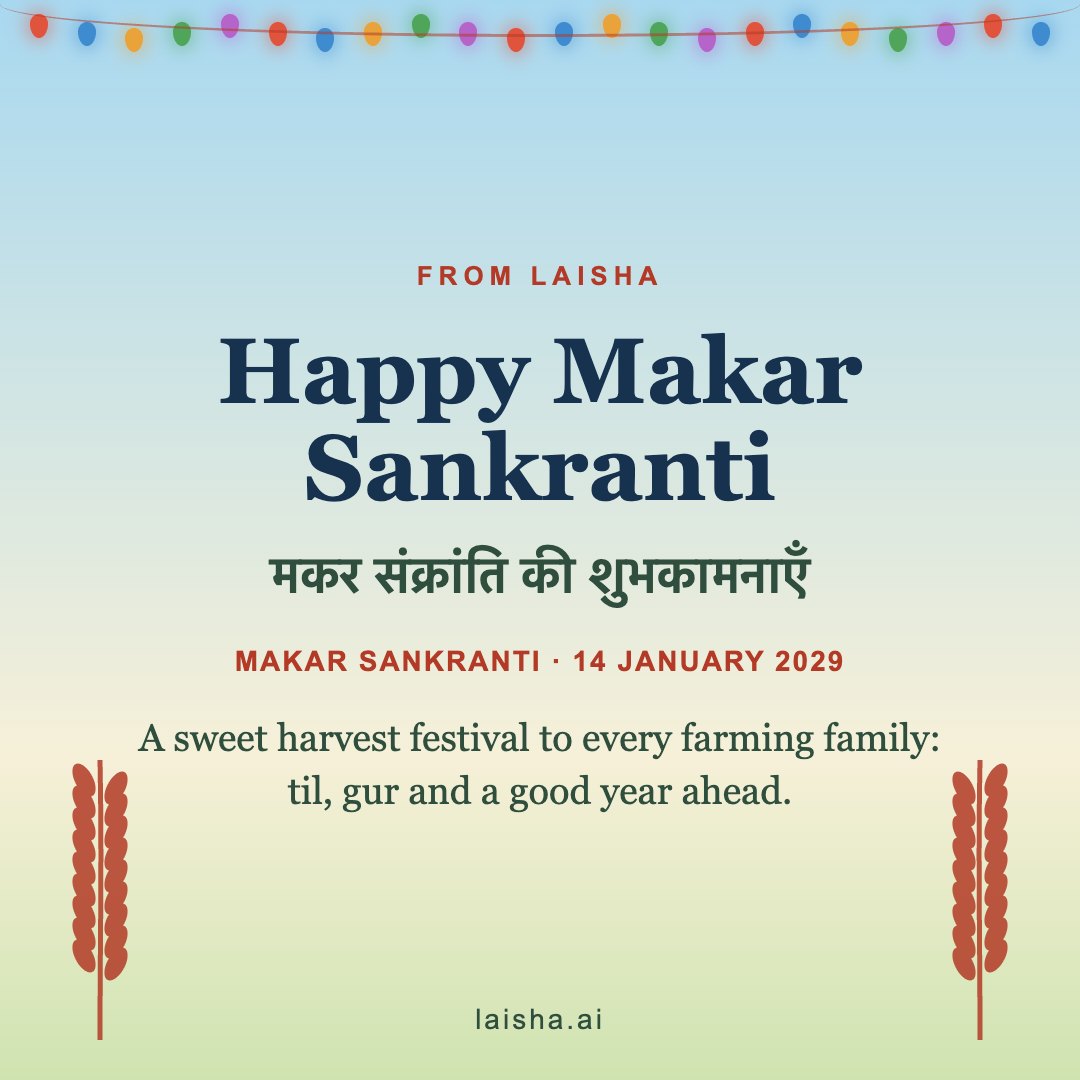
Happy Makar Sankranti from Laisha
A sweet harvest festival to every farming family: til, gur and a good year ahead.
The days of Makar Sankranti 2029
- Lohri
- Makar Sankranti · Pongal
Makar Sankranti 2029 at a glance
- Main day: Sunday 14 January 2029.
- Year: 2029 CE, Vikram Samvat 2085.
- On the main day in New Delhi: sunrise 07:15, sunset 17:45 IST; Krishna Amavasya at sunrise; nakshatra Purva Ashadha.
- Compared with 2028: then it was Saturday 15 January 2028; this year it comes 1 days earlier in the year.
- Next year: Monday 14 January 2030, on the same calendar date than this year.
The panchang for each day of Makar Sankranti 2029
For New Delhi, in IST. A tithi is the lunar day; it rarely starts at sunrise, so the table gives the tithis that run through each date with their start and end, and the nakshatra at sunrise.
| Day | Sunrise / sunset | Tithi | Nakshatra at sunrise |
|---|---|---|---|
| Lohri Saturday 13 January 2029 | 07:15 / 17:44 | Krishna Chaturdashi 23:06 (12 Jan)–22:47; Amavasya 22:47–22:54 (14 Jan) | Mula until 15:04 |
| Makar Sankranti · Pongal Sunday 14 January 2029 | 07:15 / 17:45 | Amavasya 22:47 (13 Jan)–22:54; Shukla Pratipada 22:54–23:31 (15 Jan) | Purva Ashadha until 15:37 |
Sunday 14 January 2029 hour by hour (New Delhi)
Yoga Vyaghata until 09:27; karana Chatushpada until 10:47. Moonset 17:29.
Daily periods the engine computes: Brahma Muhurat 05:27–06:21; Abhijit Muhurat 12:09–12:51; Rahu Kaal 16:26–17:45; Yamaganda 12:30–13:49; Gulika Kaal 15:07–16:26; Amrit Kaal (Purva Ashadha) 10:43–12:21.
| Choghadiya | Day | Night |
|---|---|---|
| 1 | Udveg (bad) 07:15–08:33 | Shubh (good) 17:45–19:26 |
| 2 | Char (neutral) 08:33–09:52 | Amrit (good) 19:26–21:07 |
| 3 | Labh (good) 09:52–11:11 | Char (neutral) 21:07–22:49 |
| 4 | Amrit (good) 11:11–12:30 | Rog (bad) 22:49–00:30 (15 Jan) |
| 5 | Kaal (bad) 12:30–13:49 | Kaal (bad) 00:30 (15 Jan)–02:11 (15 Jan) |
| 6 | Shubh (good) 13:49–15:07 | Labh (good) 02:11 (15 Jan)–03:52 (15 Jan) |
| 7 | Rog (bad) 15:07–16:26 | Udveg (bad) 03:52 (15 Jan)–05:33 (15 Jan) |
| 8 | Udveg (bad) 16:26–17:45 | Shubh (good) 05:33 (15 Jan)–07:14 (15 Jan) |
Computed with the Sunyra astronomical engine. Times shift by a few minutes for other Indian cities. No puja muhurta is given here: our engine computes the tithi, the nakshatra, sunrise and sunset, not the window a family or temple chooses for the puja, so follow your local panchang or priest for that.
Where Makar Sankranti 2029 falls in the farming season
Counted from the sowing windows in Laisha's farming calendar for the tropical and monsoon north (South Asia), which gives sowing by month:
- Sugarcane: sowing opens in January; 14 January 2029 is 13 days into the window.
- Rice (dry-season irrigated rice): sowing opens in November; 14 January 2029 is 291 days before it opens.
- Onion & shallot (dry-season onion): sowing opens in December; 14 January 2029 is 321 days before it opens.
On the farm in January 2029
Makar Sankranti is the winter harvest festival: sugarcane is being crushed, the rabi crops are growing, and in the south the new rice is cooked as Pongal.
Harvested in January: Cotton, Pigeon pea, Potato (cool-season potato on the plains), Tomato (cool dry-season tomato), Sugarcane, Coffee.
Farming calendar for January 2029 → · Laisha Lens: this month →
Magh Bihu in Assam: sticky rice and the end of the harvest
In Assam, the same mid-January turn of the sun is celebrated as Magh Bihu or Bhogali Bihu, the festival of feasting at the end of the harvest. On the night before, communities build a bhelaghar or meji, a tall hut of straw and bamboo, feast in it, and burn it at dawn.
The harvest being celebrated is sali rice, the main monsoon crop of Assam, transplanted around June and July and cut in November and December. Assam is one of the homes of rice diversity, with thousands of traditional varieties, and Bihu food shows several of them. Pithas, the Bihu rice cakes, are made from bora rice, a glutinous or sticky rice; komal chaul or soft rice, from traditional varieties such as Aghonibora, needs only soaking in water, not cooking; and joha, a small-grained aromatic rice, has a Geographical Indication.
Why is bora rice sticky? Rice starch is made of two molecules, amylose and amylopectin. Ordinary rice contains about 15 to 30 per cent amylose, which keeps cooked grains separate. Glutinous rice contains almost no amylose, so its starch is almost all amylopectin, which makes cooked grains soft, sticky and cohesive, ideal for rice cakes. The trait comes from a change in a single gene, Waxy, and sticky rices are also the staple in Laos and parts of Thailand.
Sali rice in Assam faces flooding: the Brahmaputra and its tributaries can submerge fields for days in July and August. Submergence-tolerant varieties carrying the SUB1 gene, developed at IRRI, survive up to about two weeks under water and have spread widely in Assam's flood-prone districts.
A full granary of sali, bora and joha is what makes Magh Bihu a feast; the festival honours the farm year that produced it.
Sources: Assam Agricultural University · IRRI: Submergence-tolerant rice
Send a greeting
A card for your family, friends and fellow farmers.
मकर संक्रांति की शुभकामनाएँ
हर किसान परिवार को फ़सल उत्सव की मीठी शुभकामनाएँ: तिल, गुड़ और आगे एक अच्छा साल।
मकर संक्रांति 2029 के दिन
- लोहड़ी
- मकर संक्रांति · पोंगल
जनवरी 2029 में खेत पर
मकर संक्रांति सर्दियों का फ़सल उत्सव है: गन्ने की पेराई चल रही होती है, रबी की फ़सलें बढ़ रही होती हैं, और दक्षिण में नए चावल से पोंगल बनता है।
जनवरी में बुआई (दक्षिण एशिया जैसी उष्णकटिबंधीय, मानसूनी जलवायु): धान, प्याज, गन्ने।
जनवरी में कटाई: कपास, अरहर (तूर), आलू, टमाटर, गन्ने, Coffee।
शुभकामना भेजें
More festivals
- Eid al-Fitr 2029Thursday 15 February 2029
- Holi 2029Thursday 1 March 2029
- Eid al-Adha 2029Wednesday 25 April 2029
- Janmashtami 2029Saturday 1 September 2029
- Navratri and Dussehra 2029Tuesday 16 October 2029
- Diwali 2029Monday 5 November 2029
- Christmas 2029 and New Year 2030Tuesday 25 December 2029
Last updated · How Laisha writes and checks its pages · Report a mistake