Navratri and Dussehra 2029 · Tuesday 16 October 2029
Shubh Navratri and Dussehra from Laisha
May the Goddess bless a full kharif harvest and a good rabi sowing.
The days of Navratri and Dussehra 2029
- Navratri begins (Ghatasthapana)
- Maha Navami
- Dussehra · Vijayadashami
Navratri and Dussehra 2029 at a glance
- Main day: Tuesday 16 October 2029.
- Year: 2029 CE, Vikram Samvat 2086.
- On the main day in New Delhi: sunrise 06:22, sunset 17:50 IST; Shukla Dashami at sunrise; nakshatra Shravana.
- Compared with 2028: then it was Wednesday 27 September 2028; this year it comes 18 days later in the year.
- Next year: Sunday 6 October 2030, 10 days earlier in the year than this year.
The panchang for each day of Navratri and Dussehra 2029
For New Delhi, in IST. A tithi is the lunar day; it rarely starts at sunrise, so the table gives the tithis that run through each date with their start and end, and the nakshatra at sunrise.
| Day | Sunrise / sunset | Tithi | Nakshatra at sunrise |
|---|---|---|---|
| Navratri begins (Ghatasthapana) Monday 8 October 2029 | 06:17 / 17:59 | Shukla Pratipada 00:44–20:55; Shukla Dwitiya 20:55–17:11 (9 Oct) | Chitra until 02:08 (9 Oct) |
| Maha Navami Monday 15 October 2029 | 06:21 / 17:51 | Shukla Navami 04:29–04:38 (16 Oct); Shukla Dashami 04:38 (16 Oct)–05:23 (17 Oct) | Uttara Ashadha until 16:17 |
| Dussehra · Vijayadashami Tuesday 16 October 2029 | 06:22 / 17:50 | Shukla Dashami 04:38–05:23 (17 Oct); Shukla Ekadashi 05:23 (17 Oct)–06:38 (18 Oct) | Shravana until 17:22 |
Tuesday 16 October 2029 hour by hour (New Delhi)
Yoga Dhriti until 07:11; karana Taitila until 16:57. Moonrise 14:17. Moonset 01:47 (17 Oct).
Daily periods the engine computes: Brahma Muhurat 04:42–05:32; Abhijit Muhurat 11:43–12:29; Rahu Kaal 14:58–16:24; Yamaganda 09:14–10:40; Gulika Kaal 12:06–13:32; Amrit Kaal (Shravana) 06:30–08:10.
| Choghadiya | Day | Night |
|---|---|---|
| 1 | Rog (bad) 06:22–07:48 | Kaal (bad) 17:50–19:24 |
| 2 | Udveg (bad) 07:48–09:14 | Labh (good) 19:24–20:58 |
| 3 | Char (neutral) 09:14–10:40 | Udveg (bad) 20:58–22:32 |
| 4 | Labh (good) 10:40–12:06 | Shubh (good) 22:32–00:06 (17 Oct) |
| 5 | Amrit (good) 12:06–13:32 | Amrit (good) 00:06 (17 Oct)–01:40 (17 Oct) |
| 6 | Kaal (bad) 13:32–14:58 | Char (neutral) 01:40 (17 Oct)–03:14 (17 Oct) |
| 7 | Shubh (good) 14:58–16:24 | Rog (bad) 03:14 (17 Oct)–04:49 (17 Oct) |
| 8 | Rog (bad) 16:24–17:50 | Kaal (bad) 04:49 (17 Oct)–06:23 (17 Oct) |
Computed with the Sunyra astronomical engine. Times shift by a few minutes for other Indian cities. No puja muhurta is given here: our engine computes the tithi, the nakshatra, sunrise and sunset, not the window a family or temple chooses for the puja, so follow your local panchang or priest for that.
Where Navratri and Dussehra 2029 falls in the farming season
Counted from the sowing windows in Laisha's farming calendar for the tropical and monsoon north (South Asia), which gives sowing by month:
- Wheat (cool dry-season wheat): sowing opens in October; 16 October 2029 is 15 days into the window.
- Chickpea: sowing opens in October; 16 October 2029 is 15 days into the window.
- Mustard: sowing opens in October; 16 October 2029 is 15 days into the window.
- Potato (cool-season potato on the plains): sowing opens in October; 16 October 2029 is 15 days into the window.
On the farm in October 2029
Navratri and Dussehra come at the kharif harvest: paddy, cotton, soybean and maize are coming in, and the fields are being readied for rabi.
Harvested in October: Rice (wet-season rice), Maize (wet-season maize), Sorghum, Millet (pearl millet), Groundnut, Cotton.
Farming calendar for October 2029 → · Laisha Lens: this month →
Fasting food from the ponds: water chestnut (singhara)
Singhare ka atta, water chestnut flour, is another staple of the Navratri fast, and in 2029 the festival begins on 8 October, just as the first fresh singhara reaches the markets. The plant is an aquatic crop grown in village ponds and shallow lakes of Uttar Pradesh, Bihar, Madhya Pradesh, West Bengal and Jammu and Kashmir.
The Indian water chestnut is Trapa natans (often listed as Trapa bispinosa), a floating plant with a rosette of diamond-shaped leaves held up by swollen, air-filled leaf stalks. Its fruit is a hard nut with two sharp horns, green or red depending on the variety, with a white, starchy kernel inside. It is different from the Chinese water chestnut used in Chinese cooking, which is the underground corm of a sedge, Eleocharis dulcis.
Nursery-raised seedlings are transplanted into ponds around June and July as the monsoon fills them. The plants spread over the surface, flower in late monsoon and fruit from about October to December, with pickers moving through the pond in small boats or on tubs every week or so. Fresh nuts are boiled or eaten raw; the rest are dried, shelled, and the kernels ground into flour.
Singhara farming is often done on leased village ponds by landless or fishing families, so it is an important source of income where land is scarce. Its main pests are the singhara beetle, which eats the leaves, and leaf spot diseases; keeping ponds free of excess weeds and avoiding very dense planting helps.
For the fast, singhara flour is used for puris, pakoras and halwa. Like kuttu flour, it should be bought fresh and kept dry, since damp flour can grow moulds.
Sources: TNAU Agritech: Water chestnut · Kew Plants of the World Online: Trapa natans
Send a greeting
A card for your family, friends and fellow farmers.
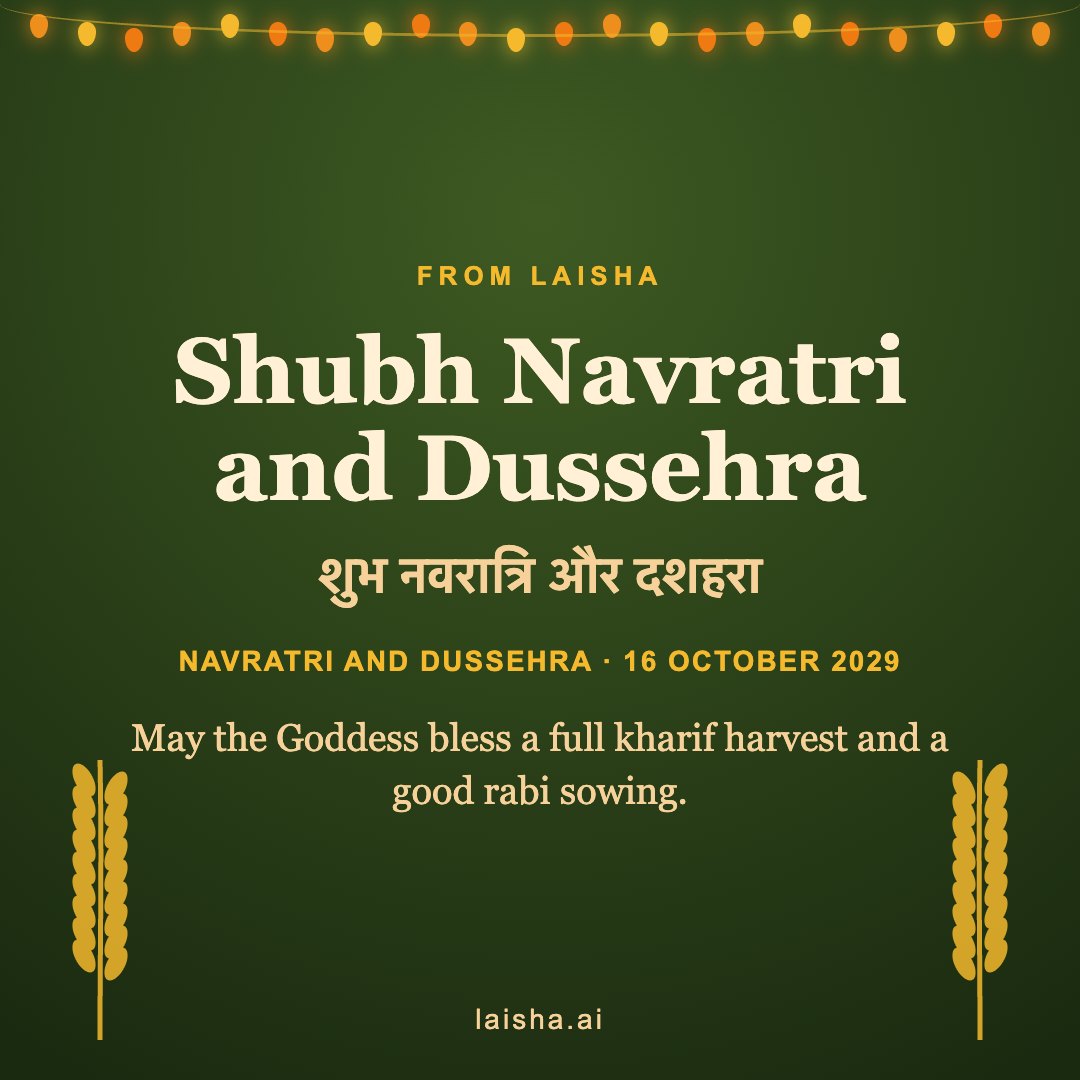
शुभ नवरात्रि और दशहरा
माँ दुर्गा ख़रीफ़ की भरपूर फ़सल और रबी की अच्छी बुआई का आशीर्वाद दें।
नवरात्रि और दशहरा 2029 के दिन
- नवरात्रि आरंभ (घटस्थापना)
- महानवमी
- दशहरा · विजयादशमी
अक्तूबर 2029 में खेत पर
नवरात्रि और दशहरा ख़रीफ़ की कटाई के समय आते हैं: धान, कपास, सोयाबीन और मक्का घर आ रहे होते हैं, और खेत रबी के लिए तैयार किए जा रहे होते हैं।
अक्तूबर में बुआई (दक्षिण एशिया जैसी उष्णकटिबंधीय, मानसूनी जलवायु): गेहूं, चने, सरसों, आलू, टमाटर।
शुभकामना भेजें
More festivals
- Makar Sankranti 2029Sunday 14 January 2029
- Eid al-Fitr 2029Thursday 15 February 2029
- Holi 2029Thursday 1 March 2029
- Eid al-Adha 2029Wednesday 25 April 2029
- Janmashtami 2029Saturday 1 September 2029
- Diwali 2029Monday 5 November 2029
- Christmas 2029 and New Year 2030Tuesday 25 December 2029
Last updated · How Laisha writes and checks its pages · Report a mistake