Navratri and Dussehra 2027 · Saturday 9 October 2027
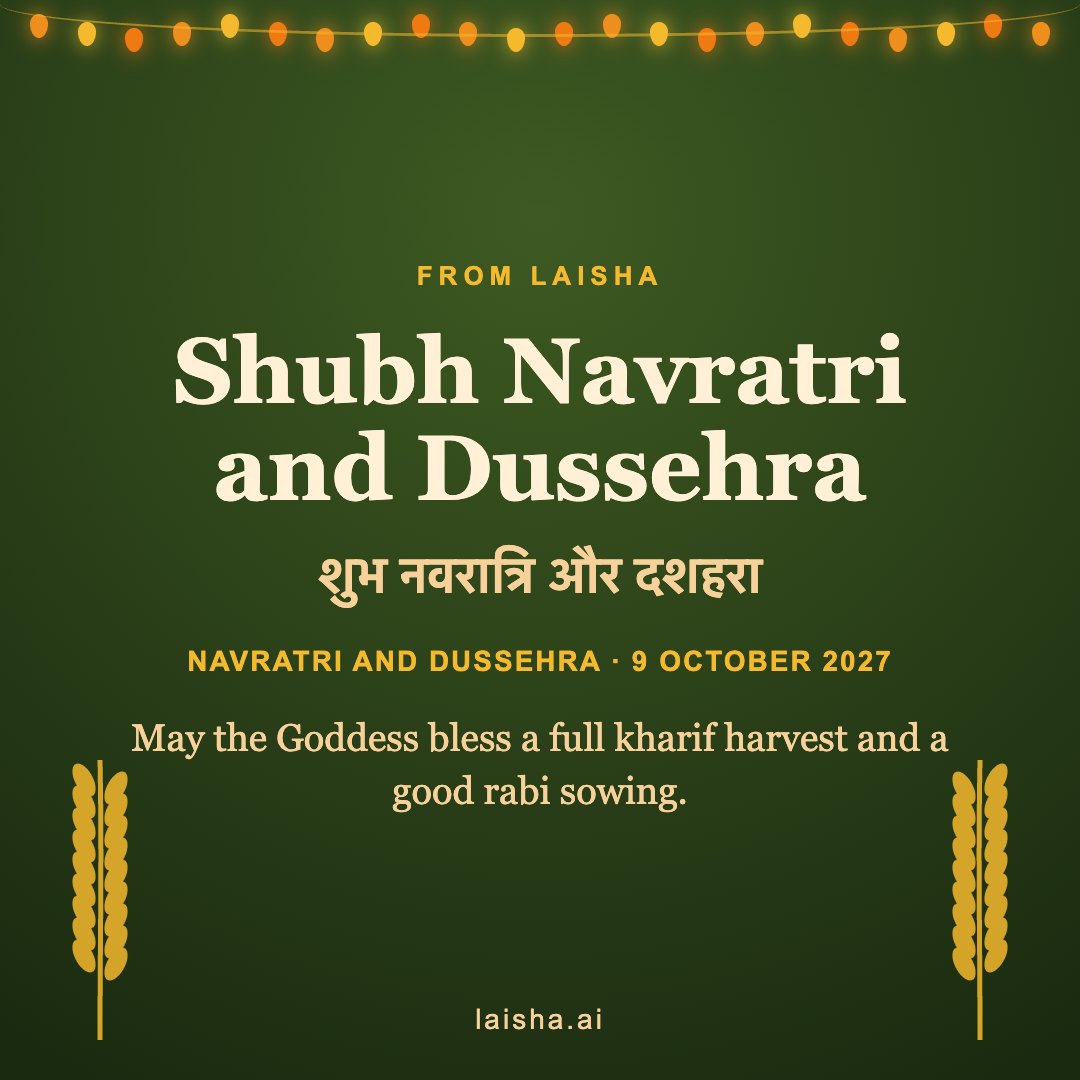
Shubh Navratri and Dussehra from Laisha
May the Goddess bless a full kharif harvest and a good rabi sowing.
The days of Navratri and Dussehra 2027
- Navratri begins (Ghatasthapana)
- Maha Navami
- Dussehra · Vijayadashami
Navratri and Dussehra 2027 at a glance
- Main day: Saturday 9 October 2027.
- Year: 2027 CE, Vikram Samvat 2084.
- On the main day in New Delhi: sunrise 06:18, sunset 17:58 IST; Shukla Navami at sunrise; nakshatra Uttara Ashadha.
- Compared with 2026: then it was Tuesday 20 October 2026; this year it comes 11 days earlier in the year.
- Next year: Wednesday 27 September 2028, 11 days earlier in the year than this year.
The panchang for each day of Navratri and Dussehra 2027
For New Delhi, in IST. A tithi is the lunar day; it rarely starts at sunrise, so the table gives the tithis that run through each date with their start and end, and the nakshatra at sunrise.
| Day | Sunrise / sunset | Tithi | Nakshatra at sunrise |
|---|---|---|---|
| Navratri begins (Ghatasthapana) Thursday 30 September 2027 | 06:13 / 18:08 | Amavasya 10:55 (29 Sep)–08:06; Shukla Pratipada 08:06–05:35 (1 Oct); Shukla Dwitiya 05:35 (1 Oct)–03:33 (2 Oct) | Hasta until 02:11 (1 Oct) |
| Maha Navami Friday 8 October 2027 | 06:17 / 17:59 | Shukla Ashtami 04:13 (7 Oct)–06:28; Shukla Navami 06:28–09:02 (9 Oct) | Purva Ashadha until 07:14 |
| Dussehra · Vijayadashami Saturday 9 October 2027 | 06:18 / 17:58 | Shukla Navami 06:28 (8 Oct)–09:02; Shukla Dashami 09:02–11:41 (10 Oct) | Uttara Ashadha until 10:18 |
Saturday 9 October 2027 hour by hour (New Delhi)
Yoga Sukarma until 13:52; karana Kaulava until 09:02. Moonrise 14:28. Moonset 01:25 (10 Oct).
Daily periods the engine computes: Brahma Muhurat 04:39–05:28; Abhijit Muhurat 11:45–12:31; Rahu Kaal 09:13–10:40; Yamaganda 13:35–15:03; Gulika Kaal 06:18–07:45; Amrit Kaal (Shravana) 01:40 (10 Oct)–03:28 (10 Oct).
| Choghadiya | Day | Night |
|---|---|---|
| 1 | Kaal (bad) 06:18–07:45 | Labh (good) 17:58–19:31 |
| 2 | Shubh (good) 07:45–09:13 | Udveg (bad) 19:31–21:03 |
| 3 | Rog (bad) 09:13–10:40 | Shubh (good) 21:03–22:36 |
| 4 | Udveg (bad) 10:40–12:08 | Amrit (good) 22:36–00:08 (10 Oct) |
| 5 | Char (neutral) 12:08–13:35 | Char (neutral) 00:08 (10 Oct)–01:41 (10 Oct) |
| 6 | Labh (good) 13:35–15:03 | Rog (bad) 01:41 (10 Oct)–03:13 (10 Oct) |
| 7 | Amrit (good) 15:03–16:30 | Kaal (bad) 03:13 (10 Oct)–04:46 (10 Oct) |
| 8 | Kaal (bad) 16:30–17:58 | Labh (good) 04:46 (10 Oct)–06:18 (10 Oct) |
Computed with the Sunyra astronomical engine. Times shift by a few minutes for other Indian cities. No puja muhurta is given here: our engine computes the tithi, the nakshatra, sunrise and sunset, not the window a family or temple chooses for the puja, so follow your local panchang or priest for that.
Where Navratri and Dussehra 2027 falls in the farming season
Counted from the sowing windows in Laisha's farming calendar for the tropical and monsoon north (South Asia), which gives sowing by month:
- Wheat (cool dry-season wheat): sowing opens in October; 9 October 2027 is 8 days into the window.
- Chickpea: sowing opens in October; 9 October 2027 is 8 days into the window.
- Mustard: sowing opens in October; 9 October 2027 is 8 days into the window.
- Potato (cool-season potato on the plains): sowing opens in October; 9 October 2027 is 8 days into the window.
On the farm in October 2027
Navratri and Dussehra come at the kharif harvest: paddy, cotton, soybean and maize are coming in, and the fields are being readied for rabi.
Harvested in October: Rice (wet-season rice), Maize (wet-season maize), Sorghum, Millet (pearl millet), Groundnut, Cotton.
Farming calendar for October 2027 → · Laisha Lens: this month →
Fasting food from the hills: buckwheat (kuttu)
During the Navratri fast many families avoid wheat and rice, and kuttu ka atta, buckwheat flour, becomes the bread of the nine days. Buckwheat is not a cereal at all. Fagopyrum esculentum belongs to the dock and rhubarb family, Polygonaceae, and its triangular seeds are botanically fruits, which is why it is counted as a fasting food. It is called a pseudocereal, like amaranth and quinoa.
In India buckwheat grows mainly in the Himalayas, from Jammu and Kashmir and Himachal Pradesh through Uttarakhand and Sikkim to Arunachal Pradesh, often on terraces too high, cold or poor for other grain crops. It matures in about 70 to 90 days, tolerates acid and infertile soils, and its white flowers attract bees, so hill farmers value it as a short, hardy crop. Tartary buckwheat (Fagopyrum tataricum), more bitter and more cold-hardy, is also grown in the high Himalaya. Russia and China are the largest producers in the world.
Buckwheat seeds ripen unevenly and the plant keeps flowering, so the crop is usually harvested when most seeds have turned brown, accepting some loss from shattering of the earliest seeds.
There is a food safety point for every Navratri. Buckwheat flour contains more oil than wheat flour and turns rancid and can grow moulds if it is old or stored damp. Reports of people falling ill after eating stale or adulterated kuttu flour appear in Indian news in some Navratri seasons. Buy flour fresh and in small packs, check the date, store it airtight in a cool place, and do not use flour that smells off or bitter.
Buckwheat contains no gluten, so kuttu rotis break easily; boiled potato or water chestnut flour is often mixed in to bind the dough.
Sources: ICAR-NBPGR: Buckwheat genetic resources · FAOSTAT: Crop production data
Send a greeting
A card for your family, friends and fellow farmers.
शुभ नवरात्रि और दशहरा
माँ दुर्गा ख़रीफ़ की भरपूर फ़सल और रबी की अच्छी बुआई का आशीर्वाद दें।
नवरात्रि और दशहरा 2027 के दिन
- नवरात्रि आरंभ (घटस्थापना)
- महानवमी
- दशहरा · विजयादशमी
अक्तूबर 2027 में खेत पर
नवरात्रि और दशहरा ख़रीफ़ की कटाई के समय आते हैं: धान, कपास, सोयाबीन और मक्का घर आ रहे होते हैं, और खेत रबी के लिए तैयार किए जा रहे होते हैं।
अक्तूबर में बुआई (दक्षिण एशिया जैसी उष्णकटिबंधीय, मानसूनी जलवायु): गेहूं, चने, सरसों, आलू, टमाटर।
शुभकामना भेजें
More festivals
- Makar Sankranti 2027Friday 15 January 2027
- Eid al-Fitr 2027Wednesday 10 March 2027
- Holi 2027Monday 22 March 2027
- Eid al-Adha 2027Monday 17 May 2027
- Janmashtami 2027Wednesday 25 August 2027
- Diwali 2027Friday 29 October 2027
- Christmas 2027 and New Year 2028Saturday 25 December 2027
Last updated · How Laisha writes and checks its pages · Report a mistake