Janmashtami 2027 · Wednesday 25 August 2027
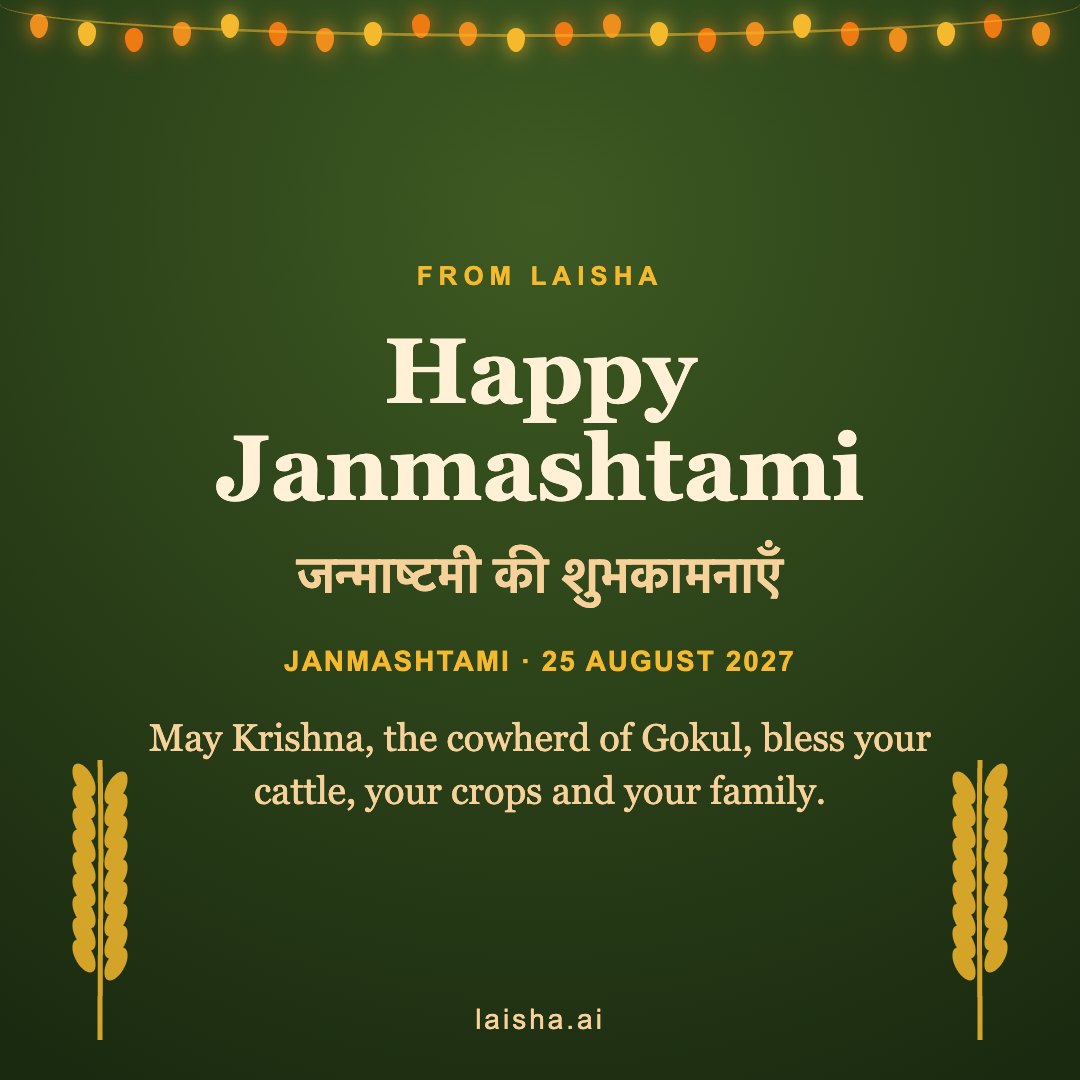
Happy Janmashtami from Laisha
May Krishna, the cowherd of Gokul, bless your cattle, your crops and your family.
The days of Janmashtami 2027
- Krishna Janmashtami
Janmashtami 2027 at a glance
- Main day: Wednesday 25 August 2027.
- Year: 2027 CE, Vikram Samvat 2084.
- On the main day in New Delhi: sunrise 05:55, sunset 18:50 IST; Krishna Ashtami at sunrise; nakshatra Krittika.
- Compared with 2026: then it was Friday 4 September 2026; this year it comes 10 days earlier in the year.
- Next year: Sunday 13 August 2028, 11 days earlier in the year than this year.
The panchang for each day of Janmashtami 2027
For New Delhi, in IST. A tithi is the lunar day; it rarely starts at sunrise, so the table gives the tithis that run through each date with their start and end, and the nakshatra at sunrise.
| Day | Sunrise / sunset | Tithi | Nakshatra at sunrise |
|---|---|---|---|
| Krishna Janmashtami Wednesday 25 August 2027 | 05:55 / 18:50 | Krishna Ashtami 20:25 (24 Aug)–19:20; Krishna Navami 19:20–17:39 (26 Aug) | Krittika until 12:28 |
Wednesday 25 August 2027 hour by hour (New Delhi)
Yoga Vyaghata until 21:49; karana Balava until 07:57. Moonrise 23:36. Moonset 13:15.
Daily periods the engine computes: Brahma Muhurat 04:26–05:11; Abhijit Muhurat 11:57–12:49; Rahu Kaal 12:23–14:00; Yamaganda 07:32–09:09; Gulika Kaal 10:46–12:23; Amrit Kaal (Krittika) 10:05–11:40.
| Choghadiya | Day | Night |
|---|---|---|
| 1 | Labh (good) 05:55–07:32 | Udveg (bad) 18:50–20:14 |
| 2 | Amrit (good) 07:32–09:09 | Shubh (good) 20:14–21:37 |
| 3 | Kaal (bad) 09:09–10:46 | Amrit (good) 21:37–23:00 |
| 4 | Shubh (good) 10:46–12:23 | Char (neutral) 23:00–00:23 (26 Aug) |
| 5 | Rog (bad) 12:23–14:00 | Rog (bad) 00:23 (26 Aug)–01:46 (26 Aug) |
| 6 | Udveg (bad) 14:00–15:37 | Kaal (bad) 01:46 (26 Aug)–03:09 (26 Aug) |
| 7 | Char (neutral) 15:37–17:13 | Labh (good) 03:09 (26 Aug)–04:32 (26 Aug) |
| 8 | Labh (good) 17:13–18:50 | Udveg (bad) 04:32 (26 Aug)–05:55 (26 Aug) |
Computed with the Sunyra astronomical engine. Times shift by a few minutes for other Indian cities. No puja muhurta is given here: our engine computes the tithi, the nakshatra, sunrise and sunset, not the window a family or temple chooses for the puja, so follow your local panchang or priest for that.
Where Janmashtami 2027 falls in the farming season
Counted from the sowing windows in Laisha's farming calendar for the tropical and monsoon north (South Asia), which gives sowing by month:
- Wheat (cool dry-season wheat): sowing opens in October; 25 August 2027 is 37 days before it opens.
- Chickpea: sowing opens in October; 25 August 2027 is 37 days before it opens.
- Mustard: sowing opens in October; 25 August 2027 is 37 days before it opens.
- Potato (cool-season potato on the plains): sowing opens in October; 25 August 2027 is 37 days before it opens.
On the farm in August 2027
Janmashtami comes in the middle of the monsoon, when the kharif crops are growing fast: a time for weeding, drainage and scouting for pests.
Harvested in August: Maize (wet-season maize).
Farming calendar for August 2027 → · Laisha Lens: this month →
Makhan and ghee: from Krishna's butter pot to the dairy
The stories of Makhan Chor, the child Krishna stealing butter from the pots of Gokul, make butter and ghee the foods of Janmashtami. Both are ways farm families turned perishable milk into foods that last, long before refrigerators.
In the traditional village method, milk is boiled and set as curd, and the curd is churned in a pot with a wooden churn (the bilona method). Churning breaks the membranes around the fat globules so the fat clumps together into butter, leaving buttermilk (chaas or lassi) behind. Dairies instead separate cream from milk with a centrifuge and churn the cream, sometimes after ripening it with lactic bacteria. The curd method gives a slightly sour, aromatic butter and ghee, and buttermilk the family can drink.
Ghee is butter heated until almost all the water boils off and the milk solids settle and brown slightly; the clear fat is then poured or filtered off. With almost no water left, bacteria cannot grow, which is why ghee keeps for months without refrigeration. Indian food standards (FSSAI) limit ghee to no more than 0.5 per cent moisture. What eventually spoils ghee is oxidation of the fat, which gives a rancid smell; keeping it in a closed, full container away from light and heat slows this.
Colour tells you something about the animal. Cow ghee is golden yellow because cows pass carotene from green fodder into their milk fat. Buffalo ghee is white because buffalo convert carotene into colourless vitamin A. Neither colour on its own proves purity, and ghee is one of the foods most often adulterated with cheaper fats.
For small dairy farmers, turning surplus milk into ghee in the monsoon flush, when milk prices are low, and selling it later is an old way to even out income.
Sources: FSSAI: Food Safety and Standards (Food Products Standards) Regulations, dairy products · ICAR-NDRI, Karnal
Send a greeting
A card for your family, friends and fellow farmers.
जन्माष्टमी की शुभकामनाएँ
गोकुल के ग्वाले श्रीकृष्ण आपके पशुओं, फ़सलों और परिवार पर कृपा करें।
जन्माष्टमी 2027 के दिन
- श्रीकृष्ण जन्माष्टमी
अगस्त 2027 में खेत पर
जन्माष्टमी मानसून के बीच आती है, जब ख़रीफ़ की फ़सलें तेज़ी से बढ़ रही होती हैं: निराई, जल-निकास और कीटों की निगरानी का समय।
अगस्त में बुआई (दक्षिण एशिया जैसी उष्णकटिबंधीय, मानसूनी जलवायु): Cowpea।
अगस्त में कटाई: मक्का।
शुभकामना भेजें
More festivals
- Makar Sankranti 2027Friday 15 January 2027
- Eid al-Fitr 2027Wednesday 10 March 2027
- Holi 2027Monday 22 March 2027
- Eid al-Adha 2027Monday 17 May 2027
- Navratri and Dussehra 2027Saturday 9 October 2027
- Diwali 2027Friday 29 October 2027
- Christmas 2027 and New Year 2028Saturday 25 December 2027
Last updated · How Laisha writes and checks its pages · Report a mistake