Janmashtami 2026 · Friday 4 September 2026
Happy Janmashtami from Laisha
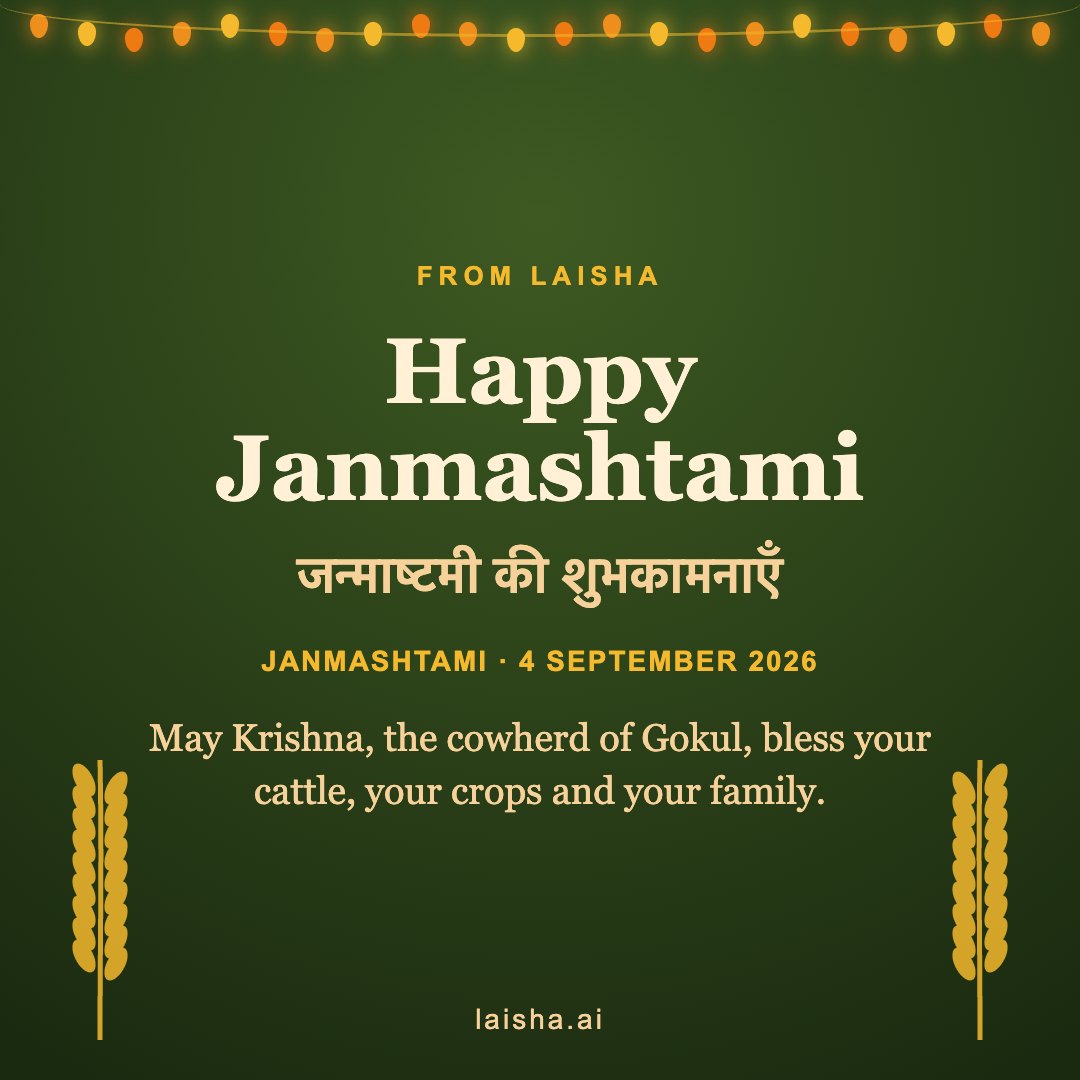
May Krishna, the cowherd of Gokul, bless your cattle, your crops and your family.
The days of Janmashtami 2026
- Krishna Janmashtami
Janmashtami 2026 at a glance
- Main day: Friday 4 September 2026.
- Year: 2026 CE, Vikram Samvat 2083.
- On the main day in New Delhi: sunrise 06:00, sunset 18:39 IST; Krishna Ashtami at sunrise; nakshatra Rohini.
- Next year: Wednesday 25 August 2027, 10 days earlier in the year than this year.
The panchang for each day of Janmashtami 2026
For New Delhi, in IST. A tithi is the lunar day; it rarely starts at sunrise, so the table gives the tithis that run through each date with their start and end, and the nakshatra at sunrise.
| Day | Sunrise / sunset | Tithi | Nakshatra at sunrise |
|---|---|---|---|
| Krishna Janmashtami Friday 4 September 2026 | 06:00 / 18:39 | Krishna Ashtami 02:25–00:14 (5 Sep); Krishna Navami 00:14 (5 Sep)–21:54 (5 Sep) | Rohini until 23:04 |
Friday 4 September 2026 hour by hour (New Delhi)
Yoga Harshana until 15:44; karana Balava until 13:21. Moonrise 23:24. Moonset 13:09.
Daily periods the engine computes: Brahma Muhurat 04:29–05:15; Abhijit Muhurat 11:54–12:45; Rahu Kaal 10:45–12:20; Yamaganda 15:29–17:04; Gulika Kaal 07:35–09:10; Amrit Kaal (Rohini) 20:03–21:34.
| Choghadiya | Day | Night |
|---|---|---|
| 1 | Char (neutral) 06:00–07:35 | Rog (bad) 18:39–20:04 |
| 2 | Labh (good) 07:35–09:10 | Kaal (bad) 20:04–21:29 |
| 3 | Amrit (good) 09:10–10:45 | Labh (good) 21:29–22:55 |
| 4 | Kaal (bad) 10:45–12:20 | Udveg (bad) 22:55–00:20 (5 Sep) |
| 5 | Shubh (good) 12:20–13:54 | Shubh (good) 00:20 (5 Sep)–01:45 (5 Sep) |
| 6 | Rog (bad) 13:54–15:29 | Amrit (good) 01:45 (5 Sep)–03:10 (5 Sep) |
| 7 | Udveg (bad) 15:29–17:04 | Char (neutral) 03:10 (5 Sep)–04:35 (5 Sep) |
| 8 | Char (neutral) 17:04–18:39 | Rog (bad) 04:35 (5 Sep)–06:01 (5 Sep) |
Computed with the Sunyra astronomical engine. Times shift by a few minutes for other Indian cities. No puja muhurta is given here: our engine computes the tithi, the nakshatra, sunrise and sunset, not the window a family or temple chooses for the puja, so follow your local panchang or priest for that.
Where Janmashtami 2026 falls in the farming season
Counted from the sowing windows in Laisha's farming calendar for the tropical and monsoon north (South Asia), which gives sowing by month:
- Wheat (cool dry-season wheat): sowing opens in October; 4 September 2026 is 27 days before it opens.
- Chickpea: sowing opens in October; 4 September 2026 is 27 days before it opens.
- Mustard: sowing opens in October; 4 September 2026 is 27 days before it opens.
- Potato (cool-season potato on the plains): sowing opens in October; 4 September 2026 is 27 days before it opens.
On the farm in September 2026
Janmashtami comes in the middle of the monsoon, when the kharif crops are growing fast: a time for weeding, drainage and scouting for pests.
Harvested in September: Rice (wet-season rice), Maize (wet-season maize), Millet (pearl millet), Groundnut, Soybean, Cowpea.
Farming calendar for September 2026 → · Laisha Lens: this month →
Krishna the cowherd and India's own cattle breeds
Krishna grew up among cowherds in Gokul and Vrindavan, and Janmashtami is a festival of milk, butter and cattle. It is a good day to look at the native cattle breeds of South Asia, the humped zebu cattle (Bos indicus) that farmers have shaped for heat, ticks and poor feed over thousands of years.
India's breed register lists dozens of indigenous cattle breeds, each tied to a region. Gir, from the Gir forest area of Gujarat, has a domed forehead and long, curled ears; Sahiwal, from the Punjab region now split between India and Pakistan, is reddish and among the best zebu milk breeds; Red Sindhi comes from Sindh; Tharparkar from the Thar desert; Kankrej from north Gujarat and Rajasthan is a strong dual-purpose breed; and Hallikar and Amrit Mahal from Karnataka are famous draught breeds.
Zebu cattle tolerate heat better than European breeds such as Holstein-Friesian. They have more sweat glands, loose skin with a large surface area, short shiny coats that reflect sunlight, and lower metabolic heat. They are also more resistant to ticks and the diseases ticks carry. The trade-off is milk: a well-managed Holstein-Friesian or Jersey cross gives much more milk per lactation than most native cows, which is why crossbreeding spread so widely in India from the 1970s.
The zebu's strengths are valued far from India. Gir and Kankrej cattle exported to Brazil in the twentieth century became the base of large herds there; Brazilian breeders developed dairy Gir (Gir Leiteiro) and crossed Gir with Holstein to create the Girolando, now one of the country's main dairy breeds. Sahiwal and Red Sindhi have been used in Kenya, Australia and other hot countries for the same reasons.
India's National Bureau of Animal Genetic Resources keeps the official list of registered breeds, and the Rashtriya Gokul Mission supports conservation and breeding of indigenous cattle. A breed is a living resource: once its last herds are crossed out, the genes that made it suited to its home are hard to bring back.
Sources: ICAR-NBAGR: Registered breeds of livestock · FAO DAD-IS: Domestic Animal Diversity Information System
Send a greeting
A card for your family, friends and fellow farmers.
जन्माष्टमी की शुभकामनाएँ
गोकुल के ग्वाले श्रीकृष्ण आपके पशुओं, फ़सलों और परिवार पर कृपा करें।
जन्माष्टमी 2026 के दिन
- श्रीकृष्ण जन्माष्टमी
सितंबर 2026 में खेत पर
जन्माष्टमी मानसून के बीच आती है, जब ख़रीफ़ की फ़सलें तेज़ी से बढ़ रही होती हैं: निराई, जल-निकास और कीटों की निगरानी का समय।
सितंबर में कटाई: धान, मक्का, बाजरा, मूंगफली, सोयाबीन, Cowpea।
शुभकामना भेजें
More festivals
- Makar Sankranti 2026Wednesday 14 January 2026
- Holi 2026Wednesday 4 March 2026
- Eid al-Fitr 2026Saturday 21 March 2026
- Eid al-Adha 2026Thursday 28 May 2026
- Navratri and Dussehra 2026Tuesday 20 October 2026
- Diwali 2026Sunday 8 November 2026
- Christmas 2026 and New Year 2027Friday 25 December 2026
Last updated · How Laisha writes and checks its pages · Report a mistake