Janmashtami 2031 · Saturday 9 August 2031
Happy Janmashtami from Laisha
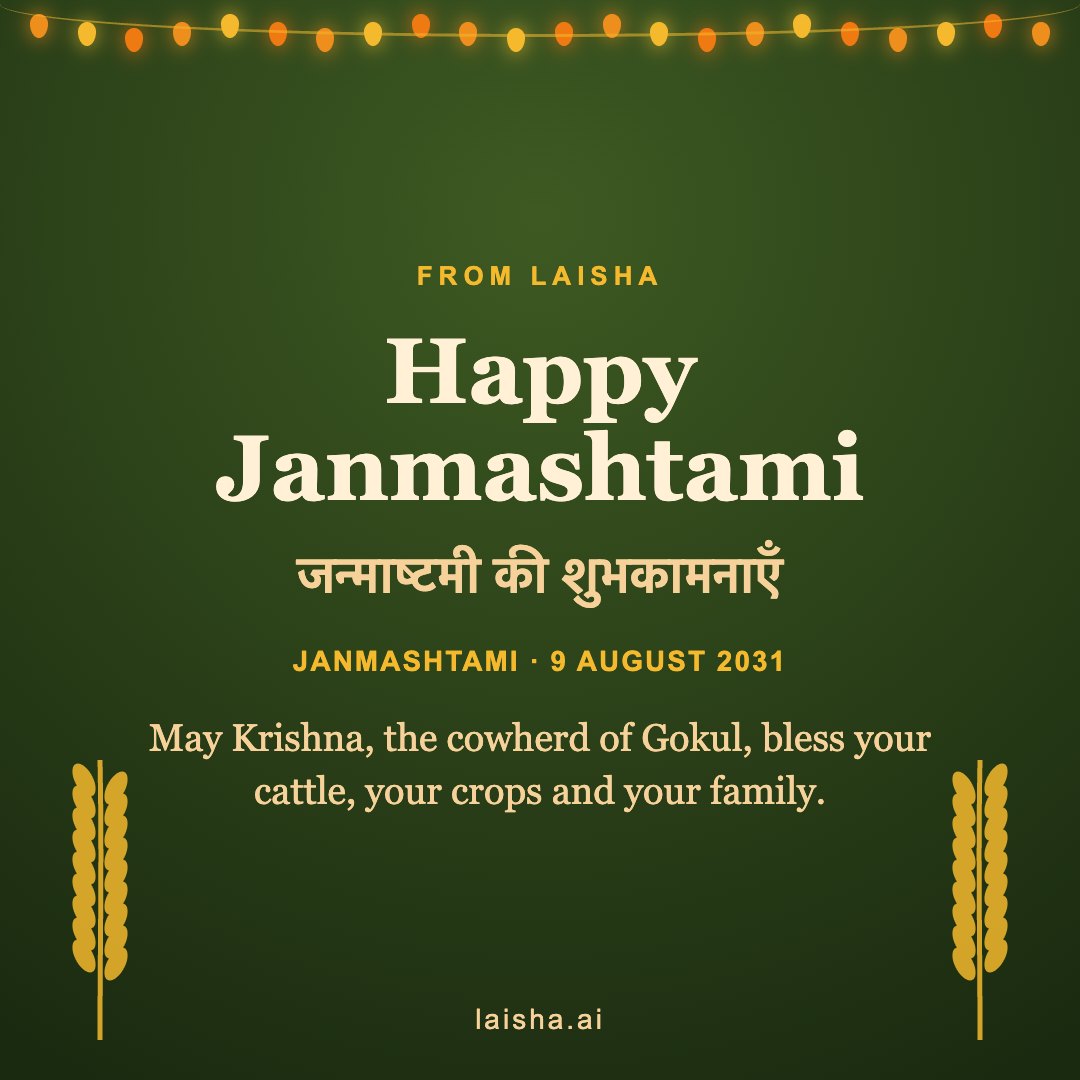
May Krishna, the cowherd of Gokul, bless your cattle, your crops and your family.
The days of Janmashtami 2031
- Krishna Janmashtami
Janmashtami 2031 at a glance
- Main day: Saturday 9 August 2031.
- Year: 2031 CE, Vikram Samvat 2088.
- On the main day in New Delhi: sunrise 05:46, sunset 19:06 IST; Krishna Saptami at sunrise; nakshatra Ashwini.
- Compared with 2030: then it was Wednesday 21 August 2030; this year it comes 12 days earlier in the year.
The panchang for each day of Janmashtami 2031
For New Delhi, in IST. A tithi is the lunar day; it rarely starts at sunrise, so the table gives the tithis that run through each date with their start and end, and the nakshatra at sunrise.
| Day | Sunrise / sunset | Tithi | Nakshatra at sunrise |
|---|---|---|---|
| Krishna Janmashtami Saturday 9 August 2031 | 05:46 / 19:06 | Krishna Saptami 17:08 (8 Aug)–17:26; Krishna Ashtami 17:26–18:32 (10 Aug) | Ashwini until 11:34 |
Saturday 9 August 2031 hour by hour (New Delhi)
Yoga Ganda until 01:24 (10 Aug); karana Bava until 17:26. Moonrise 23:15. Moonset 12:05.
Daily periods the engine computes: Brahma Muhurat 04:21–05:04; Abhijit Muhurat 11:59–12:53; Rahu Kaal 09:06–10:46; Yamaganda 14:06–15:46; Gulika Kaal 05:46–07:26.
| Choghadiya | Day | Night |
|---|---|---|
| 1 | Kaal (bad) 05:46–07:26 | Labh (good) 19:06–20:26 |
| 2 | Shubh (good) 07:26–09:06 | Udveg (bad) 20:26–21:46 |
| 3 | Rog (bad) 09:06–10:46 | Shubh (good) 21:46–23:06 |
| 4 | Udveg (bad) 10:46–12:26 | Amrit (good) 23:06–00:26 (10 Aug) |
| 5 | Char (neutral) 12:26–14:06 | Char (neutral) 00:26 (10 Aug)–01:46 (10 Aug) |
| 6 | Labh (good) 14:06–15:46 | Rog (bad) 01:46 (10 Aug)–03:07 (10 Aug) |
| 7 | Amrit (good) 15:46–17:26 | Kaal (bad) 03:07 (10 Aug)–04:27 (10 Aug) |
| 8 | Kaal (bad) 17:26–19:06 | Labh (good) 04:27 (10 Aug)–05:47 (10 Aug) |
Computed with the Sunyra astronomical engine. Times shift by a few minutes for other Indian cities. No puja muhurta is given here: our engine computes the tithi, the nakshatra, sunrise and sunset, not the window a family or temple chooses for the puja, so follow your local panchang or priest for that.
Where Janmashtami 2031 falls in the farming season
Counted from the sowing windows in Laisha's farming calendar for the tropical and monsoon north (South Asia), which gives sowing by month:
- Cowpea: sowing opens in June; 9 August 2031 is 69 days into the window.
On the farm in August 2031
Janmashtami comes in the middle of the monsoon, when the kharif crops are growing fast: a time for weeding, drainage and scouting for pests.
Harvested in August: Maize (wet-season maize).
Farming calendar for August 2031 → · Laisha Lens: this month →
Dahi handi and the world's largest dairy
On Janmashtami, teams of young people build human pyramids to break a pot of curd hung high above the street, re-enacting Krishna and his friends raiding the butter pots. Behind the game is a serious economy: India is the world's largest milk producer, with about a quarter of global output, and most of that milk comes from small farms with only a few animals each.
The change began with Operation Flood, launched in 1970 by the National Dairy Development Board under Verghese Kurien. It built on the cooperative model of Anand in Gujarat, where farmers own village milk societies that collect milk twice a day, test it for fat and pay by quality, while a district union processes and markets it under brands such as Amul. Milk from millions of small producers could then reach city markets, and India went from importing milk powder to being the largest producer.
This structure is why a family with two buffaloes can sell milk every day. Payment by fat and solids-not-fat content rewards good feeding; a regular, nearby buyer makes dairy one of the few farm incomes paid weekly or fortnightly rather than once a season.
Buffalo matter as much as cows in this story: India has more buffalo than any other country, and buffalo milk, richer in fat, makes a large share of the total. Productivity per animal is still low by world standards, and the gains now come from better feeding, mineral mixtures, artificial insemination, disease control and fodder.
As the pot breaks on Janmashtami, it is worth remembering the women who do much of the daily dairy work: feeding, milking and carrying milk to the society. Cooperatives that pay directly into their accounts have made a measurable difference to their incomes.
Sources: NDDB: Operation Flood · FAO: Gateway to dairy production and products
Send a greeting
A card for your family, friends and fellow farmers.
जन्माष्टमी की शुभकामनाएँ
गोकुल के ग्वाले श्रीकृष्ण आपके पशुओं, फ़सलों और परिवार पर कृपा करें।
जन्माष्टमी 2031 के दिन
- श्रीकृष्ण जन्माष्टमी
अगस्त 2031 में खेत पर
जन्माष्टमी मानसून के बीच आती है, जब ख़रीफ़ की फ़सलें तेज़ी से बढ़ रही होती हैं: निराई, जल-निकास और कीटों की निगरानी का समय।
अगस्त में बुआई (दक्षिण एशिया जैसी उष्णकटिबंधीय, मानसूनी जलवायु): Cowpea।
अगस्त में कटाई: मक्का।
शुभकामना भेजें
More festivals
- Makar Sankranti 2031Wednesday 15 January 2031
- Eid al-Fitr 2031Saturday 25 January 2031
- Holi 2031Sunday 9 March 2031
- Eid al-Adha 2031Thursday 3 April 2031
- Navratri and Dussehra 2031Saturday 25 October 2031
- Diwali 2031Friday 14 November 2031
- Christmas 2031 and New Year 2032Thursday 25 December 2031
Last updated · How Laisha writes and checks its pages · Report a mistake