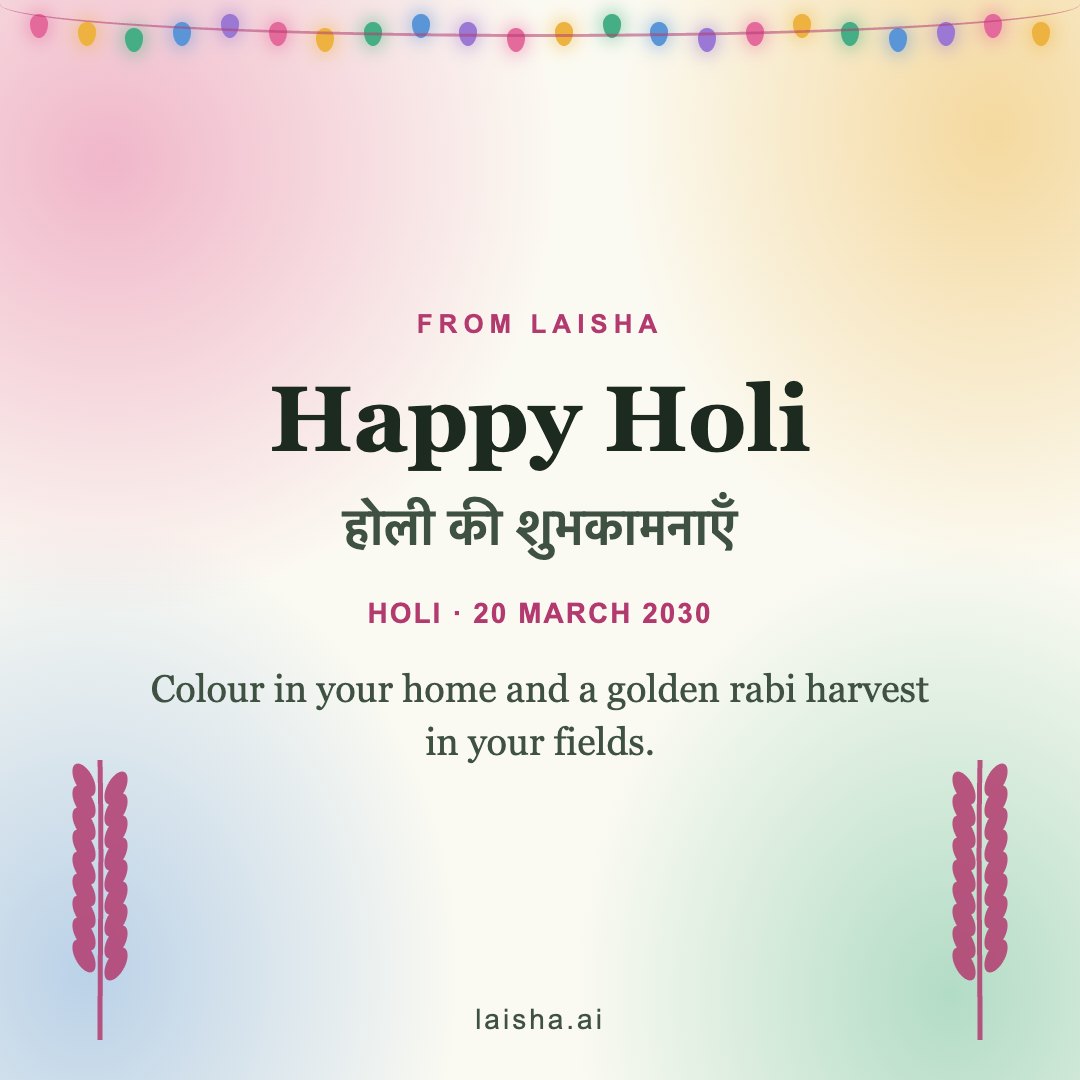
Holi 2030 · Wednesday 20 March 2030
Happy Holi from Laisha
Colour in your home and a golden rabi harvest in your fields.
The days of Holi 2030
- Holika Dahan
- Holi (colours)
Holi 2030 at a glance
- Main day: Wednesday 20 March 2030.
- Year: 2030 CE, Vikram Samvat 2086.
- On the main day in New Delhi: sunrise 06:25, sunset 18:32 IST; Krishna Pratipada at sunrise; nakshatra Uttara Phalguni.
- Compared with 2029: then it was Thursday 1 March 2029; this year it comes 19 days later in the year.
- Next year: Sunday 9 March 2031, 11 days earlier in the year than this year.
The panchang for each day of Holi 2030
For New Delhi, in IST. A tithi is the lunar day; it rarely starts at sunrise, so the table gives the tithis that run through each date with their start and end, and the nakshatra at sunrise.
| Day | Sunrise / sunset | Tithi | Nakshatra at sunrise |
|---|---|---|---|
| Holika Dahan Tuesday 19 March 2030 | 06:26 / 18:31 | Purnima 02:03–23:26; Krishna Pratipada 23:26–20:29 (20 Mar) | Purva Phalguni until 09:50 |
| Holi (colours) Wednesday 20 March 2030 | 06:25 / 18:32 | Krishna Pratipada 23:26 (19 Mar)–20:29; Krishna Dwitiya 20:29–17:23 (21 Mar) | Uttara Phalguni until 07:49 |
Wednesday 20 March 2030 hour by hour (New Delhi)
Yoga Vriddhi until 01:16 (21 Mar); karana Balava until 10:00. Moonrise 19:23.
Daily periods the engine computes: Brahma Muhurat 04:50–05:37; Abhijit Muhurat 12:04–12:53; Rahu Kaal 12:28–13:59; Yamaganda 07:56–09:27; Gulika Kaal 10:58–12:28; Amrit Kaal (Hasta) 00:07 (21 Mar)–01:34 (21 Mar).
| Choghadiya | Day | Night |
|---|---|---|
| 1 | Labh (good) 06:25–07:56 | Udveg (bad) 18:32–20:01 |
| 2 | Amrit (good) 07:56–09:27 | Shubh (good) 20:01–21:30 |
| 3 | Kaal (bad) 09:27–10:58 | Amrit (good) 21:30–22:59 |
| 4 | Shubh (good) 10:58–12:28 | Char (neutral) 22:59–00:28 (21 Mar) |
| 5 | Rog (bad) 12:28–13:59 | Rog (bad) 00:28 (21 Mar)–01:57 (21 Mar) |
| 6 | Udveg (bad) 13:59–15:30 | Kaal (bad) 01:57 (21 Mar)–03:26 (21 Mar) |
| 7 | Char (neutral) 15:30–17:01 | Labh (good) 03:26 (21 Mar)–04:55 (21 Mar) |
| 8 | Labh (good) 17:01–18:32 | Udveg (bad) 04:55 (21 Mar)–06:24 (21 Mar) |
Computed with the Sunyra astronomical engine. Times shift by a few minutes for other Indian cities. No puja muhurta is given here: our engine computes the tithi, the nakshatra, sunrise and sunset, not the window a family or temple chooses for the puja, so follow your local panchang or priest for that.
Where Holi 2030 falls in the farming season
Counted from the sowing windows in Laisha's farming calendar for the tropical and monsoon north (South Asia), which gives sowing by month:
- Cassava: sowing opens in April; 20 March 2030 is 12 days before it opens.
- Rice (wet-season rice): sowing opens in May; 20 March 2030 is 42 days before it opens.
- Maize (wet-season maize): sowing opens in May; 20 March 2030 is 42 days before it opens.
- Cotton: sowing opens in May; 20 March 2030 is 42 days before it opens.
On the farm in March 2030
Holi falls as the rabi crops ripen: mustard is being cut, wheat is turning gold and the harvest is a few weeks away.
Harvested in March: Rice (dry-season irrigated rice), Pigeon pea, Wheat (cool dry-season wheat), Chickpea, Mustard, Potato (cool-season potato on the plains).
Farming calendar for March 2030 → · Laisha Lens: this month →
The spices of thandai: fennel, cumin and the market at Unjha
Thandai, the cooling Holi drink of milk and spices, is made with almonds, fennel seeds, melon seeds, black pepper, cardamom and rose petals, ground together. Several of its spices come from the arid west of India, and in March 2030 those crops are being harvested as Holi arrives.
Fennel (saunf, Foeniculum vulgare) and cumin (jeera, Cuminum cyminum) are winter seed spices grown mainly in Gujarat and Rajasthan, which together produce most of India's crop. They like a cool, dry season and need little water, which makes them good rabi crops for sandy soils with limited irrigation. India is the world's largest producer and exporter of cumin.
Unjha, a small town in north Gujarat, hosts one of the largest seed spice markets in Asia. Farmers bring cumin, fennel and isabgol (psyllium) to its market yard each spring, and its daily prices are watched by traders across the country. For the farmer, the timing of sale matters as much as yield: prices often fall at the peak of arrivals and rise later in the year.
Cumin is a delicate crop. It is badly damaged by Alternaria blight and powdery mildew, especially when cloudy, humid weather comes at flowering; one rainy week can destroy a field. Wilt, caused by a soil-borne Fusarium, is the other main disease, so farmers rotate fields and avoid sowing cumin year after year on the same plot.
Fennel is harvested in stages because the umbels do not ripen together. The best grade, the thin green lucknowi saunf, is picked early, shortly after flowering, and dried in shade to keep its colour; the bolder seed is harvested later. Drying on clean sheets and keeping seed spices dry and covered protects their colour and aroma, which decide the grade and price.
Sources: ICAR-NRC on Seed Spices, Ajmer · Spices Board India
Send a greeting
A card for your family, friends and fellow farmers.
होली की शुभकामनाएँ
घर में रंग और खेतों में सुनहरी रबी फ़सल।
होली 2030 के दिन
- होलिका दहन
- होली (रंग)
मार्च 2030 में खेत पर
होली तब आती है जब रबी की फ़सल पकती है: सरसों कट रही होती है, गेहूँ सुनहरा हो रहा होता है और कटाई कुछ ही हफ़्ते दूर होती है।
मार्च में बुआई (दक्षिण एशिया जैसी उष्णकटिबंधीय, मानसूनी जलवायु): गन्ने।
शुभकामना भेजें
More festivals
- Makar Sankranti 2030Monday 14 January 2030
- Eid al-Fitr 2030Tuesday 5 February 2030
- Eid al-Adha 2030Sunday 14 April 2030
- Janmashtami 2030Wednesday 21 August 2030
- Navratri and Dussehra 2030Sunday 6 October 2030
- Diwali 2030Saturday 26 October 2030
- Christmas 2030 and New Year 2031Wednesday 25 December 2030
Last updated · How Laisha writes and checks its pages · Report a mistake